
Summary of LED Dot Matrix Room Temperature Display using P10 and ATmega8
This article details a cost-effective industrial room temperature display using a P10 dot matrix display (DMD) instead of traditional seven-segment units. The project utilizes an ATmega8 microcontroller to process data from an LM35 temperature sensor via its built-in ADC. Key advantages include a modern appearance, reduced wiring, fewer external components, and lower assembly time. The system is powered by a 5V 6A SMPS rather than a linear regulator to handle the high current demands of the DMD panel.
Parts used in the LED Dot Matrix Room Temperature Display:
- P10 32x16 DMD panel
- ATmega8 microcontroller
- LM35 temperature sensor
- General purpose PCB or dedicated ATmega8 PCB
- 5V 6A SMPS power supply
Room temperature display on big screen is a common requirement from industrial sector. Used in server rooms, PLC rooms, storage rooms and many other places in an industrial units. Traditionally seven segment displays of big size (say four inch height) were used. But now a days DMD (dot matrix display) have become so cheap and easily available that we are tempted to use them in place of old seven segment displays. Following are the obvious advantages that immediately comes to our mind.

- Nicer, fancier and advanced look!
- Less wiring
- Less external components required like ULN IC and transistor.
- Gets ready in lesser time.
- Does not cost too much extra money
(in comparison to 3 units of 12V 4inch seven segment displays wired in multiplexed mode and driven using ULN plus transistors)
Today I will share circuit diagram and program for such an application so that all my readers can make such a display themselves over a weekend. I will use a common P10 32×16 DMD panel to show the temperature. The microcontroller would be my fav ATmega8 which is a 28 PIN DIP packaged MCU available at low cost. Temperature would be sensed by the popular LM35 sensor using the inbuilt ADC of ATmega8.
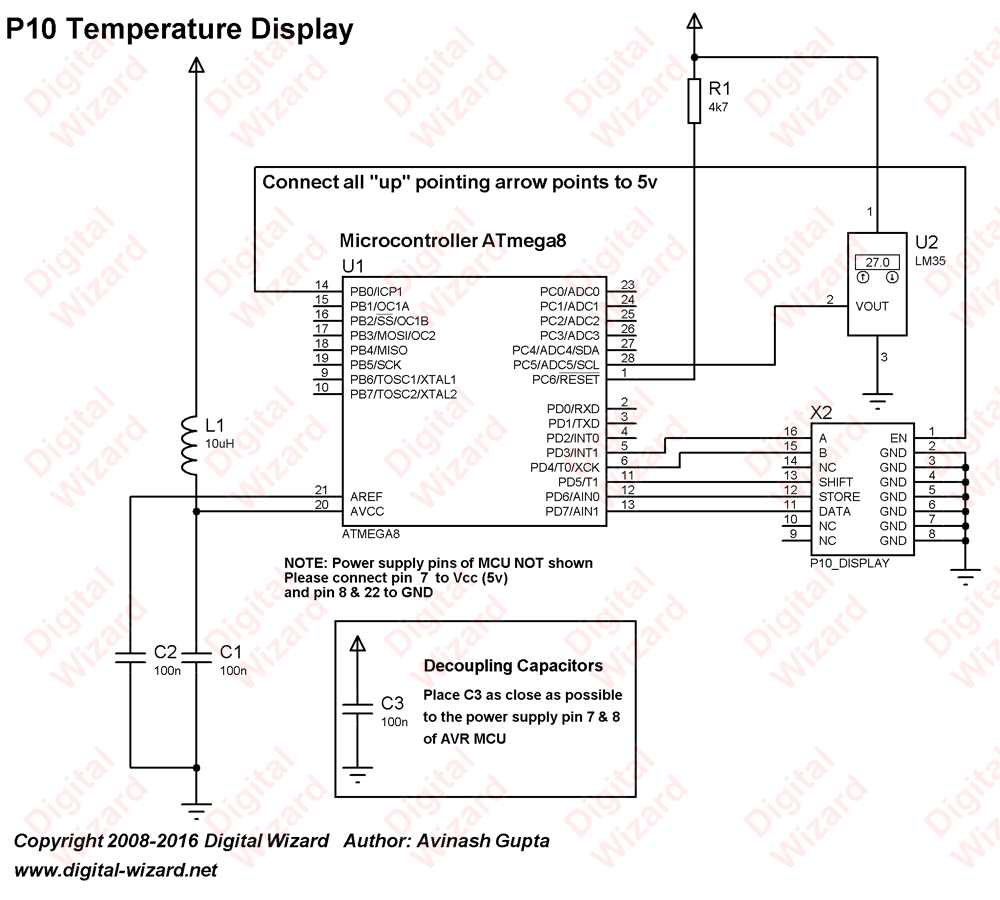
You can design the circuit on any general purpose PCB or a PCB dedicated to ATmega8. The latter option is easier, cleaner, quicker as less wiring is required. Please notice that we have not used any kind of voltage regulator IC like 7805 in the above circuit, this is because we will use a 5V 6A SMPS to power the system. A 7805 IC can only provide 1A current that is NOT enough to drive P10 DMDs.
For more detail: LED Dot Matrix Room Temperature Display using P10 and ATmega8
- Why use a DMD instead of seven segment displays?
DMDs offer a nicer look, less wiring, fewer external components, faster assembly, and lower costs compared to multiplexed seven segment displays. - What microcontroller is used in this project?
The project uses an ATmega8, which is a 28 PIN DIP packaged MCU available at a low cost. - How is the temperature sensed in the circuit?
Temperature is sensed by the popular LM35 sensor using the inbuilt ADC of the ATmega8. - Can I use a 7805 voltage regulator for this project?
No, a 7805 IC can only provide 1A current which is not enough to drive P10 DMDs. - What power supply should be used to drive the system?
A 5V 6A SMPS should be used to power the system to ensure sufficient current for the DMD. - What are the advantages of using a dedicated PCB over a general purpose one?
A dedicated PCB for ATmega8 is easier, cleaner, and quicker because it requires less wiring. - Where is this type of display commonly used?
It is commonly used in server rooms, PLC rooms, storage rooms, and other places in industrial units. - Does this design require extra components like ULN ICs and transistors?
No, this design does not require external components like ULN ICs and transistors that were needed for older seven segment setups.
