
Summary of Lock it without a key
This article explains the implementation of electromagnetic door locks, categorizing them into external types (Y280, Y350) and built-in types (Y100S). External locks use an electromagnet and metal plate for high holding force without modifying the door frame. The built-in Y100S uses a metal stick ejection mechanism with a security sensor that activates only when a magnetized plate is detected, preventing premature locking. All models operate at 12V, with some supporting 24V.
Parts used in Electromagnetic Door Lock Project:
- Electromagnet module
- Metal plate made of magnetically conducting material
- Backstop with spring damping
- Security sensor
- Permanent magnet plate
- Power supply unit
Electromagnetic door locks can be very easily implemented to almost any entry or security system.
We got used, that electromagnetic locks are a common part of entry doors to various buildings and offices. There are several types of such locks on a market, the most often they are a part of a doorframe. Each type has its pros and cons.
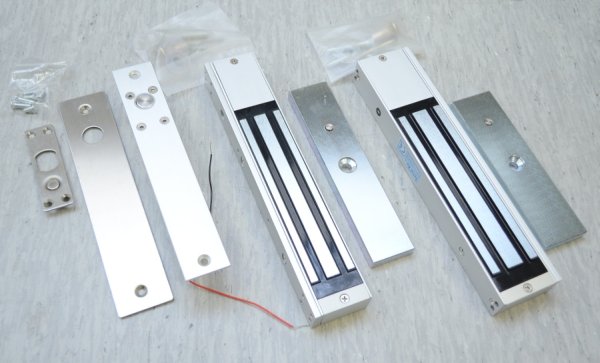
From some point of view, the most universal are “external” types, which can be easily implemented into any door without a necessity of an intervention to a door construction. Even such types can be found in our offer.
Y280 and Y350 are bulky locks consisting of a module with an electromagnet and a metal plate from a magnetically conducting material, which shall be mounted to a door (usually an upper portion). After switching on a power supply, a strong magnetic field will be created, sufficient to keep the door locked. A force necessary to open a door is quite considerable (2800/3500N) and normally it isn´t possible to unlock such doors by a “violence”. A positive fact is that a metal plate also contains a backstop with a spring damping a noise at locking.
A representative of “to be built in” types, is the type Y100S. It operates on a principle of a metal stick ejection, that´s why even in this case is a holding force very high, limited mainly by a door construction. A big advantage of the Y100S is that the lock already contains a security sensor against premature lock activation. After applying a power supply on the lock, “nothing happens” – the lock gets activated only after approximation of a plate with a small permanent magnet (included in a package),i.e. only after the doors are closed. All three types operate at 12V, types Y280 and Y350 can also be supplied with 24V (overall power consumption remains approximately constant).
For more detail: Lock it without a key
- How do external electromagnetic locks like Y280 work?
They consist of an electromagnet module and a metal plate mounted on the door; power creates a magnetic field strong enough to prevent opening by violence. - What is the advantage of the Y100S lock type?
It includes a security sensor that prevents activation until a plate with a small permanent magnet is detected, ensuring the door is closed first. - Can the Y280 and Y350 locks be powered by 24V?
Yes, these types can be supplied with 24V, though their overall power consumption remains approximately constant compared to 12V operation. - What voltage do all three lock types operate on?
All three types (Y280, Y350, and Y100S) operate at 12V. - Does the Y280 or Y350 require intervention to the door construction?
No, external types like Y280 and Y350 can be implemented without necessity of intervention to the door construction. - What feature damps the noise at locking for Y280 and Y350?
The metal plate contains a backstop with a spring that dampens the noise when the lock engages. - How does the Y100S prevent premature lock activation?
It requires the approximation of a plate containing a small permanent magnet before the lock gets activated after power application. - What limits the holding force of the Y100S lock?
The holding force is limited mainly by the door construction rather than the lock mechanism itself.
