
Summary of MDBT42Q, nRF52832-based BLE module
The Seeedstudio MDBT42Q is a compact Bluetooth Low Energy module based on the Nordic nRF52832 SoC. It supports BT 4.0 through 4.2 and offers dual transmission modes for BLE and 2.4GHz RF with an 80-meter range. Featuring a 32-bit ARM Cortex-M4F processor, 512KB flash, and 64KB RAM, it includes diverse interfaces like SPI, UART, I2C, and ADC. Ideal for IoT, beacons, and remote controls, this ultra-low power device ensures flexible application development across various wireless protocols.
Parts used in the MDBT42Q Module:
- Nordic nRF52832 SoC
- 32-bit ARM Cortex-M4F CPU
- 512kB Flash memory
- 64kB RAM
- 2.4GHz transceiver
- 32MHz external crystal oscillator
- On-chip DC/DC buck converter
- GPIO pins (32-pin)
- SPI, UART, I2C, I2S, PWM, and ADC interfaces
- NFC-A tag interface
The open hardware innovation platform Seeedstudio produces the MDBT42Q, a Bluetooth Low Energy (BLE) module. It is a BT 4.0, BT 4.1 and BT 4.2 module designed based on Nordic nRF52832 SoC, a powerful, highly flexible ultra-low power multiprotocol SoC ideally suited for Bluetooth low energy, ANT and 2.4GHz ultra low-power wireless applications.
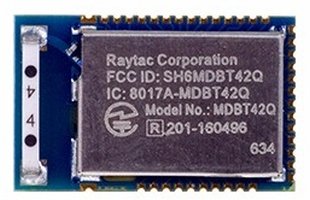
MDBT42Q features a dual transmission mode of BLE and 2.4 GHz RF with over 80 meters working distance in open space. It is a 16 x 10 x 2.2 mm board which contains GPIO, SPI, UART, I2C, I2S, PWM and ADC interfaces for connecting peripherals and sensors.
The nRF52832 SoC is built around a 32-bit ARM® Cortex™-M4F CPU with 512kB and 64kB RAM. The embedded 2.4GHz transceiver supports Bluetooth low energy, ANT and proprietary 2.4 GHz protocol stack. It is on air compatible with the nRF51 Series, nRF24L and nRF24AP Series products from Nordic Semiconductor.
MDBT42Q Specifications:
- Multi-protocol 2.4GHz radio
- 32-bit ARM Cortex – M4F processor
- 512KB flash programmed memory and 64KB RAM
- Software stacks available as downloads
- Application development independent from protocol stack
- On-air compatible with nRF51, nRF24AP and nRF24L series
- Programmable output power from +4dBm to -20dBm
- RAM mapped FIFOs using EasyDMA
- Dynamic on-air payload length up to 256 bytes
- Flexible and configurable 32 pin GPIO
- Simple ON / OFF global power mode
- Full set of digital interface all with Easy DMA including:
- 3 x Hardware SPI master ; 3 x Hardware SPI slave
- 2 x two-wire master ; 2 x two-wire slave
- 1 x UART (CTS / RTS)
- PDM for digital microphone
- I2S for audio
- 12-bit / 200KSPS ADC
- 128-bit AES ECB / CCM / AAR co-processor
- Lowe cost external crystal 32MHz ± 40ppm for Bluetooth ; ± 50ppm for ANT Plus
- Lowe power 32MHz crystal and RC oscillators
- Wide supply voltage range 1.7V to 3.6V
- On-chip DC/DC buck converter
- Individual power management for all peripherals
- Timer counter
- 3 x 24-bit RTC
- NFC-A tag interface for OOB pairing
- RoHS and REACH compliant
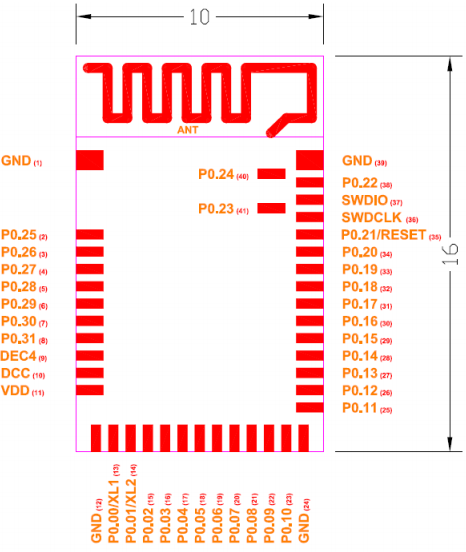
This BLE module can be used in a wide range of applications, such as Internet of Things (IoT), Personal Area Networks, Interactive entertainment devices, Beacons, A4WP wireless chargers and devices, Remote control toys, and computer peripherals and I/O devices.
For more detail: MDBT42Q, nRF52832-based BLE module
- What is the working distance of the MDBT42Q?
The module offers over 80 meters working distance in open space. - Can the MDBT42Q support multiple Bluetooth versions?
Yes, it is designed as a BT 4.0, BT 4.1, and BT 4.2 module. - Does the nRF52832 SoC include a dedicated co-processor for security?
Yes, it features a 128-bit AES ECB / CCM / AAR co-processor. - How much flash memory does the module contain?
The embedded SoC contains 512kB of flash programmed memory. - Is the MDBT42Q compatible with older Nordic products?
It is on-air compatible with the nRF51 Series, nRF24L, and nRF24AP Series. - What is the supply voltage range for this module?
The module supports a wide supply voltage range from 1.7V to 3.6V. - Can the output power be adjusted on the MDBT42Q?
Yes, it allows programmable output power ranging from +4dBm to -20dBm. - What digital interfaces are available on the board?
It includes GPIO, SPI, UART, I2C, I2S, PWM, and ADC interfaces.
