
Summary of Mini Logic Analyzer using ATmega8 microcontroller
This article describes a Mini Logic Analyzer built around the ATmega8 microcontroller, designed to monitor and analyze digital logic transitions (0 or 1). It features a Nokia 3310/5110 LCD for signal display and supports four input channels. The device can capture digital signals up to 400 kHz from various sources, such as TSOP-1730 infrared receivers, MAX-232 chips, and I2C buses.
Parts used in the Mini Logic Analyzer:
- ATmega8 microcontroller
- Nokia 3310/5110 LCD
- 4 channel inputs
- TSOP-1730 Infrared Receiver
- MAX-232 chip
- I2C data bus components
Mini Logic analyzer is ATmega8-based electronics tool that can be used to watch and analyze logic transitions 0 or 1 of a digital data signal. It comes with Nokia 3310/5110 LCD to display signal and it has 4 channel inputs.
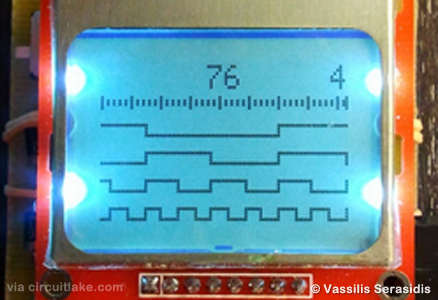
A digital data signal can be found on the output pin of TSOP-1730 Infrared Receiver, on the Transmit and receive pins of MAX-232 chip (RS-232), on Clock and Data pins of I2C data bus and many more electronic components. This circuit supports capturing for up to 400 kHz digital signals.
For more detail: Mini Logic Analyzer using ATmega8 microcontroller
- What is the Mini Logic Analyzer?
It is an electronics tool based on the ATmega8 microcontroller used to watch and analyze logic transitions of digital data signals. - How does it display signals?
The device uses a Nokia 3310/5110 LCD to display the captured signals. - How many input channels does it support?
This circuit has 4 channel inputs for capturing data. - Can it capture signals from an IR receiver?
Yes, it can capture digital data signals found on the output pin of a TSOP-1730 Infrared Receiver. - Does it work with RS-232 communication?
Yes, the circuit supports capturing signals on the Transmit and receive pins of the MAX-232 chip. - Is it compatible with I2C buses?
Yes, it can capture signals on the Clock and Data pins of an I2C data bus. - What is the maximum frequency it can capture?
The circuit supports capturing digital signals up to 400 kHz.
