
Summary of MORE FLEXIBILITY AND HIGHER I/O SPEEDS? MEET THE NEW USB2IO INTERFACE EXPLORER
USB2IO is a USB-powered, FPGA-based multi-I/O interface device designed for engineers to communicate with breakout boards and hardware. Utilizing an STMicro STM32H7 MCU and Intel Cyclone 10 FPGA, it functions as a protocol analyzer, data logger, and signal generator. It supports up to 300 MHz I/O speeds, offers flexible voltage levels from 1.8V to 3.3V, and includes Python/C++ SDKs for automated testing.
Parts used in the USB2IO:
- STMicro STM32H743 Arm Cortex-M7 MCU
- Intel Cyclone 10LP (10CL040) FPGA
- 64MB QSPI flash memory
- 32MB SDRAM
- High-speed USB 2.0 Type-C port
- 50 MHz oscillator
- Si570 Programmable PLL
- 1A max programmable LDO
USB2IO is a high-tech interface device that is fully powered by USB and totally dependent on STMicro STM32H7 MCU and Intel Cyclone 10 FPGA. It is an FPGA-based multi-I/O device that offers ease of working with various electronic devices using common interfaces. It is designed towards helping engineers and embedded developers communicate with various breakout boards and functional hardware blocks.
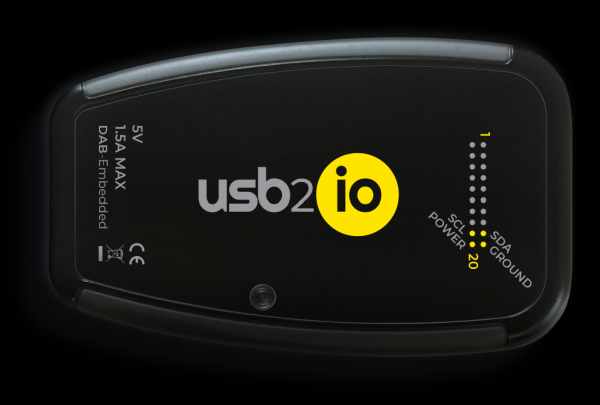
USB2IO comes with an I/O speed of 300 MHz, I/O voltage level support of 1.8V – 3.3V, 32MB RAM, 64MB ROM, a 20-pin I/O port (single I/O or 8-differential high-speed pairs), and a USB 2.0 high-speed port.
USB2IO is a USB to IO interface that combines the functionality of a protocol analyzer, a data logger, a communication interface, an embedded functional test platform, and a basic signal generator.
KEY FEATURES:
- Upgradable FPGA and MCU firmware for control modules
- Failsafe bootloader for safe firmware upgrade
- Python and C++ SDKs for developer’s support (invade you need to implement automated testing for instance)
SPECIFICATIONS:
- STMicro STM32H743 Arm Cortex-M7 clocked @ 480MHz
- Intel Cyclone 10LP (10CL040) FPGA with 40k logic elements, 1,134 Mbit embedded memory and 126 DSP blocks
- External 64MB QSPI flash for extra FPGA code storage
- 32MB SDRAM for MCU and FPGA (64MB in total)
- High-speed USB 2.0 Type-C port
- 50 MHz oscillator
- I/Os via 20-pin header
- 16x GPIO single-ended mode, 8x LVDS pair mode or a mix of 2 modes depending on firmware configuration
- 1.8V – 3.3V, LVDS 2.5V
- 300 MHz I/O speed
- Si570 Programmable PLL with frequency range of 10 MHz to 250 MHz
- Power Supply
- 5V/1.5A using USB-C interface
- 1A max programmable LDO with voltage range 1.8V – 3.3V designed for powering external (customer’s) device
- Operating System: Microsoft Windows OS, MacOS and Linux
- Dimensions: 100 mm x 65 mm x 20 mm
- Weight: 80 g
- Certification: CE
Read more: MORE FLEXIBILITY AND HIGHER I/O SPEEDS? MEET THE NEW USB2IO INTERFACE EXPLORER
- What components make up the core of the USB2IO device?
The device relies on an STMicro STM32H743 MCU and an Intel Cyclone 10LP FPGA. - Can the firmware on the USB2IO be upgraded?
Yes, it features upgradable FPGA and MCU firmware along with a failsafe bootloader. - What programming languages are supported for development?
The device provides Python and C++ SDKs for developer support and automated testing. - What is the maximum I/O speed supported by this interface?
The USB2IO operates with an I/O speed of 300 MHz. - Does the device support multiple voltage levels?
It supports I/O voltage levels ranging from 1.8V to 3.3V. - How much RAM and ROM does the USB2IO contain?
It includes 32MB of RAM and 64MB of ROM. - Is the USB2IO compatible with Linux operating systems?
Yes, it operates on Microsoft Windows OS, MacOS, and Linux. - What type of connector is used for power and data?
A high-speed USB 2.0 Type-C port is used for both power and data.
