
Summary of NEW OLED ARCHITECTURE HAS 10,000 PPI RESOLUTION
Samsung and Stanford researchers developed a new OLED architecture achieving 10,000 PPI resolution. This design utilizes an ultra-thin solar panel electrode with a reflective metal base featuring nanoscale corrugations known as an optical metasurface. The metasurface manipulates light reflection to create resonances within pixels, significantly improving light extraction efficiency compared to current smartphone displays. This innovation offers brighter images and superior color accuracy for virtual reality applications while addressing the fabrication and power limitations of existing red-green-blue and white OLED technologies.
Parts used in the Metasurface OLED Project:
- Ultra-thin solar panels
- Reflective metal base layer
- Nanoscale corrugations (optical metasurface)
- Red-green-blue emitters
- White OLED stacks
- Color filters
- Fine metal mesh
Researchers at Samsung in Korea and Stanford University in the US have developed and patented a new architecture for OLED displays with resolution up to 10,000 pixels per inch (PPI). by Nick Flaherty @ eenewsembedded.com
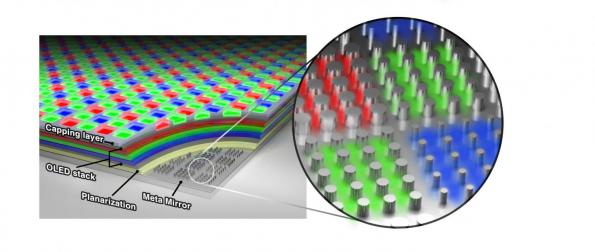
The design uses adapted an electrode ultra-thin solar panels with a base layer of reflective metal with nanoscale corrugations, called an optical metasurface.
The metasurface can manipulate the reflective properties of light and thereby allow the different colours to resonate in the pixels. These resonances are key to improving the light extraction from the OLEDs.
Compared to OLED displays in today smartphones with resolution of 500PPI, the metaphonic pixel array will be able to provide brighter and better colour accuracy for virtual reality displays.
We’ve taken advantage of the fact that, on the nanoscale, light can flow around objects like water,” said Mark Brongersma, professor of materials science and engineering at Stanford who worked with Won-Jae Joo at the Samsung Advanced Institute of Technology (SAIT). “The field of nanoscale photonics keeps bringing new surprises and now we’re starting to impact real technologies. Our designs worked really well for solar cells and now we have a chance to impact next generation displays,” he said.
The metasonic OLED offers an alternative to the two types of OLED displays that are currently commercially available. Red-green-blue OLEDs have individual sub-pixels that each contain only one colour of emitter. These are fabricated by spraying each layer of materials through a fine metal mesh to control the composition of each pixel. They can only be produced on a small scale.
Larger devices such as TVs use white OLED displays where each of the sub-pixels contains a stack of all three emitters and then relies on filters to determine the final sub-pixel colour. This is easier to fabricate but are more power-hungry as the filters reduce the overall output of light.
Read more: NEW OLED ARCHITECTURE HAS 10,000 PPI RESOLUTION
- What is the maximum resolution of the new OLED architecture?
The new architecture achieves a resolution of up to 10,000 pixels per inch. - How does the metasurface improve light extraction?
The metasurface manipulates the reflective properties of light to allow different colors to resonate in the pixels. - Can this technology be used for virtual reality displays?
Yes, the array provides brighter and better color accuracy specifically for virtual reality displays. - What are the main components of the new electrode design?
The design uses adapted ultra-thin solar panels with a base layer of reflective metal containing nanoscale corrugations. - Why are white OLED displays considered more power-hungry?
Filters reduce the overall output of light in white OLED displays, making them less efficient. - How are red-green-blue OLED sub-pixels currently fabricated?
They are fabricated by spraying each layer of materials through a fine metal mesh to control pixel composition. - Does the new design work on a small scale or large scale?
Current red-green-blue methods can only be produced on a small scale, whereas the new architecture aims to impact next-generation displays broadly. - Who are the key researchers involved in this project?
The project involves researchers from Samsung Advanced Institute of Technology and Mark Brongersma from Stanford University.
