
Summary of OLED on the Cheap!
This article reviews a budget-friendly project using a $4 Chinese mono OLED display (Yellow-Blue) with an Arduino-compatible STM32F103 Maple Mini clone. The author compares the cheap clone to Adafruit's more expensive, supported version, noting similar functionality but different shipping times and support levels. The project requires specific software cores for Arduino 1.6.1 to operate the SPI-capable display on either 8-bit or 32-bit platforms.
Parts used in the OLED on the Cheap:
- OLED 128x64 SPI-capable
- Adafruit libs
- Maple Mini Clone
- STM32 ARM core files
- Arduino 1.6.1
Things used in this project
| Hardware components: | ||||||
|
× | 1 | ||||
|
× | 1 |
Story 
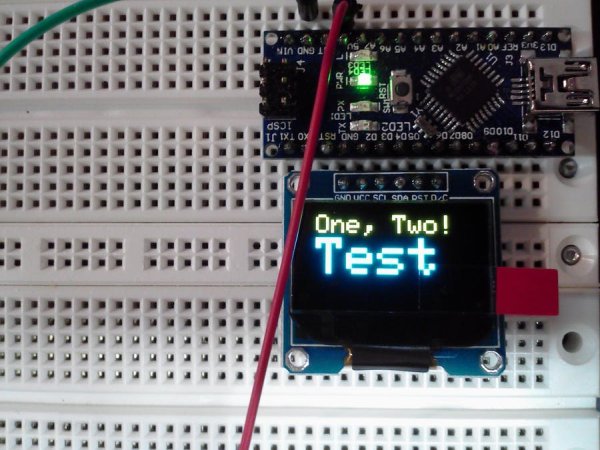
I like cheap electronics for playing.
Cheap is good for budget conscious hobbyists and China is delivering lots of toys for playing – one being the inexpensive “mono” OLED displays. The single-color displays often come in a dual-color implementation where the top row of pixels are one color and the remaining majority of the lower pixels are another color. These dual-color units allow the title information to be easily distinguished from the lower part of the screen which is usually utilized for changing data.
In a recent eBay (no endorsement intended) special, one Chinese vendor was offering $4 OLED screens in a Yellow-Blue implementation with free-shipping. That was back in mid-February and I received the modules this week: about 6 weeks. Mostly my experience is that the ePackets are arriving in 3 to 4 weeks and the economy shipping (often free) is coming in 6 to 8 weeks: your experience is likely to be different as pinning down the shipping times is difficult.
But,
this article is about the color module which is very similar to the one that Adafruit sells and has written libraries to support: Adafruit 0.96″ OLED. Of course, there is $16 dollars difference between the two (and about 31 – 45 days in getting your hands on it!) I encourage anyone wanting “a play” to support Adafruit as you gain access to their web-support which is really not bad and the little extra you spend supports the software development.
However,
if you are just experimenting and could care less about whether the Chinese part will work or not (or even if you actually receive it), then the $4 clone may be the way to go.
Low cost + low expectations = low risk.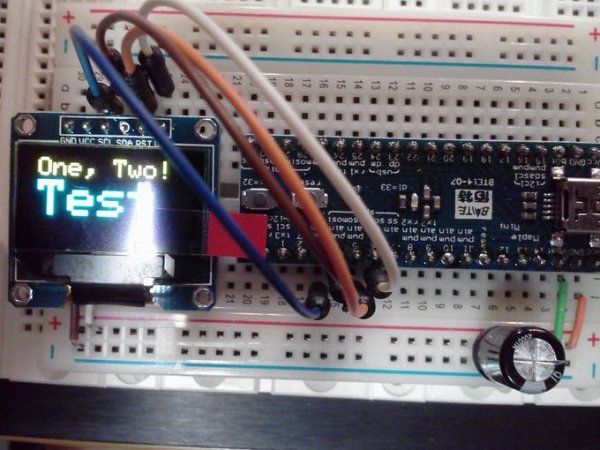
Generally speaking,
I would not post an entire article just to highlight a product sold and supported by Adafruit (or any vendor), but in this case, I am attaching a ZIP to support the OLED running on a Maple Mini Clone (also $4 – $5) which is supported by these new core files for Arduino 1.6.1. To duplicate this project, you need Arduino 1.6.1 (unmodified), a SPI OLED 128×64 pixel display (warning: some are I2C only), the STM32 ARM core files from the above link, and your choice of 8-bit Arduino or 32-bit ARM STM32F103 (Maple, Maple Mini.)
For more detail: OLED on the Cheap!
- What is the price difference between the Chinese OLED and the Adafruit version?
The Chinese module costs about $4 while the Adafruit version is around $16. - How long does shipping typically take for economy orders from China?
Economy shipping often takes 6 to 8 weeks to arrive. - Can this project run on standard Arduino platforms?
Yes, you can use unmodified Adafruit libraries for standard Arduino platforms. - What specific software version is required for this project?
You need Arduino 1.6.1 without modifications. - Does the OLED display use I2C or SPI communication?
The project uses a SPI OLED 128x64 pixel display, though some models are I2C only. - Which microcontroller boards are compatible with this setup?
The setup supports both 8-bit Arduino boards and 32-bit ARM STM32F103 Maple or Maple Mini boards. - Why might someone choose the cheaper Chinese OLED over the Adafruit one?
The low cost combined with low expectations creates a low-risk option for experimentation.
