
Summary of Polyimide (Kapton) PCB Solder Paste Stencil
Creating a solder paste stencil for use with a toaster reflow oven or hot plate using a laser cutter. The guide assumes you have PCB Gerber files (instructions given for EAGLE with a CAM job included) and shows generating Gerbers for both top and bottom sides (create two stencils if double-sided). The example uses an Arduino RTC Shield (DS3231) and recommends including the PCB dimension and cream (solder paste) layers when exporting Gerbers. Polyimide (Kapton) is discussed for stencils.
Parts used in the Arduino RTC Shield Stencil Project:
- PCB Gerber files (including dimension and cream/solder paste layers)
- EAGLE CAM job file (optional, for EAGLE users)
- Laser cutter (e.g., at a local TechShop)
- Stencil material (Polyimide/Kapton)
- Arduino RTC Shield design files (DS3231 based)
- Optional: access to other PCB design software capable of exporting Gerbers
Creating a solder paste stencil for a toaster reflow oven or hot plate is simple when you have access to a laser cutter. I used the Laser Cutter at my local TechShop to create this and other PCB stencils.
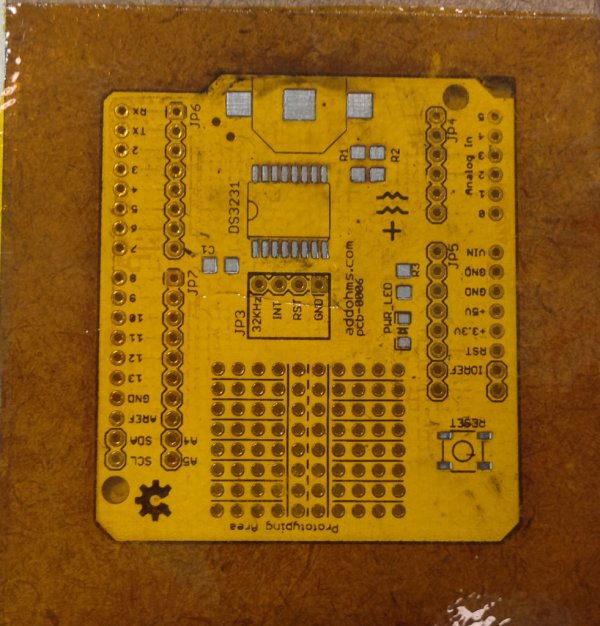
This Instructable assumes you have created a PCB and are able to generate the Gerber Files for it. Specific directions will be given for EAGLE, but other PCB software can be used. The board used in this example is an Arduino RTC Shield based on the DS3231. Follow the link for the EAGLE design files if you want to follow along.
If you’re doing a stencil for both sides, you’re going to have to create two stencils. These instructions show how to generate a GERBER file for both the top and bottom. If you only need one side, you can stop at #5.
If you are using EAGLE, I have created a CAM job file and included manual instructions. If you are using another PCB software, generate a GERBER file with the dimension layer and cream layer.
For more detail: Polyimide (Kapton) PCB Solder Paste Stencil
- Can I make a solder paste stencil with a laser cutter?
Yes, the article describes using a laser cutter to create PCB stencils. - Do I need Gerber files to create the stencil?
Yes, the guide assumes you have generated Gerber files for your PCB. - Does the guide provide instructions for EAGLE?
Yes, specific directions and an EAGLE CAM job file are provided. - What layers must be included when exporting Gerbers for a stencil?
Include the PCB dimension layer and the cream (solder paste) layer. - Do I need two stencils for double-sided boards?
Yes, you must create two stencils if populating both top and bottom sides. - What example board is used in the article?
An Arduino RTC Shield based on the DS3231 is used as the example. - Is Kapton recommended for stencil material?
Yes, Polyimide (Kapton) is discussed for stencils. - Can other PCB software be used besides EAGLE?
Yes, other PCB software can be used as long as it can generate the required Gerber layers.
