
Summary of Remote Temperature Monitoring using GSM – AVR Project
This article describes a GSM-based remote temperature monitoring system using an xBoard MINI v2.1, allowing users to check temperatures via SMS from anywhere with mobile coverage without needing special receiver hardware.
Parts used in the Remote Temperature Monitoring System:
- xBoard MINI v2.1
- ATmega8 microcontroller
- 16×2 character LCD Module
- Temperature Sensor LM35
- USART connector
- GSM network module (implied)
Temperature monitoring have wide application in daily life. In modern day keeping an eye on temperature of places such as server rooms, hospital rooms, warehouses and green houses can help solve many problems. But with the use of normal temperature sensors, someone needs to go to the place in order to view the temperature. But with the development of GSM network, one can easily connect the sensor with GSM network, so that you don’t need to be present near the sensor in order to view the temperature. You can just pick up your cell phone and send a request to your sensor by a text message and in no time you will receive the temperature of the remote place !
The advantage is the you don’t need any kind of “special” device at the receiver end. You can use any cell phone to view the remote temperature. This reduces cost as you already have a cell phone.
Other benefit is that the range is not limited. You can be at any place in the world (with mobile coverage of course!), to request temperature data from your room.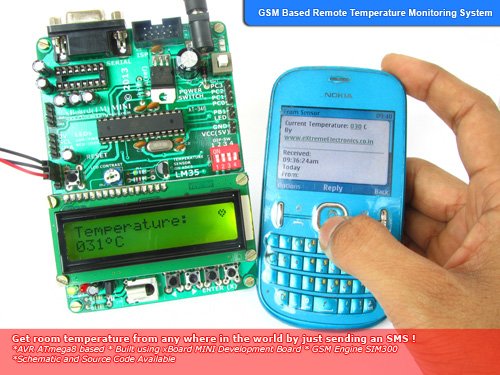
Construction of the Project
We have selected xBoard MINI v2.1 as the base to develop our project. This is because it has all the peripherals required for this project. It has an ATmega8 connected with a 16×2 character LCD Module, Temperature Sensor LM35 and a connector for USART. It has some other peripherals too, but they are NOT utilized in this project, they are:-
- LED
- IR Remote
- Keypad
- Real time clock and calendar.
But if you wish to extend the project they might be of great use.
Step I
Remove the MAX232 IC from the xBoard MINI.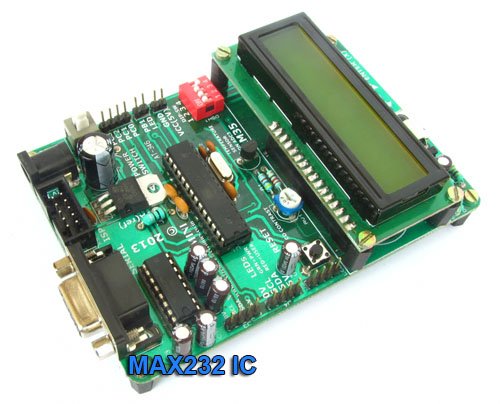
For more detail: Remote Temperature Monitoring using GSM – AVR Project
- How does this system help monitor server rooms or greenhouses?
You can send a text message request to the sensor and receive the temperature data instantly without being present near the sensor. - What is the main advantage of using a cell phone as the receiver?
You do not need any special device at the receiver end since you can use any existing cell phone to view the data, which reduces cost. - Does the range of this project have limitations?
The range is not limited; you can be anywhere in the world with mobile coverage to request temperature data. - Which board was selected as the base for this project?
The xBoard MINI v2.1 was selected because it contains all necessary peripherals like the ATmega8 and LM35 sensor. - What components on the xBoard MINI are NOT utilized in this project?
The LED, IR Remote, Keypad, and Real time clock and calendar are not utilized but could be useful for extensions. - What modification is required during the construction of the project?
You must remove the MAX232 IC from the xBoard MINI before proceeding. - Can this system work without internet connectivity?
The article states it works by connecting the sensor with the GSM network, implying reliance on mobile coverage rather than internet.
