
Summary of Reverse engineering the silicon in the ARM1 processor
This article reverse-engineers the ARM1 processor's hardware circuit for counting set bits in a 16-bit field. It details how individual transistors build multiplexers, which combine into adders to form the final bit counter. Designed originally by Acorn Computer in 1985, this circuit supports block data transfer instructions by determining how many registers are selected for memory operations.
Parts used in the ARM1 Bit Counter:
- Individual transistors
- Multiplexers
- Adders
- Bit counter circuit
- Priority encoder circuit
- ARM1 processor silicon
How can you count bits in hardware? In this article, I reverse-engineer the circuit used by the ARM1 processor to count the number of set bits in a 16-bit field, showing how individual transistors form multiplexers, which are combined into adders, and finally form the bit counter. The ARM1 is the ancestor of the processor in most cell phones, so you may have a descendent of this circuit in your pocket.
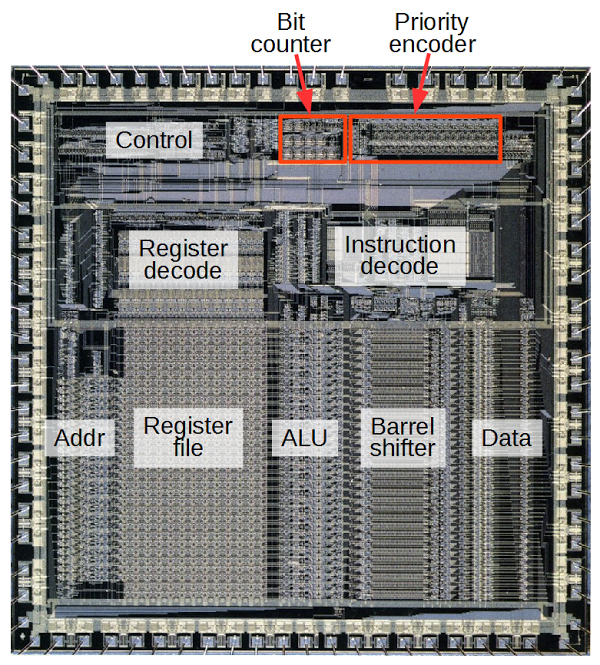
ARM is now the world’s most popular instruction set but it has humble beginnings. The original ARM1 processor was designed in 1985 by a UK company called Acorn Computer for the BBC Micro home/educational computer. A few years later Apple needed a low-power, high-performance processor for its ill-fated Newton handheld system and chose ARM.[1] In 1990, Acorn Computers, Apple, and chip manufacturer VLSI Technology formed the company Advanced RISC Machines to continue ARM development. ARM became very popular for low power applications (such as phones) and now more than 50 billion ARM processors have been manufactured.
One way ARM processors increase performance is through block data transfer instructions, which efficiently copy data between on-chip registers and memory storage.[2] These instructions can transfer any subset of ARM’s 16 registers in a single instruction. The desired registers are specified by setting the corresponding bits in a 16-bit field in the instruction. To implement the block transfer instructions, the ARM requires two specialized circuits. The first circuit, the bit counter, counts the number of bits set in the register select field to determine how many registers are being transferred.[3] The second circuit, the priority encoder, scans the register select field and finds the next set bit, indicating which register to load/store next.
For more detail: Reverse engineering the silicon in the ARM1 processor
- How does the ARM1 processor count bits?
The processor uses a circuit where individual transistors form multiplexers, which combine into adders to create the bit counter. - What is the purpose of the bit counter circuit?
It counts the number of bits set in a 16-bit register select field to determine how many registers are being transferred. - Which company designed the original ARM1 processor?
A UK company called Acorn Computer designed the ARM1 processor in 1985. - Does the ARM1 support block data transfer instructions?
Yes, these instructions efficiently copy data between on-chip registers and memory storage. - What other specialized circuit does the ARM require for block transfers?
The ARM requires a priority encoder that scans the register select field to find the next set bit. - Can you find an ARM1 descendant in your pocket?
Yes, the ARM1 is the ancestor of the processor found in most cell phones today. - How many ARM processors have been manufactured?
More than 50 billion ARM processors have been manufactured. - Why did Apple choose the ARM processor?
Apple needed a low-power, high-performance processor for its Newton handheld system.
