
Summary of Rubidium Disciplined Atomic Clock
This article details "Project GREAT," a hardware experiment designed to monitor cumulative time dilation effects by comparing local time against various atomic and crystal standards. The project utilizes a Rubidium atomic frequency standard as the primary reference, measuring deviations relative to an OCXO, GPS with battery backup, WWVB radio signals, and multiple temperature-compensated RTC modules. By continuously tracking these discrepancies, the project aims to visualize how location, elevation, and velocity impact the passage of time.
Parts used in Project GREAT:
- Rubidium atomic frequency standard
- Electrical Frequency Controlled (EFC) Ovenized Crystal Oscillator (OCXO)
- muRata OC2545-DT 10.00 MHz OCXO Crystal Oscillator
- GPS with battery backup for internal RTC
- WWVB US atomic clock radio frequency signal receiver
- (3) Temperature Compensated RTC modules with independent battery backup
- 12 bit i2c DAC board
- Adafruit Si5351 Clock Generator Breakout
- RS232 to TTL converter board
Description
As recently stated on hackaday:
“A timepiece is rather a rite of passage in the world of hardware hacking”Presenting: A personal time base.
Depending on current location, elevation, and velocity we all experience very real time dilation effects. Time does not pass at the same rate for everyone. The “Project GREAT” experiment in 2005 measured a 20 to 30 ns shift during a weekend family trip to Mt Rainier.
The idea is to continuously monitor and record cumulative time deviation.
“A timepiece is rather a rite of passage in the world of hardware hacking”Presenting: A personal time base.
Depending on current location, elevation, and velocity we all experience very real time dilation effects. Time does not pass at the same rate for everyone. The “Project GREAT” experiment in 2005 measured a 20 to 30 ns shift during a weekend family trip to Mt Rainier.
The idea is to continuously monitor and record cumulative time deviation.
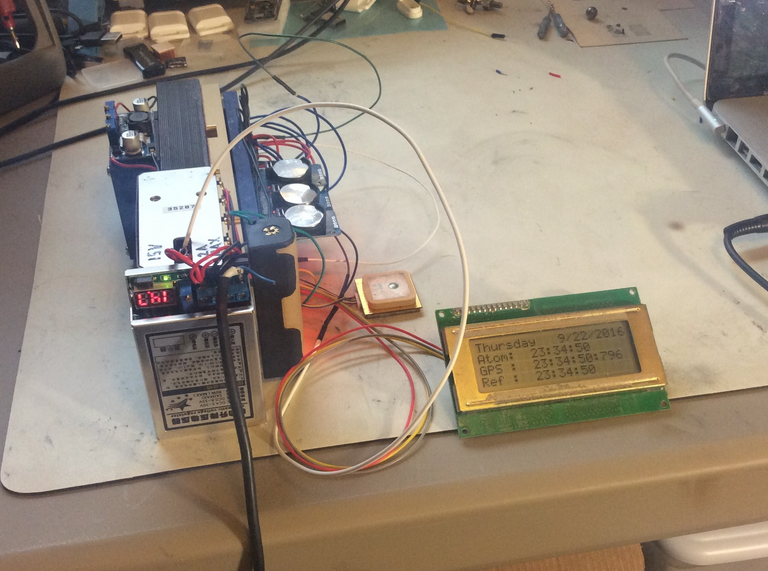
This project uses a Rubidium atomic frequency standard to continuously track local time dilation effects relative to:
Electrical Frequency Controlled (EFC) Ovenized Crystal Oscillator (OCXO)
GPS with battery backup for internal RTC
WWVB US atomic clock radio frequency signal
(3) x Temperature Compensated RTC modules with independent battery backup
Electrical Frequency Controlled (EFC) Ovenized Crystal Oscillator (OCXO)
GPS with battery backup for internal RTC
WWVB US atomic clock radio frequency signal
(3) x Temperature Compensated RTC modules with independent battery backup
Details
Thanks to comments from Doc Pedersen and nsayer, I ordered an Electrical Frequency Controlled (EFC) Ovenized Crystal Oscillator (OCXO) with TTL output to improve the short term stability.
It is a muRata OC2545-DT 10.00 MHz OCXO Crystal Oscillator.
OC2545-DT Datasheet
Thanks to the commenters I now have some new parts on hand:
muRata OC2545-DT 10.00 MHz OCXO Crystal Oscillator
12 bit i2c DAC board (To generate the control voltage – Delta Sigma w/Filter)
Adafruit Si5351 Clock Generator Breakout (To generate microcontroller clock)
RS232 to TTL converter board
For more detail: Rubidium Disciplined Atomic Clock
It is a muRata OC2545-DT 10.00 MHz OCXO Crystal Oscillator.
OC2545-DT Datasheet
Thanks to the commenters I now have some new parts on hand:
muRata OC2545-DT 10.00 MHz OCXO Crystal Oscillator
12 bit i2c DAC board (To generate the control voltage – Delta Sigma w/Filter)
Adafruit Si5351 Clock Generator Breakout (To generate microcontroller clock)
RS232 to TTL converter board
For more detail: Rubidium Disciplined Atomic Clock
- What is the main goal of Project GREAT?
The idea is to continuously monitor and record cumulative time deviation caused by real time dilation effects. - How does the project measure time differences?
It uses a Rubidium atomic frequency standard to track local time dilation effects relative to other standards. - Which specific OCXO model was ordered?
The project uses a muRata OC2545-DT 10.00 MHz OCXO Crystal Oscillator. - Can the system operate without external power?
Yes, the GPS unit has a battery backup for its internal RTC and the three RTC modules have independent battery backups. - What component generates the control voltage?
A 12 bit i2c DAC board using Delta Sigma with Filter is used to generate the control voltage. - Does the project use a microcontroller clock source?
Yes, an Adafruit Si5351 Clock Generator Breakout is used to generate the microcontroller clock. - What signal serves as a reference for the project?
The project references the WWVB US atomic clock radio frequency signal. - Why was the OCXO added to the setup?
It was ordered to improve the short term stability of the system.
