
Summary of Simple battery-status indicator uses two LEDs
This article describes a simple battery-status indicator circuit using two LEDs to monitor rechargeable battery voltage. A reference LED operates at a constant 1 mA current via a series resistor, ensuring stable light output regardless of battery charge level. A second variable LED changes brightness with voltage fluctuations. Comparing the two intensities allows users to assess battery status easily. The design emphasizes using diffused LEDs and proper optical isolation to prevent eye damage and cross-interference.
Parts used in the Battery-Status Indicator:
- Reference LED (LEDREF)
- Variable LED
- Resistor R1
- Diode
Properly maintained rechargeable batteries can provide good service and long life. Maintenance involves regular monitoring of battery voltage. The circuit in Figure 1 works in most rechargeable batteries. It comprises a reference LED, LEDREF, which operates at a constant current of 1 mA and provides reference light of constant intensity regardless of battery voltage.
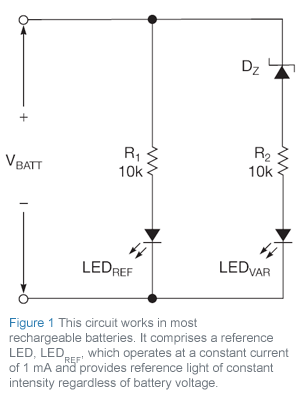
It accomplishes this task by connecting resistor R1 in series with the diode. Therefore, even if the battery voltage changes from a charged state to a discharged state, the change in current is only 10%. Thus, the intensity of LEDREF remains constant for a battery state from a fully charged state to a fully discharged state.
The light output of the variable LED changes with respect to changes in battery voltage. The side-by-side-mounted LEDs let you easily compare light intensities and, thus, battery status. Using diffused LEDs as crystal-clear LEDs can damage your eyes. Instead, mount the LEDs with sufficient optical isolation so that the light from one LED does not affect the intensity of the other LEDs.
For more detail: Simple battery-status indicator uses two LEDs
- How does the circuit maintain constant light intensity for the reference LED?
It connects resistor R1 in series with the diode to operate the LED at a constant current of 1 mA. - Can the reference LED intensity change significantly during discharge?
No, the current change is only 10% even if the battery voltage drops from fully charged to fully discharged. - What is the purpose of mounting the LEDs side by side?
Side-by-side mounting allows for easy comparison of light intensities to determine battery status. - Why should crystal-clear LEDs be avoided in this project?
Using diffused LEDs is recommended because crystal-clear LEDs can damage your eyes. - How should the LEDs be mounted to ensure accurate readings?
Mount them with sufficient optical isolation so that light from one LED does not affect the other. - Does the variable LED brightness stay constant regardless of voltage?
No, the light output of the variable LED changes with respect to changes in battery voltage. - What component limits the current through the reference LED?
Resistor R1 is connected in series with the diode to limit the current. - Is this circuit suitable for most rechargeable batteries?
Yes, the described circuit works in most rechargeable batteries.
