
Summary of Sipeed MAix: AI at the edge
Sipeed MAIX is an AIoT module designed to run high-accuracy AI models at the edge with low power and cost. Unlike cloud-based solutions or accelerators like Google Edge TPU, it acts as a master controller integrating custom hardware and open software. It features the K210 chip with a RISC-V CPU, KPU for neural networks, and APU for audio processing, supporting applications in robotics, voice recognition, and machine vision across various industries.
Parts used in the Sipeed MAIX Project:
- K210 Chip
- KPU (Neural Network Processor)
- APU (Audio Processor)
- FPIOA (Field Programmable IO Array)
- DVP Camera Interface
- MCU LCD Interface
- AES Accelerator
- SHA256 Accelerator
- FFT Accelerator
- 8MB High-Speed SRAM
Sipeed MAix: AI at the edge
AI is pervasive today, from consumer to enterprise applications. With the explosive growth of connected devices, combined with a demand for privacy/confidentiality, low latency and bandwidth constraints, AI models trained in the cloud increasingly need to be run at the edge.
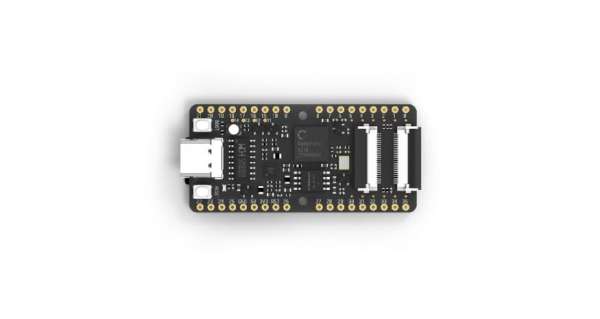
MAIX is Sipeed’s purpose-built module designed to run AI at the edge, we called it AIoT. It delivers high performance in a small physical and power footprint, enabling the deployment of high-accuracy AI at the edge, and the competitive price make it possible embed to any IoT devices. As you see, Sipeed MAIX is quite like Google edge TPU, but it act as master controller, not an accelerator like edge TPU, so it is more low cost and low power than AP+edge TPU solution.
MAix’s Advantage and Usage Scenarios:
- MAIX is not only hardware, but also provide an end-to-end, hardware + software infrastructure for facilitating the deployment of customers’ AI-based solutions.
- Thanks to its performance, small footprint, low power, and low cost, MAIX enables the broad deployment of high-quality AI at the edge.
- MAIX isn’t just a hardware solution, it combines custom hardware, open software, and state-of-the-art AI algorithms to provide high-quality, easy to deploy AI solutions for the edge.
- MAIX can be used for a growing number of industrial use-cases such as predictive maintenance, anomaly detection, machine vision, robotics, voice recognition, and many more. It can be used in manufacturing, on-premise, healthcare, retail, smart spaces, transportation, etc.
MAix’s CPU
- In hardware, MAIX have powerful KPU K210 inside, it offers many excited features:
- 1st competitive RISC-V chip, also 1st competitive AI chip, newly release in Sep. 2018
- 28nm process, dual-core RISC-V 64bit IMAFDC, on-chip huge 8MB high-speed SRAM (not for XMR :D), 400MHz frequency (able to 800MHz)
- KPU (Neural Network Processor) inside, 64 KPU which is 576bit width, support convolution kernels, any form of activation function. It offers [email protected],400MHz, when overclock to 800MHz, it offers 0.5TOPS. It means you can do object recognition 60fps@VGA
- APU (Audio Processor) inside, support 8mics, up to 192KHz sample rate, hardcore FFT unit inside, easy to make a Mic Array (MAIX offer it too)
- Flexible FPIOA (Field Programmable IO Array), you can map 255 functions to all 48 GPIOs on the chip
- DVP camera and MCU LCD interface, you can connect an DVP camera, run your algorithm, and display on LCD
- Many other accelerators and peripherals: AES Accelerator, SHA256 Accelerator, FFT Accelerator (not APU’s one), OTP, UART, WDT, IIC, SPI, I2S, TIMER, RTC, PWM, etc.
Read more: Sipeed MAix: AI at the edge
- What is the primary function of the Sipeed MAIX module?
It is designed to run AI models at the edge with high performance, low power, and low cost. - How does MAIX differ from Google Edge TPU?
MAIX acts as a master controller rather than just an accelerator, making it more low cost and low power. - What type of processor architecture does the K210 chip use?
It uses a dual-core RISC-V 64bit IMAFDC architecture. - Can the MAIX module support microphone arrays?
Yes, its APU supports up to 8 microphones with a sample rate up to 192KHz. - What is the maximum TOPS performance when overclocking the KPU?
When overclocked to 800MHz, it offers 0.5TOPS performance. - How many GPIOs are available on the FPIOA interface?
You can map 255 functions to all 48 GPIOs on the chip. - Does the chip include hardware security accelerators?
Yes, it includes AES and SHA256 accelerators. - What industrial use cases are supported by MAIX?
It supports predictive maintenance, anomaly detection, machine vision, robotics, and voice recognition.
