
Summary of SUPER SENSOR ON A CHIP CAN MONITOR THE HEART AND LUNGS USING SOUNDS/VIBRATIONS
This article details a groundbreaking chip developed by Georgia Tech researchers, named the Accelerometer Contact Microphone. Smaller than a ladybug, it combines an electronic stethoscope and accelerometer to monitor heart and lung signals non-invasively. The device uses two silicon layers separated by 270 nanometers to detect internal body vibrations while filtering external noise, offering real-time health monitoring capabilities that could revolutionize medical diagnostics.
Parts used in the Accelerometer Contact Microphone:
- Accelerometer Contact Microchip
- Two layers of silicon
- Voltage source
Daily substantial advancements are being made in the world of wearables, especially for health-related applications. Most of our fantasies around real-time, round-the-clock, non-invasive, out-of-the-way, monitoring of health parameters are now beyond dreams as researchers continue to cut away through hindrances and unlock new levels of possibilities.
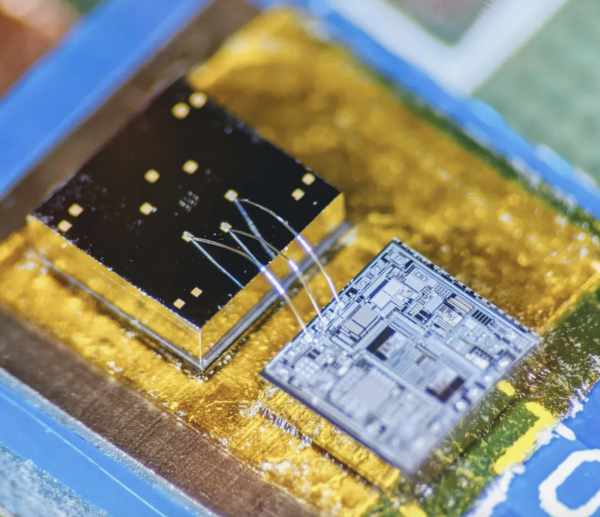
One of such new level of possibilities are the capabilities of a new chip developed by researchers at the Georgia Institute of Technology, which comes in a size smaller than a ladybug, and is able to capture multiple body vitals including movements and critical lungs and heart signals.
Aptly called an Accelerometer Contact Microphone, the chip acts as a combination of an advanced electronic stethoscope an accelerometer, bringing to life the ages long desire of medical practitioners to use the body’s mechanical signals for diagnosis.
The core mechanism of the chip features two finely manufactured layers of silicon, which overlay each other separated by the space of 270 nanometers – about 0.005 the width of a human hair. The silicon layers carry a minute voltage which is put in flux by vibrations from body motion and sounds, creating a readable electronic output that could provide information on different parts of the human body. The silicon layer technology adopted in the chip allows it to detect vibrations from inside the body and filter out vibration and noise from outside the body’s core.
Speaking on the Chip’s development and applications, Farrokh Ayazi, a Ken Byers Professor in Georgia Tech’s School of Electrical and Computer Engineering, described the shortcomings of current systems, and how the chip could be a game-changer as shown in human testing.
Read more: SUPER SENSOR ON A CHIP CAN MONITOR THE HEART AND LUNGS USING SOUNDS/VIBRATIONS
- What is the new chip developed by Georgia Tech researchers?
It is called an Accelerometer Contact Microphone that acts as a combination of an advanced electronic stethoscope and an accelerometer. - How small is the new chip?
The chip comes in a size smaller than a ladybug. - What body vitals can the chip capture?
It is able to capture movements and critical lungs and heart signals. - What is the core mechanism of the chip?
The core features two finely manufactured layers of silicon overlaying each other separated by a space of 270 nanometers. - How does the chip filter out noise?
The silicon layer technology allows it to detect vibrations from inside the body and filter out vibration and noise from outside the body's core. - Who described the shortcomings of current systems?
Farrokh Ayazi, a Ken Byers Professor in Georgia Tech's School of Electrical and Computer Engineering, described these shortcomings. - Can the chip provide information on different parts of the human body?
Yes, the readable electronic output created by the chip could provide information on different parts of the human body.
