
Summary of The decoupling capacitor…is it really necessary?
This article recounts an engineer's experience with an I2C temperature sensor prototype that failed due to a missing decoupling capacitor. The author explains that decoupling capacitors are essential for stability, transient response, and preventing internal node glitches caused by power supply trace inductance. Without them, amplifiers may oscillate or malfunction.
Parts used in the I2C Temperature Sensor Project:
- I2C temperature sensor
- Software
- Hand-wired prototype board
- Decoupling capacitor
- Buffer circuit
- R-C load
- Power supply trace
Before working as an applications engineer, I worked as an IC test development engineer here at TI. One of my projects was to characterize an I2C temperature sensor. After writing some software, I threw together a hand-wired prototype board. I was in a hurry, so I left off that pesky decoupling capacitor. Who needs it, right?
I collected data for about a week, and none of my results matched expectations. I made numerous changes in an attempt to improve performance, but nothing worked. Finally, I decided to add the decoupling capacitor. As you might expect, this solved the issue.
This got me thinking…do we always need decoupling capacitors? What do they really do?
One way to answer the question is to show what happens when you don’t use proper decoupling.
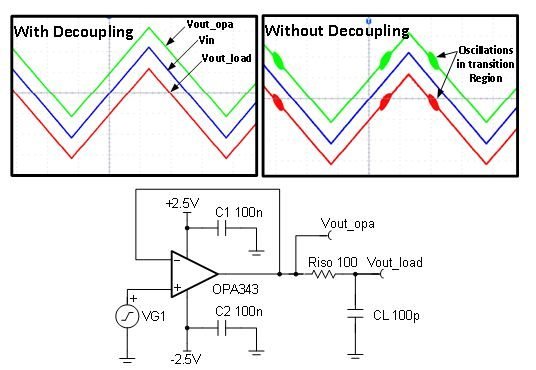
Figure 1 shows a buffer circuit driving an R-C load with and without decoupling capacitors (C1 and C2). Notice that the output signal has a high frequency (3.8MHz) oscillation for the circuit without decoupling. Poor stability, poor transient response, start-up problems, and other anomalies are common challenges with amplifiers that do not have decoupling capacitors.
Figure 2 illustrates why decoupling is important. Note that the inductance of the power supply trace will limit the transient current.
The decoupling capacitor is very close to the device, so it has a very low inductance path for current flow. During transients, the capacitor can supply very large amounts of current to the device for a very short duration.
The device without decoupling does not have a mechanism to provide the transient currents, so the amplifier’s internal nodes will droop – often referred to as a glitch. The internal power supply glitches on the device without decoupling cause inconsistent operation, because the internal nodes are not properly biased.
For more detail: The decoupling capacitor…is it really necessary?
-
What happened when the decoupling capacitor was left off?
The results did not match expectations until the capacitor was added, which solved the issue. -
Do we always need decoupling capacitors?
The text implies they are necessary to avoid poor stability and other anomalies in amplifier circuits. -
What happens to the output signal without decoupling capacitors?
The output signal exhibits high frequency oscillation, such as the 3.8MHz oscillation shown in the buffer circuit example. -
Why is the decoupling capacitor placed close to the device?
It provides a very low inductance path for current flow to the device. -
How do decoupling capacitors handle transient currents?
They can supply very large amounts of current to the device for a very short duration during transients. -
What causes internal nodes to droop without decoupling?
The inductance of the power supply trace limits transient current, causing a glitch or droop in internal nodes. -
What are common challenges with amplifiers lacking decoupling capacitors?
Poor stability, poor transient response, start-up problems, and other anomalies are common challenges.
