
Summary of Toaster oven reflow controller
This article discusses building a low-cost reflow soldering controller using a modified toaster oven. It explains that leadless chips require precise temperature profiles achievable via reflow ovens, which are often expensive. The proposed solution uses an external microcontroller connected to a solid-state relay and thermocouple to manage the oven's heating cycle. The system allows for USB-based profile programming and can operate autonomously from non-volatile memory if disconnected from a computer.
Parts used in Toaster Oven Reflow Controller:
- Toaster oven
- External controller board
- USB port
- Solid state relay
- Extension cord
- Thermocouple
- Microcontroller
- Non-volatile memory
Introduction
Nowadays many of the most “exiting” chips come only in leadless packages, such as BGA and QFN which are hard or impossible to solder just by soldering iron, because leads are under the chip where they can’t be reached. These kinds of chips are usually soldered using reflow soldering. In reflow process solder paste is used instead of solder wire. It contains very small balls of solder in flux, diameter of the balls is just few micrometers. First this paste is put on the contact pads, then components are placed on the pads and whole board is heated in reflow oven where solder balls in the paste melt and attaches the components firmly in place.
For the solder paste to work correctly temperature of the oven must follow correct temperature profile accurately. If the temperature rises too quickly it can damage the components and if the temperature rises too slowly, too much flux can evaporate and the components aren’t soldered reliably.
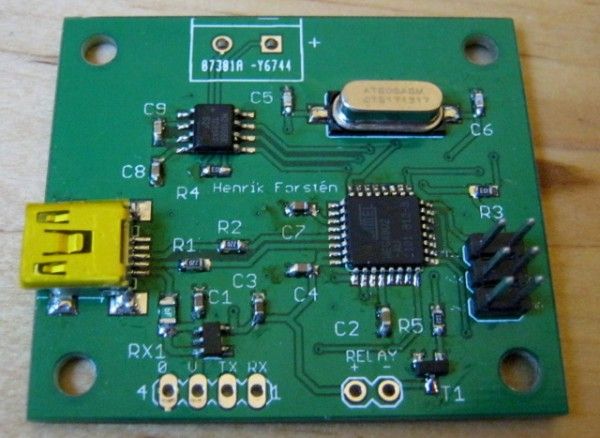
Real reflow ovens are usually expensive, like many other manufacturing tools, but ordinary toaster ovens can be used in reflow soldering with few modifications. They are much cheaper than real reflow ovens, but temperature cannot be set programmatically or accurately. External controller board can be used to control these ovens.
Reflow oven controller
Toaster oven reflow controllers have been done before many times (for example 1 and 2). I wanted to make a simple and cheap controller that wouldn’t use outdated parts. Instead of buttons and dedicated display, it should use USB port for setting the temperature profile and monitoring the temperature if needed. This would be cheaper to make and easy to use. If the computer isn’t connected, it should be able to be switched on by just connecting the power supply, load the temperature profile from non-volatile memory and run without user intervention.
Because the oven gets very hot, it’s not possible to add any electronics inside it. Controlling is done by switching the power on and off rapidly with solid state relay that is connected on extension cord. Temperature is measured using thermocouple inside the oven. Microcontroller will read the temperature and output PWM signal for the solid state relay which can be used to accurately control the temperature of the oven.
For more detail: Toaster oven reflow controller
-
Why are BGA and QFN chips hard to solder with a standard iron?
These chips come in leadless packages where leads are located under the chip and cannot be reached by a soldering iron. -
What happens if the reflow oven temperature rises too quickly or too slowly?
If it rises too quickly components may be damaged, and if it rises too slowly flux evaporates preventing reliable soldering. -
How does the proposed controller avoid using outdated parts?
The design replaces buttons and dedicated displays with a USB port for setting profiles and monitoring temperatures. -
Can the controller operate without a computer connected?
Yes, it can be switched on by connecting power, load a profile from non-volatile memory, and run without user intervention. -
How is the power to the hot oven controlled safely?
Electronics are kept outside the hot zone; a microcontroller outputs a PWM signal to a solid state relay connected to an extension cord. -
What component measures the temperature inside the oven?
A thermocouple placed inside the oven provides temperature readings to the microcontroller.
