
Summary of Tri-Mode Digital Clock with ATtiny85 and RTC
This project builds a Tri-Mode Digital Clock using an ATtiny85 microcontroller and a DS1307 RTC, offering a standard decimal display and two binary-display modes (digit-wise binary and an unusual hours/minutes/seconds per digit). It uses the RTC internal memory to remember the selected clock mode. The design runs from 3–5V, connects a TM1637 4-digit 7-segment display, a tactile button for mode control, and is implemented with provided schematics and an Arduino INO program adapted for the ATtiny85.
Parts used in the Tri-Mode Digital Clock:
- ATtiny85 microcontroller
- Display TM1637 (4 Digits x 7 Segments)
- RTC module DS1307
- Tactile button switch
- Breadboard
- Wires
- Power supply (3V to 5V), e.g., 2x or 3x AA batteries or 5V supply
Story
Hello everybody,
This is my first project using ATtiny85 microcontroller and also including a Real Time Clock (RTC) working with it.
The use of ATtiny85 is a very interesting way to shrink your Arduino projects in a final tiny version.
The Three-Modes Digital Clock includes a version with common decimal clock and also with two versions of binary clock.
One version of binary clock is traditional where each digit of hours and minutes are converted into binary for a LED display of 7 segments.
The last one is my favorite of an unusual version of binary clock where the first digit represents the hour, the second, the minutes and the third the seconds.
An interesting additional feature is about the use of internal memory of RTC that you can save the status of the mode of clock.
This feature is less known and is not applied commonly but give you an extra bonus card for your projects.
Let’s see the project!
You will need for this project:
ATtiny85 microcontroller
Display TM1637 (4 Digits x 7 Segments)
RTC module (DS1307)
Tactile button switch
Breadboard
Wires
Power supply (3V to 5V)
Note:
You can use AA batteries (02x or 03x), for example, or any power supply of 5 Volts at maximum.2 – Schematics & Program
This is my first project using ATtiny85 microcontroller and also including a Real Time Clock (RTC) working with it.
The use of ATtiny85 is a very interesting way to shrink your Arduino projects in a final tiny version.
The Three-Modes Digital Clock includes a version with common decimal clock and also with two versions of binary clock.
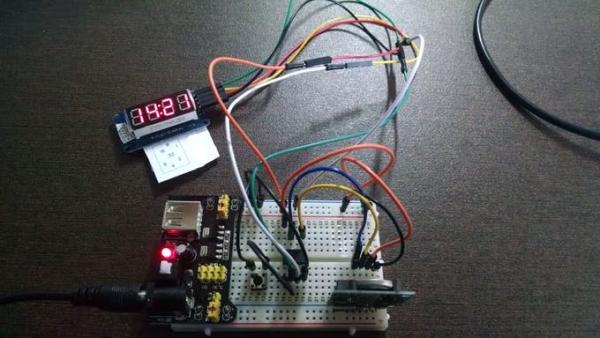
One version of binary clock is traditional where each digit of hours and minutes are converted into binary for a LED display of 7 segments.
The last one is my favorite of an unusual version of binary clock where the first digit represents the hour, the second, the minutes and the third the seconds.
An interesting additional feature is about the use of internal memory of RTC that you can save the status of the mode of clock.
This feature is less known and is not applied commonly but give you an extra bonus card for your projects.
Let’s see the project!
You will need for this project:
ATtiny85 microcontroller
Display TM1637 (4 Digits x 7 Segments)
RTC module (DS1307)
Tactile button switch
Breadboard
Wires
Power supply (3V to 5V)
Note:
You can use AA batteries (02x or 03x), for example, or any power supply of 5 Volts at maximum.
2 – Schematics & Program
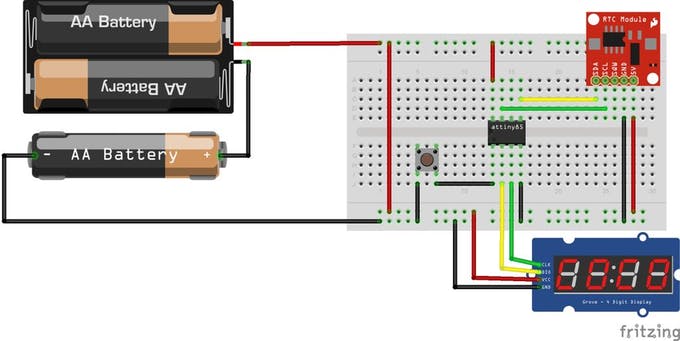
Schematics
The circuit is shown on attached schematic.
It is very simple, just follow with care the wires connection.
Arduino Program
The program is shown on attached files (INO version).
For more detail: Tri-Mode Digital Clock with ATtiny85 and RTC
- What microcontroller is used in the project?
The project uses an ATtiny85 microcontroller. - What display does the clock use?
The clock uses a TM1637 4-digit x 7-segment display. - Which RTC module is used with the ATtiny85?
The project uses a DS1307 RTC module. - Can the clock remember the selected mode after power off?
Yes, it uses the internal memory of the RTC to save the mode status. - What clock display modes are available?
There is a common decimal clock and two binary clock versions: digit-wise binary and a version where digits represent hour, minute, and second respectively. - What supply voltage is required?
The project runs from 3V to 5V. - What components are needed to assemble the circuit?
The circuit requires the ATtiny85, TM1637 display, DS1307 RTC, a tactile button, breadboard, wires, and a 3V–5V power supply. - Is an Arduino program provided for the project?
Yes, the Arduino INO program is provided in the attached files. - Are schematics provided for wiring?
Yes, the circuit schematic is included and the wiring is described as simple to follow.
