
Summary of Understanding Logic Analyzer basics using SCANALOGIC-2 EDU KIT
A logic analyzer captures and displays digital signal timing, ideal for debugging complex circuits. Unlike oscilloscopes that measure analog details on few channels, logic analyzers handle over 100 channels to verify bus relationships and decode protocols. This article uses the SCANALOGIC-2 educational kit to demonstrate basic features like asynchronous/synchronous modes, triggering, and protocol decoding.
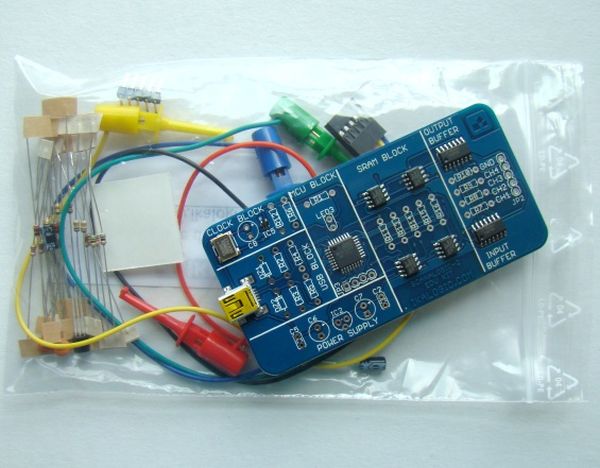
Parts used in the SCANALOGIC-2 Educational Kit:
- ATMEL Atmega168 microcontroller
- Memory chips
- I/O buffer chips
- Quartz oscillator
- Resistors
- Capacitors
- Regulator IC
- Diodes
- Gripper probes
A logic analyzer is an excellent tool for capturing many digital signals at once and displaying their timing relationships. It is particularly useful in verifying and debugging digital circuits. This tutorial is intended to provide a quick overview of a logic analyzer tool and its uses in analyzing and decoding data flowing on multiple signal lines or bus in a digital system. The logic analyzer tool is extremely helpful in troubleshooting problems arising from timing violations and transients on buses. In this article, I am going to use the SCANALOGIC-2 educational kit from IKALOGIC to illustrate very basic features of a logic analyzer.
Logic analyzer vs oscilloscope
Several types of electronic measurement tools are used to test and verify digital circuits. A digital oscilloscope is one of the most commonly used tools in an electronics lab. The oscilloscope is used for general-purpose signal viewing and it allows to make accurate measurements of various attributes of the signal such as rise- and fall-times, peak amplitude, frequency, the elapsed time between edges, etc. Typical digital oscilloscopes have up to four signal inputs, which means you can simultaneously observe four signals and their attributes. However, the oscilloscope cannot help you when you need to measure digital signals on a 32-bit microcprocessor bus simultaneously because it doesn’t have that many channels. A logic analyzer tool can serve this purpose. Although it grew out of an oscilloscope, the logic analyzer have different capabilities, and it measures and analyzes signals differently than an oscilloscope. Instead of measuring analog details, the logic analyzer only detects the logic state of a signal. Logic analyzers can have over 100 channels (some sophisticated ones have over thousand channels). Because they can capture and display logic states of many signal lines at once, logic analyzers are very helpful for verifying time relationship between the signals. They can also decode information sent over the microprocessor bus and present them in a meaningful form.
Logic analyzers present data basically in the same way as oscilloscopes do with time axis along horizontal. But the vertical axis of logic analyzer has only 1-bit resolution required to indicate either a logic High or a logic Low. When you connect a logic analyzer to a digital circuit, you’re only concerned with the logic state of the signal, and not analog details as oscilloscopes do. Besides, logic analyzers can’t display data in real time. They first capture the signals and display them later. They are very useful when looking at time relationship between many signals at one glance. It can also decode information sent over the microprocessor buses and present them in a meaningful form.
The basic defining characteristics of a logic analyzer are the number of input channels it can sample, the maximum sampling rate, and the memory depth for storing the samples. The specification of memory depth defines how many captured samples can be stored per channel in a single run. For example, an analyzer with 32K depth can store 32K samples per channel. If you use a sampling frequency of 1 million samples per second, then it will fill up just in 32 milliseconds. Larger memory depths allow you to sample data for longer time, which is helpful to spot and correct a timing violation on bus.
Modes
Logic analyzers have two basic modes of operation: timing mode and state mode.
In timing mode, the data is sampled at regular intervals according to a clock internal to the logic analyzer. As such there is no fixed timing relationship between a target system and the samples acquired by the logic analyzer. The samples are stored in the memory and are used later to analyze the timing relationship between the signals. This mode of operation is also known as asynchronous acquisition and is useful in debugging mostly hardware problems.
The timing relationship between the signals is not particularly useful while tracking down software related problems. The software developer is more interested to see the instruction flow of the program. In state mode, a signal from the target device (usually a microprocessor clock) defines the sample point. Signals are captured on the active edge of every clock signal received from the target device. In this case, the relative timing information between the signals is unimportant. Since the data are sampled during the active edge of the system clock, the logic signals are stable and represent a valid state of the target system. Therefore, with multiple samples, it is possible to capture and display successive states of the system in a sequence. This points up the major difference between timing and state mode. The timing analyzer has an internal clock to control sampling, so it asynchronously samples the system under test. A state analyzer synchronously samples the system since it gets its sampling clock from the system.
Triggering
A logic analyzer needs a trigger signal that basically tells it when to start recording samples. Since a logic analyzer has a limited amount of memory for storing samples, a trigger helps to capture the action of interest properly. A trigger is normally defined by a logic condition built on the sampled data that has to be met in order to capture the data. Many conditions can be used to trigger a logic analyzer. For example, a change in the logic state of a single line can be used as a trigger. Similarly, in a more complex system, recognizing a specific binary value on a bus or a sequence of pre-defined data values can be used as triggers. Although there is no theoretical limit on how you would define a trigger, complex trigger algorithms are difficult to implement because the trigger event has to be evaluated in real time.
SCANALOGIC-2
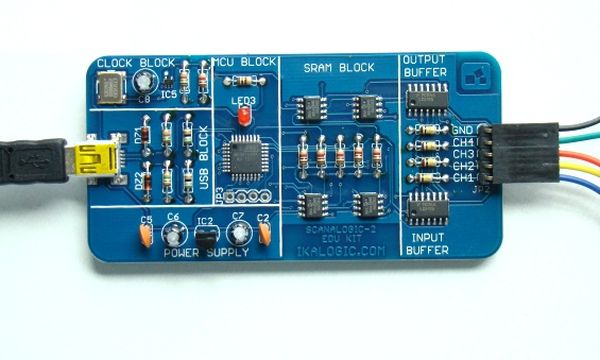
SCANALOGIC-2 is an educational kit that allows you to build a low-cost four channel logic analyzer at home. It is based on ATMEL’s Atmega168 microcontroller. It connects to a PC through USB port and uses a free PC software called ScanaStudio to visualize and analyze the captured signals. The key features of SCANALOGIC-2 are:
- Sampling rate: 20 Million samples per seconds
- No. of channels: 4
- Memory depth: 256K per channel (total 1 MByte)
- Protocol decoding: I2C, SPI, UART, 1-Wire
- Digital output capability: PWM, FM, UART packets
When you order the Scanalogic-2 EDU KIT, the board comes with presoldered SMT components that include the microcontroller, memory chips, I/O buffer chips and quartz oscillator. Rest of the through-hole components (resistors, capacitors, regulator IC, and diodes) are to be soldered by yourself, which is pretty easy. The KIT also includes gripper probes to hook the logic analyzer to your circuit.
For more detail: Understanding Logic Analyzer basics using SCANALOGIC-2 EDU KIT
- What is the primary difference between a logic analyzer and an oscilloscope?
An oscilloscope measures analog signal attributes like rise time and amplitude on up to four channels, while a logic analyzer detects only logic states (High or Low) across many channels to analyze timing relationships. - How does timing mode differ from state mode in a logic analyzer?
Timing mode uses an internal clock for asynchronous sampling useful for hardware debugging, whereas state mode synchronously samples based on the target system's clock to track software instruction flow. - Why is a trigger signal necessary when using a logic analyzer?
A trigger defines a specific logic condition to tell the analyzer when to start recording, ensuring limited memory captures the exact action of interest. - What are the key specifications of the SCANALOGIC-2 kit?
The kit offers a 20 million samples per second rate, 4 input channels, 256K memory depth per channel, and supports I2C, SPI, UART, and 1-Wire protocol decoding. - Which software is required to visualize signals captured by the SCANALOGIC-2?
The free PC software called ScanaStudio is used to visualize and analyze the captured signals via the USB connection. - What components must be soldered by the user when building the SCANALOGIC-2 kit?
Users must solder through-hole components including resistors, capacitors, regulator ICs, and diodes, as SMT components are pre-soldered. - Can a logic analyzer display data in real time?
No, logic analyzers cannot display data in real time; they must first capture the signals and then display them later. - What types of problems can a logic analyzer help troubleshoot?
It is helpful for troubleshooting timing violations, transients on buses, and verifying time relationships between multiple digital signals.
