
Summary of USRP B205MINI-I SOFTWARE-DEFINED RADIO PLATFORM
The USRP B205mini-i is a compact, flexible software-defined radio platform by Ettus Research. It features a wide frequency range from 70 MHz to 6 GHz and includes an industrial-grade Xilinx Spartan-6 XC6SLX150 FPGA. The device utilizes the Analog Devices AD9364 RFIC for up to 56 MHz instantaneous bandwidth. Powered via USB 3.0, it supports synchronization through 10 MHz clock or PPS inputs. Control is managed via the USRP Hardware Driver (UHD), offering APIs for C/C++ and Python across Linux, Windows, and Mac OS.
Parts used in the USRP B205mini-i:
- Xilinx Spartan-6 XC6SLX150 FPGA
- Analog Devices AD9364 RFIC transceiver
- High-speed USB 3.0 connection
- GPIO connectors
- JTAG connectors
- 10 MHz clock reference input
- PPS time reference input signal
- USRP Hardware Driver (UHD)
A wide frequency range (70 MHz to 6 GHz) and a user-programmable transceiver
The USRP B205mini-i is a flexible and compact platform that is ideal for both hobbyist and OEM applications. It is designed by Ettus Research™ and provides a wide frequency range (70 MHz to 6 GHz) and a user-programmable, industrial-grade Xilinx Spartan-6 XC6SLX150 FPGA. USRPs are transceivers, meaning that they can both transmit and receive RF signals.
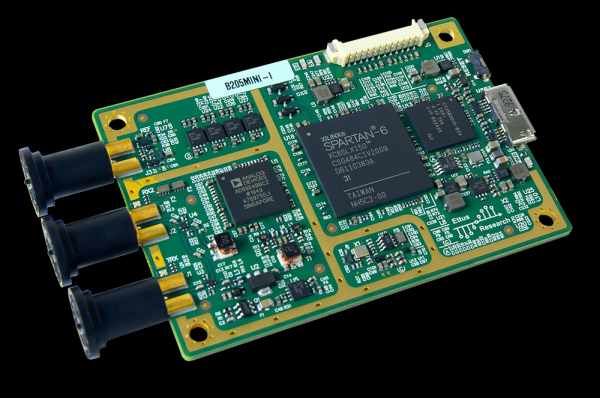
The RF front end uses the Analog Devices AD9364 RFIC transceiver with 56 MHz of instantaneous bandwidth. The board is bus-powered by a high-speed USB 3.0 connection for streaming data to the host computer. The USRP B205mini-i also includes connectors for GPIO, JTAG, and synchronization with a 10 MHz clock reference or PPS time reference input signal.
The hardware is conveniently accessible through the USRP Hardware Driver (UHD). UHD provides both a C/C++ and Python API and offers cross-platform support for multiple industry-standard development environments and frameworks, including RFNoC, GNU Radio, LabVIEW and Matlab/Simulink. And to ensure you have no restrictions on how you use UHD, it is available on Linux, Windows, and Mac OS. UHD provides the necessary control used to transport user waveform samples to and from USRP hardware as well as control various parameters (e.g. sampling rate, center frequency, gains, etc) of the radio.
RF Capabilities
- 1 TX, 1 RX
- 70 MHz to 6 GHz Frequency Range
- Up to 56 MHz instantaneous bandwidth
Software
- USRP Hardware Driver 3.9.2 (or later)
- GNU Radio
Synchronization
- 10 MHz clock reference
- PPS time reference
Read more: USRP B205MINI-I SOFTWARE-DEFINED RADIO PLATFORM
- What is the frequency range of the USRP B205mini-i?
The device provides a wide frequency range from 70 MHz to 6 GHz. - How does the USRP B205mini-i receive power?
The board is bus-powered by a high-speed USB 3.0 connection for streaming data. - Does the USRP B205mini-i support both transmission and reception?
Yes, as a transceiver, it can both transmit and receive RF signals. - What is the maximum instantaneous bandwidth supported?
The device supports up to 56 MHz of instantaneous bandwidth. - Which programming languages are supported by the UHD API?
UHD provides both a C/C++ and Python API. - Can the USRP B205mini-i be synchronized with external clocks?
Yes, it includes connectors for a 10 MHz clock reference or PPS time reference input signal. - Is the USRP Hardware Driver available on Windows?
Yes, UHD is available on Linux, Windows, and Mac OS. - What FPGA is included in the USRP B205mini-i?
It includes an industrial-grade Xilinx Spartan-6 XC6SLX150 FPGA.
