
Summary of Voice Control Ready Pico-ITX i.MX8M Board for Embedded IoT Solutions
The Estone EMB-2238 is a new pico-ITX embedded board based on the NXP i.MX8M processor. Designed for IoT and voice control applications, it features a quad-core ARM Cortex-A53, dual-core hardware DSP, PoE-ready GbE port, USB 3.0, RS-232/485, MIPI DSI/CSI interfaces, and a 40-pin expansion header. It supports 4K video, extensive digital audio I/O, and various software stacks including Android and Embedded Linux.
Parts used in the EMB-2238 Project:
- NXP i.MX8M application processor
- Quad core ARM Cortex-A53 CPU
- Dual core hardware DSP
- PoE ready GbE port
- RS-232/485 interfaces
- USB 3.0 ports
- MIPI DSI and CSI interfaces
- 40-pin expansion header
- Built-in I2C touch panel support
- Smart codec with Dual Digital MEMS Microphone inputs
Estone technology is proud to announce the new addition to our pico-ITX embedded board family – EMB-2238, an NXP i.MX8M based single board computer. Building upon the success of our i.MX6 board series. The EMB-2238 is our first embedded board to integrated with hardware DSP specially designed for voice control applications, This Quad core ARM Cortex-A53 board takes the advantage of NXP’s latest i.MX8M application processor with up to 15-year longevity, advance audio and 4K video supports. It is ready for ODM and industrial product designs for the fast-growing edge computing, voice human machine interface (HMI), streaming multimedia, and machine learning applications.
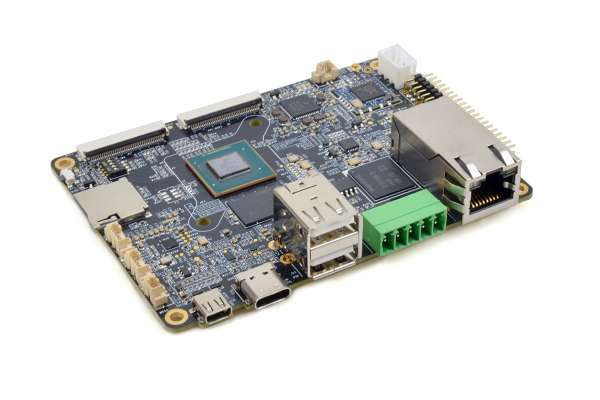
Targeting embedded and IoT applications with voice control, advance audio and display requirements, the EMB-2238 features a PoE (Power over Ethernet) ready GbE port, rich I/O options including RS-232/485 and USB 3.0, over 20 channels of high performance digital audio input and output expansion and dual core hardware DSP for voice-control algorithms. The board also features a 4-lane MIPI DSI and CSI and built in I2C touch panel support for all types of touchscreen applications. A 40-pin expansion header supports PCIe, GPIO, I2C, serial communications and a wide range of expansion options.
The voice control and audio support of the board is where the EMB-2238 truly stands apart. The on-board smart codec provides support for Dual Digital MEMS Microphone inputs, dual-core DSP with multi-mic noise suppression, Automatic Speech Recognition (ASR) enhancement, acoustic echo cancellation (AEC) and barge-in technology enable voice commands for during loud music playback., functions. 16 channel digital audio inputs and 10 channel digital audio outputs support microphone array expansion for voice and best in class audio with 32-bit 384KHz at each channel. BSP supports include Embedded Linux, Android, Qt, Wayland, Amazon AVS (Alexa Voice Service) Device SDK, Sensory TrulyHandsfree Wake Word Engine, and offline Automatic Speech Recognition (ASR), and Natural Language Understanding (NLU) engine, like the Snips AI voice control platform.
Read more: Voice Control Ready Pico-ITX i.MX8M Board for Embedded IoT Solutions
-
What is the primary processor used in the EMB-2238?
The board uses the NXP i.MX8M application processor featuring a Quad core ARM Cortex-A53. -
Does the EMB-2238 support voice control applications?
Yes, it is designed for voice control with integrated dual core hardware DSP for voice-control algorithms. -
What video capabilities does the board offer?
The board supports advance audio and 4K video through its 4-lane MIPI DSI interface. -
Can the EMB-2238 operate with Power over Ethernet?
Yes, the board features a PoE ready GbE port. -
How many digital audio channels are supported?
It provides over 20 channels of high performance digital audio input and output expansion. -
Which operating systems are supported by the BSP?
BSP supports include Embedded Linux, Android, Qt, Wayland, and Amazon AVS Device SDK. -
What specific voice technologies are enabled by the DSP?
Features include multi-mic noise suppression, ASR enhancement, acoustic echo cancellation, and barge-in technology.
