
Summary of What is Dual ToneMultiple Frequency (DTMF)
DTMF (Dual Tone Multiple Frequency) generates unique signals by combining row and column frequencies when telephone keypad buttons are pressed. Each key produces two specific tones, such as 770 Hz and 1336 Hz for the '5' button. The article outlines ANSI standards for tone duration, silence intervals, and signal strength, while listing specific chips used for encoding and decoding these signals in telephony applications.
Parts used in the DTMF Telephony Project:
- TP5089 DTMF Generator
- MT8870DE DTMF Decoder
DTMF is an abbreviation of Dual ToneMultiple Frequency. When you press a button in the telephone set keypad, aconnection is made that generates a resultant signal of two tones at the same time. These two tones are takenfrom a row frequency and a column frequency. Theresultant frequency signal is called “Dual ToneMultiple Frequency“. These tones are identical and unique.
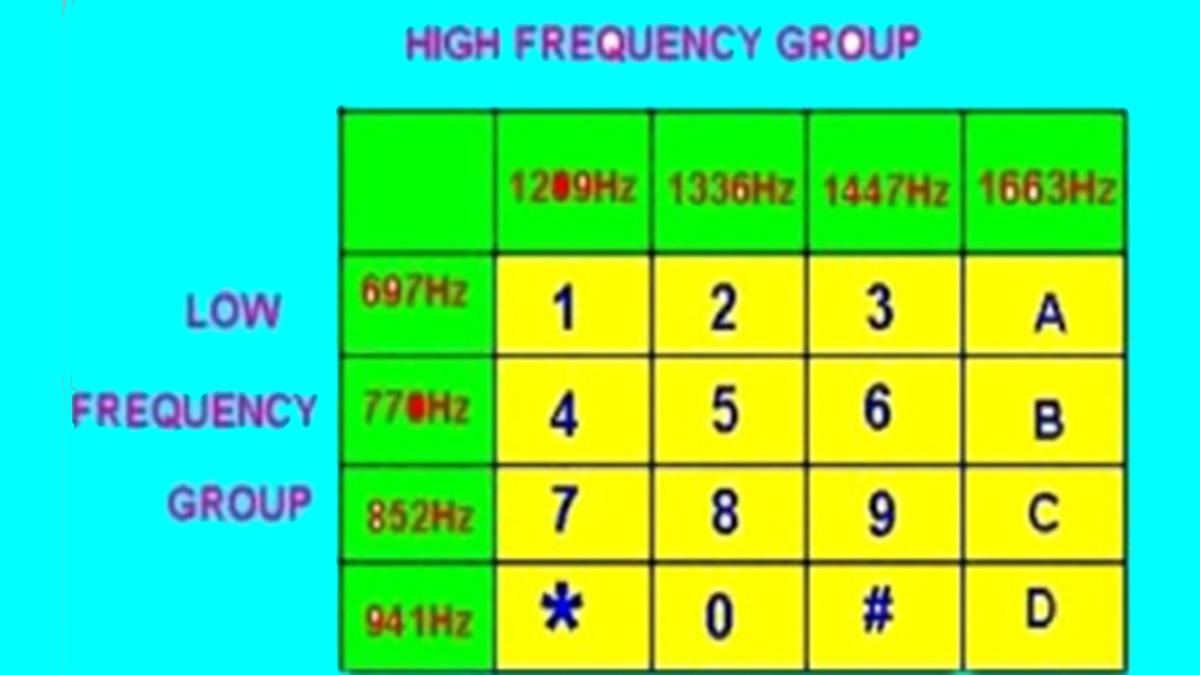
Telephone keypad with frequency
DTMF signaling uses two tones to represent each key on the touch pad. There are 12 distinct tones. When any key is pressed the tone of the column and the tone of the row are generated. As an example, pressing the ‘5’ button generates the tones 770 Hz and 1336 Hz. In this example, use the number 10 to represent the ‘*’ key and 11 to represent the ‘#’ key.
What are DTMF Frequencies:
ANSI standards state that DTMF tones used in telephony must meet the following criteria:
- The DTMF duration must be at least 50ms.
- The inter-digit interval (silence) between tones must be at least 45ms.
- The receiver should receive the DTMF digits with a signal strength of at least -25dBm and no more than 0dBm.
- The energy strength of the high-group frequency must be -8 dB to +4 dB relative to the energy strength of the low-group frequency as measured at the receiver.
When the level between the two frequencies is not equal it is said to have a twist. Most modern equipment is fairly tolerant of unbalanced levels between tones.
| Event | Low frequency | High frequency |
|---|---|---|
| Busy signal (US) | 480 Hz | 620 Hz |
| Ringback tone (US) | 440 Hz | 480 Hz |
| Dial tone (US) | 350 Hz | 440 Hz |
Chips Used to Encode & Decode DTMF
- TP5089 DTMF (TOUCH-TONE) Generator
- DTMF decoder MT8870DE
- How does a telephone keypad generate a signal?
Pressing a button connects a row frequency and a column frequency to create a resultant Dual Tone Multiple Frequency signal. - What is the minimum duration required for a DTMF tone?
ANSI standards state that the DTMF duration must be at least 50ms. - How many distinct tones are used for each key?
Two tones are used to represent each key on the touch pad. - What frequencies are generated when pressing the number 5?
Pressing the number 5 generates tones of 770 Hz and 1336 Hz. - What represents the asterisk and hash keys in this system?
The number 10 represents the asterisk key and 11 represents the hash key. - What is the minimum silence interval between digits?
The inter-digit interval or silence between tones must be at least 45ms. - Which chip is used to encode DTMF signals?
The TP5089 DTMF Touch-Tone Generator chip is used to encode the signals. - Which chip is used to decode DTMF signals?
The MT8870DE DTMF decoder chip is used to decode the signals.
