
Summary of Wifi throwie : improved version
This article details the "wifi throwie 2.0," an improved IoT device using a recycled 100mAh micro drone battery with an ESP8266 to create a hotspot serving images or captive portals. By utilizing modem sleep mode, it achieves up to six hours of operation or roughly 160 tweets before depletion. The project replaces bulky LiPO batteries with cost-effective mini-drone cells, significantly extending functionality while maintaining a small form factor for various internet-connected applications.
Parts used in the Wifi Throwie 2.0:
- ESP8266 microcontroller
- Micro 100 mAh LiPO battery (recycled from broken minidrone)
- Mini drone battery (alternative option, e.g., 500 mAh)
A few months ago, Andreas presented a nice version of the “throwie” (a LED packed with a small battery that you can throw & see shining for hours) using an ESP8266 instead of a LED : a “wifi throwie”.
He could not make it work with button cell batteries (the ESP8266 draws too much current) so he ended using a 3.7 LIPO battery, which is quite bulky as you can see on the following post : http://hackaday.com/2015/05/03/esp8266-wifi-throwies/
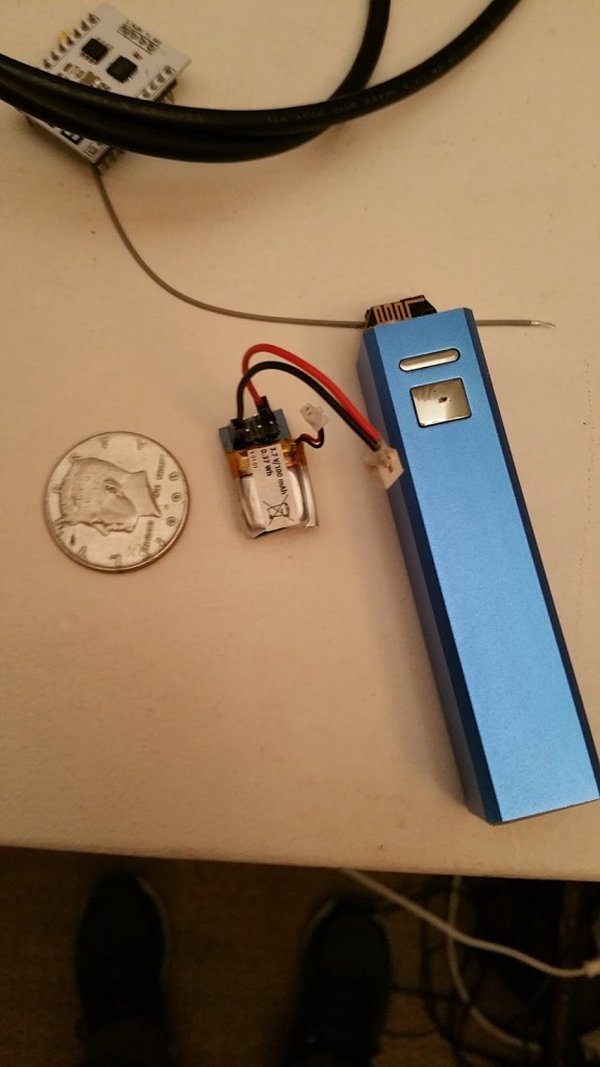
What if you could use instead a cheap mini drone battery you can find for half a euro on eBay ?
Bingo !
Introducing the “wifi throwie 2.0”, using a micro 100 mah lipo battery recycled from a broken minidrone. According to espressif data (http://bbs.espressif.com/viewtopic.php?t=133), the ESP only burns 15 ma in “Modem sleep mode” – which can last 6 hours with a 100 mah battery. Since the server only send a 5k picture (takes less 30 seconds at 120 mah, ie 1 mah), you can serve ~ 100 connections before the battery dies. The number if even larger if you only want people to see the AP name, but not to really connect.
[Edit] :
-As seen in hackaday !
-I tested the battery with a programm connecting to the internet, sending a tweet and waiting for one minute. It could stay alive 2 hours and a half and send 160 tweets before dying… More than enough for many applications…
You’ll find here a demo : https://www.youtube.com/watch?v=nD_AHmZ63PY
The throwie appears as “ggo iot demo” hotspot. One connected to this hotspot, any url leads you to the captive intraweb showing an “iot demo” picture.
Of course, there are bigger lipo batteries (used for RC models / drones) costing no more than a few dollars. For example this one costs 2 $ and offers a 500 mah capacity: http://www.ebay.com/itm/3-7V-500mAh-Li-Po-Battery-For-Hubsan-X4-H107-H107L-H107C-H107D-V252-JXD385-HC-/281790908597?hash=item419c0c08b5:g:t0QAAOSwqv9V6ToU
For more detail: Wifi throwie : improved version
- How can the wifi throwie operate longer than previous versions?
The device uses a recycled 100 mAh LiPO battery and keeps the ESP8266 in Modem sleep mode to extend runtime. - What is the maximum duration the battery lasts in sleep mode?
The battery can last approximately 6 hours when the ESP8266 consumes only 15 mA in Modem sleep mode. - How many connections can the device support before the battery dies?
The system can serve around 100 connections by sending a 5k picture that takes less than 30 seconds to transmit. - Can the device send tweets over the network?
Yes, testing showed it could stay alive for two and a half hours and send 160 tweets before dying. - What name does the hotspot display to users?
The throwie appears as the hotspot named ggo iot demo. - What happens when a user connects to the hotspot?
Any URL accessed leads to a captive intraweb showing an iot demo picture. - Are larger batteries available for this project?
Yes, bigger LiPO batteries like a 500 mAh model for RC drones are available for a few dollars. - Why was the original version replaced with version 2.0?
The original could not work with button cell batteries because the ESP8266 draws too much current.
