
Summary of 16 LED Knight Rider using 74HCT138 microcontroller
This article describes a 16-LED Knight Rider circuit built using standard TTL logic ICs, specifically the 74HCT191 counter and two 74HCT138 decoders. It explains how the counter drives the LEDs sequentially by enabling one decoder at a time based on binary output states. The design uses an oscillator for clock pulses and includes components like resistors, capacitors, diodes, and a voltage regulator to ensure stable operation without a microcontroller.
Parts used in the 16 LED Knight Rider:
- 8x LED (red)
- 1x 180 ohm resistor
- 1x 10k ohm resistor
- 1x 33k ohm resistor
- 1x 2u2/16V capacitor
- 1x 74HCT191 IC
- 1x 74HCT132 IC
- 2x 74HCT138 ICs
- 1x 78L05 voltage regulator
- 1x 47uF/16V capacitor
- 1x 100nF capacitor
- 2x 1N4007 diodes
8x LED (red)
1x 180 ohm
1x 10k ohm
1x 33k ohm
1x 2u2/16V
1x 74HCT191
1x 74HCT132
2x 74HCT138
1x 78L05
1x 47uF/16V
1x 100n
2x 1N4007
Yet another version:
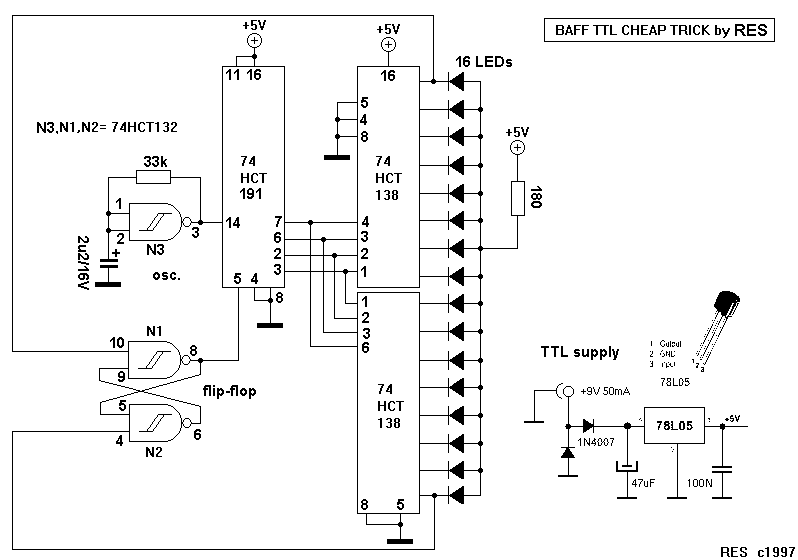
Here an example with 4 TTL ICs. This is I think the cheapest solution with standard logic ICs. The 74HCT191 is a Presettable Synchronous 4-Bit Binary Up/Down Counter. Pin 14 is the clock input (from the osc.) Pin 5 is the Up/Down input, this lets the counter counts up or down (via the flip-flop) when reaching the last LED. Enable the counter by connecting pin 4 to GND. The counter generates 4 bits data at the 4 outputs (Q0 to Q3) The data goes to the two 3-to-8 line decoder/demultiplexers, the trick is this, you have 3 address inputs (btw 2^3 = 8) and two Enabling inputs (pin 4 and 6), with these you can enable each 74HCT138 individually. At the first clock of the oscillator (N3), the counter starts at 0001 (first LED on), so pin 4 and 6 are both 0, so only one 74HCT138 is enabled at a time. When reaching the 9th clockpulse, the two 74HCT138s flip, because the counter is at 1001.
For more detail: 16 LED Knight Rider using 74HCT138 microcontroller
16 LED Knight Rider using 74HCT138 microcontroller
- What is the function of the 74HCT191 IC?
The 74HCT191 is a Presettable Synchronous 4-Bit Binary Up/Down Counter that generates 4 bits of data at its outputs. - How does the circuit enable only one decoder at a time?
Pin 4 and pin 6 of the decoders are controlled so that only one 74HCT138 is enabled at any given moment. - What happens when the counter reaches the 9th clock pulse?
When reaching the 9th clockpulse, the counter is at 1001, causing the two 74HCT138s to flip. - Which pin serves as the clock input for the counter?
Pin 14 is the clock input which receives signals from the oscillator. - How is the counting direction controlled?
Pin 5 is the Up/Down input which lets the counter count up or down via the flip-flop when reaching the last LED. - How do you enable the counter?
You enable the counter by connecting pin 4 to GND. - What is the role of the two 74HCT138 chips?
They act as 3-to-8 line decoder/demultiplexers receiving data from the counter to drive the LEDs. - Can this solution be considered cost-effective?
Yes, it is described as the cheapest solution using standard logic ICs.
