
Summary of 8 Channel RS485 Relay Board
This project enables control of eight relays via an RS485 link from a PC, effectively transforming the computer into a low-cost PLC. It supports various programming languages and terminal software for command issuance. The system uses a 12V to 15V DC supply, features ULN2803 drive ICs, includes status LEDs, and utilizes screw terminals for connections.
Parts used in the 8 Channel RS485 Relay Board:
- RS232 to RS485 Interface (C020 or suitable converter)
- PC with Serial Port
- ULN2803 Industry Standard Relay Drive IC
- Eight 12V SPDT Relays
- Onboard Regulator IC
- Data Received Indicator LED (D2)
- Relay State Indicator LEDs
- Power-On Board Indicator LED (D5)
- Screw Terminal Connectors
- Protection Diodes
- RS485 Cable
This project helps you control 8 relays using RS485 link with the help of a PC. This kit can effectively convert a standard PC to a powerful PLC ( programmable logic controller ). At the PC end , you will need to use our RS232 to RS485 Interface – C020 or any other suitable RS232 to RS485 Converter.
The project can offer a low-cost serial relay contact interface, easy to use with Visual Basic, Basic, C, Labview, Testpoint, or other high level languages that allow access to a serial port.
You can simply use the accompanying software provided with this project or issue control commands using any popular Terminal Port software available on the net.
The Serial port on the computer should be configured to 2400 baud – 8 bit words – 1 stop bit – no parity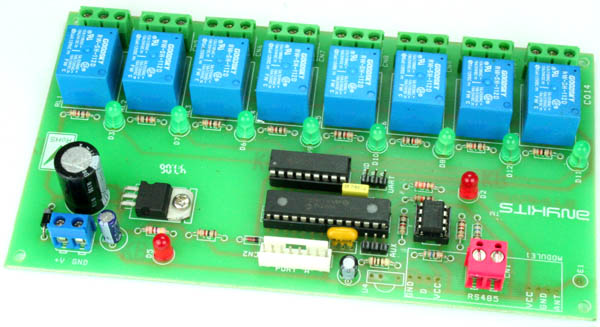
RELAY OUTPUT COMMAND SUMMARY
RBnc – “RB” preamble, n – Relay number (1 to 8) and c – set/reset (1 – set, 0 – reset)
RS485 cable connects at CN1 connector. The setting or resetting of the relays is indicated by the associated LED’s close to them. LED D2 blinks to indicate a valid command received. LED D5 is the Power On Board Indicator.
Please refer to the schematic diagram for the configuration of this board.
With RS485 Controlled 8 Relay Board you can control upto 8 SPDT (Single Pole Double Throw) relays using a simple RS485 protocol.
Specifications
- Upto 8, 12V SPDT relay control
- Industry standard relay drive IC – ULN2803
- Data received indicator LED
- LED indicator to display relay state
- Power-On LED indicator
- Onboard regulator IC
- Screw terminal type connector for easy connection of all wires to the PCB
- Simple RS485 Protocol
- Can be controlled either by a microcontroller board or via PC using suitable RS232 – RS485 converter
- Diode protection against reverse polarity connection
- NC-C-NO pin outs from each relay into a screw terminal connector
- Four mounting holes of 3.2 mm each
- PCB dimensions 166 mm x 92 mm
- Supply Voltage : 12 ~ 15 V DC
- I/O Voltage : 5 V DC
For more detail: 8 Channel RS485 Relay Board
- How can I convert a standard PC into a powerful PLC?
This kit allows you to convert a standard PC into a powerful PLC by controlling 8 relays using an RS485 link. - What serial port configuration is required?
The serial port must be configured to 2400 baud, 8 bit words, 1 stop bit, and no parity. - Can I use high-level languages like C or Labview?
Yes, the interface is easy to use with Visual Basic, Basic, C, Labview, Testpoint, or other high-level languages. - How do I set or reset a specific relay?
Use the RBnc command where n is the relay number (1 to 8) and c is 1 for set or 0 for reset. - What indicates that a valid command was received?
LED D2 blinks to indicate that a valid command has been received. - Can this board be controlled by a microcontroller?
Yes, the board can be controlled either by a microcontroller board or via a PC using a suitable RS232 to RS485 converter. - What are the power supply requirements?
The supply voltage should be between 12 and 15 V DC.
