
Summary of Build Your Own Microcontroller Based PID Control Line Follower Robot (LFR) – Second Part
This article details the construction of BRAM II, a programmable Line Follower Robot (LFR) using an Atmel AVR ATMega168 microcontroller. It highlights features like PID control via UART and EEPROM, five IR sensors with an MCP23008 expander, and a MAX756 DC-DC step-up circuit for stable 5V power. The chassis is made of acrylic, utilizing two geared DC motors and a caster mechanism.
Parts used in the BRAM II Line Follower Robot:
- Acrylic sheets for the chassis
- Two geared DC motors with wheels rated 4.5 to 5 volt
- One 3 x 1.5 volt AA battery holder with on-off switch
- One plastic bead and one paper clip for the caster
- Nuts, bolts, and PCB standoffs
- AVRJazz Mega168 board
- Motor Control Circuit
- Sensor Circuit
- Maxim MAX756 DC to DC Step-Up chip
- Microchip MCP23008 8-bit I2C I/O expander chip
- SGS-Thomson L293D chip
- Five infra red reflective object sensors
One of the interesting parts in building the Line Follower Robot is; you could start it with a very simple version by using just two transistors with the LED and LDR for sensor (Build Your Own Transistor Based Mobile Line Follower Robot – First Part) and enhance it to the programmable version that use microcontroller as the brain for controlling the robot. The reason of using the microcontroller for the Line Follower Robot is we need to make more robust, reliable and flexible robot which you could not have it from the discrete electronics component robot without changing most of the electronic circuit design.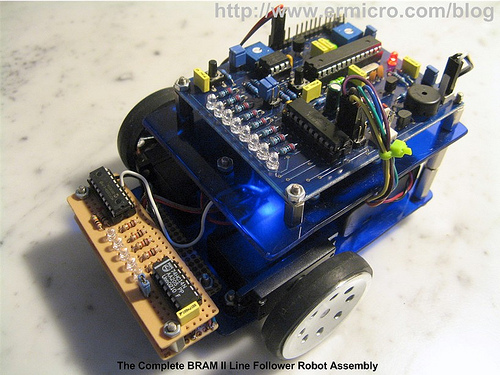
The advantages in building the microcontroller based Line Follower Robot (LFR) is we could take the advantage of microcontroller’s ALU (Arithmetic Logic Unit) to compute mathematics equation to perform the industrial standard Proportional, Integral and Derivative control or known as PID control. On this tutorial we will learn to build the LFR using the powerful Atmel AVR ATMega168 microcontroller and at the same time we will learn to utilize many of the AVR ATMega168 microcontroller sophisticated features to support our Line Follower Robot.
Now let’s check out all the exciting features of this Line Follower Robot that we are going to build:
- Fully implement the industrial standard Proportional, Integral and Derivative (PID) control with flexible PID tuning parameter using the AVR ATMega168 UART peripheral and store the parameter to the AVR ATMega168 microcontroller build-in 512 Bytes EEPROM
- Use five infra red reflective object sensor for the black line sensor with Microchip MCP23008 8-bit I2C (read as I square C) I/O expander chip to talk to the AVR ATMega168 Microcontroller I2C peripheral
- 4.5 Volt to 5 Volt DC to DC Step-Up using Maxim MAX756 for powering both the electronics circuits and the DC motors. This will ensure the electronics circuits and the DC motors keep working properly even though the battery voltage level drops below 4.5 Volt.
- Use the AVR ATMega168 ADC (Analog to Digital Converter) peripheral to control the maximum speed of the robot.
- Use the AVR ATMega168 PWM (Pulse Width Modulation) peripheral to drive the SGS-Thomson L293D chip to control the DC motors speed
BRAM II Chassis Construction
The first version of BRAM (Beginner’s Robot Autonomous Mobile), used CD/DVD for the chassis; in this version of BRAM, I use the acrylic as the base for the chassis; which is easy to shape, drill and it came with transparent look and many color to choose too. You could read more information about the first BRAM version on my previous posted blog Building BRAM your first Autonomous Mobile Robot Using Microchip PIC Microcontroller.
BRAM II construction material parts:
- Acrylic for the BRAM chassis
- Two geared DC motors with wheels rated 4.5 to 5 volt (25-30mA) with the wheel or you could use the modified servo motor (it’s a servo motor without the electronics’s control board)
- One 3 x 1.5 volt AA battery holder with on-off switch
- One plastic bead (usually it use for the neck less) and one paper clip for the caster
- Enough nuts, bolts and PCB (printed circuit board) standoff.
BRAM construction consists of two decks, where the lower deck is used to hold the battery, DC motors and the sensor circuit while the upper deck is used to hold the motor controller circuit and the AVRJazz Mega168 board.
Finally put the AVRJazz Mega168 board on top of the upper deck and connect all the connectors from the Motor Control Circuit and Sensor Circuit to the AVRJazz Mega168 board, now you are ready to program the robot.
BRAM II Electronic Circuit and Program
BRAM II use quite sophisticated power mechanism circuit as well as the line sensor circuit design to make it more robust line follower robot.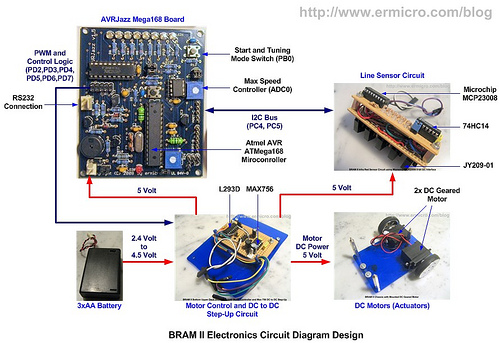
The 3xAA battery is the main power source for both the electronics circuits and the DC motors, because the Line Follower Robot need to accurately control the motor speed and tracking the line; therefore BRAM II design use DC to DC step-up circuit to boost 4.5 volt level up to the 5 volt level using the Maxim MAX756, you could read more about MAX756 in my previous posted blog Powering your Microcontroller’s Based Project. The advantages of using the power boost is all the electronics circuits and DC motors will guarantee to get proper voltage level even though the main power source theoretically drops down to 2 volt level; although I’ve never try this.
For more detail: Build Your Own Microcontroller Based PID Control Line Follower Robot (LFR) – Second Part
- Why use a microcontroller for the Line Follower Robot?
A microcontroller makes the robot more robust, reliable, and flexible compared to discrete electronics components. - How does the robot implement PID control?
It uses the microcontroller's ALU to compute Proportional, Integral, and Derivative equations with flexible tuning parameters stored in EEPROM. - What sensor configuration is used for line detection?
The design utilizes five infra red reflective object sensors connected via a Microchip MCP23008 8-bit I2C I/O expander. - How is the voltage stabilized for the electronics and motors?
A Maxim MAX756 DC to DC Step-Up circuit boosts the battery voltage from 4.5 volts to 5 volts. - Which chip controls the DC motor speed?
The SGS-Thomson L293D chip is driven by the AVR ATMega168 PWM peripheral to control motor speed. - What material is used for the BRAM II chassis?
Acrylic is used as the base because it is easy to shape, drill, and comes in various colors. - What are the two decks in the BRAM construction used for?
The lower deck holds the battery, DC motors, and sensor circuit, while the upper deck holds the motor controller and AVRJazz Mega168 board. - Can the PID parameters be adjusted during operation?
Yes, flexible PID tuning parameters can be set using the AVR ATMega168 UART peripheral and saved to the build-in EEPROM.
