
Summary of Binary Resistance Decade Box
I built a binary resistance decade box using two 8-channel DIP switches (binary powers of two) instead of rotary decimal switches. A DPDT toggle selects between an ohmmeter verification pair of binding posts and the in-circuit pair. A 25 ohm potentiometer provides fine tuning to compensate analog component tolerances. Switch positions represent values from 1 up to 32,768 ohms, allowing combinations from 0 to 65,535 ohms, arranged with the least significant bit at the right.
Parts used in the Binary Resistance Decade Box:
- Two 8-channel DIP switches
- DPDT toggle switch
- 25 ohm potentiometer
- Two sets of binding posts (ohmmeter and in-circuit)
- Resistors for each binary weight (values per power of two up to 32,768 ohms)
- Enclosure or project box
- Wiring and connectors
- PCB or perfboard for mounting components
I’ve been an electronics hobbyist for many years, so I’ve used and even built my share of resistance decade boxes. Each one consisted of rotary switches with labels identifying a different power of 10 for each switch. You “dialed up” the desired resistance by turning the appropriate knobs to add up to the target resistance value.
Well, I’m also a computer geek, so I got the crazy idea to build a decade box using DIP switches (instead of rotary switches) and binary values (instead of decimal values). Each switch represents a power of 2 and the resulting resistance equals the combined value of the “ON” switches.
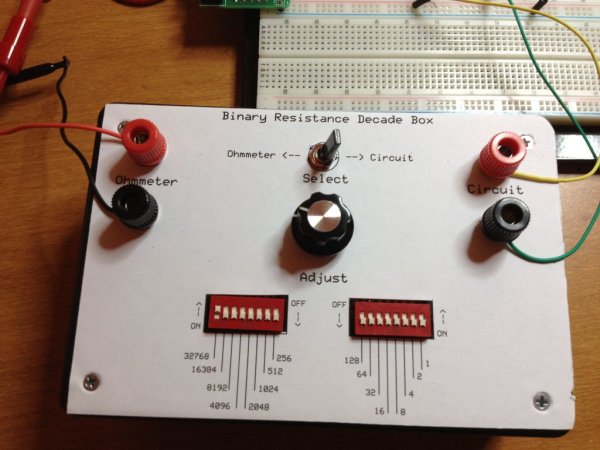
Since binary DIP switches are more difficult to read on site than rotary switches, I decided to include two sets of binding posts; one set to attach to an ohmmeter (to verify the selected resistance value) and one set to put the resistance in-circuit. A DPDT switch lets you toggle between them. Also, since the combined analog resistor values tend to vary from the perfect digital values you want, I added a 25 ohm POT for fine tuning.
This project uses two 8-channel DIP switches, which provide the following binary values: 1, 2, 4, 8, 16, 32, 64, 128, 256, 512, 1,024, 2,048, 4,096, 8,192, 16,384, and 32,768. With it, you can combine switches to create any value between 0 and 65,535 ohms.
As is customary with binary numbers, I started with with the least significant digit (lowest ohm value) on the rightmost switch and increased in power-of-two increments to the maximum value on the left.
For more detail: Binary Resistance Decade Box
- How does the binary decade box select resistance values?
Each DIP switch represents a power of two and selected ON switches sum to the resulting resistance value. - What resistance range does this design cover?
It covers any value between 0 and 65,535 ohms using two 8-channel DIP switches. - Why are there two sets of binding posts?
One set is for connecting an ohmmeter to verify the selected resistance and the other is for placing the resistance in-circuit. - How do you switch between the ohmmeter and in-circuit connections?
A DPDT toggle switch lets you toggle between the ohmmeter pair of binding posts and the in-circuit pair. - What is the purpose of the 25 ohm potentiometer?
The 25 ohm POT provides fine tuning to adjust for analog resistor value deviations from the ideal digital sums. - How are the binary switch positions arranged?
The least significant bit (lowest ohm value) is on the rightmost switch and values increase by powers of two toward the left. - Which binary values do the two 8-channel DIP switches provide?
They provide values 1, 2, 4, 8, 16, 32, 64, 128 on one switch and 256, 512, 1,024, 2,048, 4,096, 8,192, 16,384, and 32,768 across both, enabling sums up to 65,535 ohms.
