
Summary of What is LED
LEDs (Light Emitting Diodes) are electrical components that emit light when electricity passes through terminals. They offer advantages like high efficiency, long lifespan, small size, and durability compared to incandescent lamps. However, they have a higher initial cost and are sensitive to temperature and voltage. Common applications include lighting, displays, and marketing signs.
Parts used in the LED:
- LED Semiconductor Substrate / Filament
- LED Cathod Terminal
- LED Anode Terminal
- LED Epoxy encapsulation
What is LED:
LED is a combination of 3 letters, and is an abbreviation of “Light Emitting Diode”. Led is an electrical component which emits light when electricity is passed through its terminals. We can divide Simple LED in 4 major parts
1)LED Semiconductor Substrate / Filament
Top portion of the led which glows by passing electric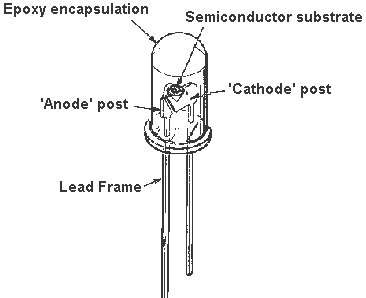 ity through its terminals
2)LED Cathod Terminal
Led Terminal which will be connected to – ive terminal of electricity
3)LED Anode Terminal
LED Terminal which will be connected to +ive terminal of the electricity.
4)LED Epoxy encapsulation
A protective cover, Which encloses LED Filament
LEDs emitting a non-visible light in the infra-red part of the radiation spectrum are also available. These LEDs are invaluable for use in detection applications when used in conjunction with infra-red detector components.
What are LED Features
Compared to incandescent lamps, LEDs offer a number of advantages including:
- Robust construction – there is no glass to shatter or filament to break.
- Modern LEDs are extremely efficient – they can emit light equal to a small incandescent lamp while consuming about 10 percent of the electrical power.
- High reliability – modern LEDs have life spans of 100,000 hours (over 11 years) of continuous use.
- Environmental – LEDs can withstand large shock and vibration far beyond that tolerated by incandescent lamps.
What is LED Advantages
- Efficiency: LEDs emit more light per watt than incandescent light bulbs.Their efficiency is not affected by shape and size, unlike fluorescent light bulbs or tubes.
- Color: LEDs can emit light of an intended color without using any color filters as traditional lighting methods need. This is more efficient and can lower initial costs.
- Size: LEDs can be very small (smaller than 2 mm2) and are easily populated onto printed circuit boards.
- On/Off time: LEDs light up very quickly. A typical red indicator LED will achieve full brightness in under a microsecond.LEDs used in communications devices can have even faster response times.
- Dimming: LEDs can very easily be dimmed either by pulse-width modulation or lowering the forward current.
- Cool light: In contrast to most light sources, LEDs radiate very little heat in the form of IR that can cause damage to sensitive objects or fabrics.
- Slow failure: LEDs mostly fail by dimming over time, rather than the abrupt failure of incandescent bulbs.
- Lifetime: LEDs can have a relatively long useful life. One report estimates 35,000 to 50,000 hours of useful life, though time to complete failure may be longer. Fluorescent tubes typically are rated at about 10,000 to 15,000 hours
What is LED Disadvantages
- High initial price: LEDs are currently more expensive, price per lumen, on an initial capital cost basis, than most conventional lighting technologies. As of 2010, the cost per thousand lumens (kilolumen) was about $18. The price is expected to reach $2/kilolumen by 2015.The additional expense partially stems from the relatively low lumen output and the drive circuitry and power supplies needed.
- Temperature dependence: LED performance largely depends on the ambient temperature of the operating environment. Over-driving an LED in high ambient temperatures may result in overheating the LED package, eventually leading to device failure. An adequate heat sink is needed to maintain long life. This is especially important in automotive, medical, and military uses where devices must operate over a wide range of temperatures, and need low failure rates.
- Voltage sensitivity: LEDs must be supplied with the voltage above the threshold and a current below the rating. This can involve series resistors or current-regulated power supplies
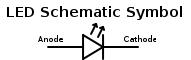
What is LED Schematic Symbol
What are applications of LED
LED is being used in variety of ways, for lightening to displaying pixels in TV/Monitors/LCD . LED Sign boards are widely being used for marketing purposes.
- What is an LED?
An abbreviation for Light Emitting Diode, it is an electrical component that emits light when electricity is passed through its terminals. - How many major parts does a simple LED have?
A simple LED is divided into 4 major parts: the semiconductor substrate, cathode terminal, anode terminal, and epoxy encapsulation. - Can LEDs withstand shock and vibration better than incandescent lamps?
Yes, LEDs can withstand large shock and vibration far beyond that tolerated by incandescent lamps due to their robust construction. - How quickly do LEDs light up?
LEDs light up very quickly, with a typical red indicator achieving full brightness in under a microsecond. - Do LEDs require color filters to emit specific colors?
No, LEDs can emit light of an intended color without using any color filters as traditional lighting methods need. - What happens if an LED is over-driven in high ambient temperatures?
Over-driving an LED in high ambient temperatures may result in overheating the package, eventually leading to device failure. - How should LEDs be supplied with power?
LEDs must be supplied with a voltage above the threshold and a current below the rating, often involving series resistors or current-regulated power supplies. - What are some common applications of LEDs?
LEDs are used for lighting, displaying pixels in TV/Monitors/LCD, and on sign boards for marketing purposes.
