
Summary of Speech Synthesis on Atmega128
Summary: This article explains implementing speech synthesis on a microcontroller (Atmega128). It outlines reasons to choose a microcontroller—cost, portability, fun, and relative ease—and gives a high-level workflow: store 8-bit sampled voice files in MCU memory, output via PWM/waveform channel through a low-pass filter to a speaker. It warns that audio consumes significant memory and suggests larger or external memory for longer phrases.
Parts used in the Speech Synthesis on Atmega128:
- Atmega128 microcontroller
- Low power speaker (8 ohm)
- Low pass filter tuned for 8 kHz band
- Display (optional, for debugging)
- Power supply for the microcontroller
I had this one project where the device was supposed to speak out the output. And I was too Lazy to actually go and build a PC based application and not that lazy to make it on a micro controller. So here is some of my research where i am gonna show you how to do speech synthesis for your Embedded Project.
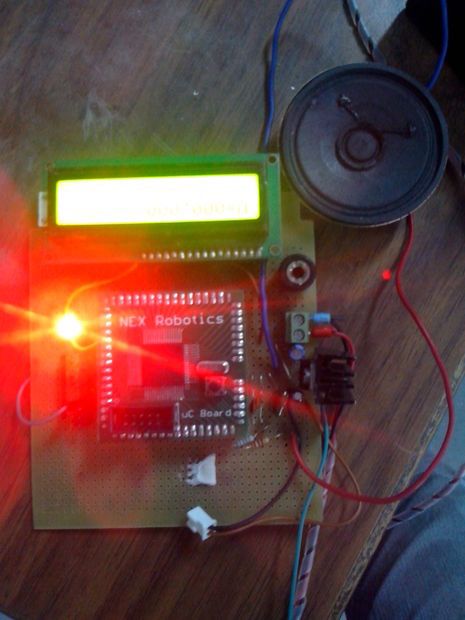
Why I am Implementing it on a Microcontroller?
- Its Cheap
- Its Portable
- Its Fun
- Its Easy ( Yes! Once you Port it on your platform, it is)
Step 1: Things you need to gather
-A Micro controller with PWM generation possible and lots of memory ( We are using Atmega128)
-A low power Speaker (8 Ohm one will match the impedence)
=A low pass filter adjusted on 8Khz Band.
-A display maybe, if you need it for debugging.
-Supply for your controller.
Step 2: Overview of its Working
here is one Warning before implementing this project. This will eat up lots of memory from your Micro controller so if you need larger syntax’s as speeches. Buy a micro controller with larger memories or interface external memories as even smaller words takes KB’s of memory
okay, now let me give you an overview of this. What we are gonna do here is we will take some Voice files, store into our Micro controllers and then put it out on a speaker. Simple right? well it is’nt took me days to implement this.
The audio files are sampled into 8bits of values and are Put out through a Waveform generation channle to a low pass filter which will give you a nice analog signal.
For more detail: Speech Synthesis on Atmega128
- Why implement speech synthesis on a microcontroller?
Because it is cheap, portable, fun, and relatively easy once ported to the platform. - What microcontroller is used in the project?
The Atmega128 is used in this project. - How are the audio files stored and output?
Voice files are sampled into 8-bit values, stored in the microcontroller, and output through a waveform generation channel to a low pass filter and speaker. - What audio sampling format is used?
Audio files are sampled as 8-bit values. - What output hardware is required to get analog audio?
A waveform/PWM output through a low pass filter into a low power speaker provides the analog audio. - What filter specification is recommended?
A low pass filter adjusted for an 8 kHz band is recommended. - Do you need a display for this project?
A display is optional and can be used for debugging. - What is a major limitation when implementing speech on a microcontroller?
Speech consumes lots of memory, so longer phrases require a microcontroller with larger memory or external memory.
