
Summary of How to interface serial ADC0831 with AVR microcontroller (ATmega16)
This article explains interfacing the serial ADC0831 with an ATmega16 microcontroller to achieve 8-bit analog-to-digital conversion. It contrasts serial ADCs with parallel alternatives, highlighting that while serial options reduce pin count, they offer lower data transfer speeds suitable for non-critical speed applications. The text details the ADC0831's eight pins, its support for single-ended or differential inputs, and its operation within a 0-5V range using a reference voltage setting.
Parts used in the Interfacing of Serial ADC0831 with ATmega16:
- ADC0831 (Serial ADC chip)
- ATmega16 (Microcontroller)
- Vin (+) (Positive Analog Input pin)
- Vin (-) (Negative Analog Input pin)
- CLK (Clock pin)
- DO (Data Output pin)
- Vref (Reference Voltage pin)
- Vcc (Power Supply pin)
- GND (Ground pin)
ADC is an electronics device that converts the analog signals to digital number proportional to the magnitude of voltage. The ADC chips like ADC0804, ADC0809 etc., give 8-bit digital output. The controller device needs eight pins to receive the 8-bit data (For more details about ADC refer to Using Inbuilt ADC of AVR). Some applications need higher resolution ADCs, (10 or higher bits digital data output) for data accuracy.
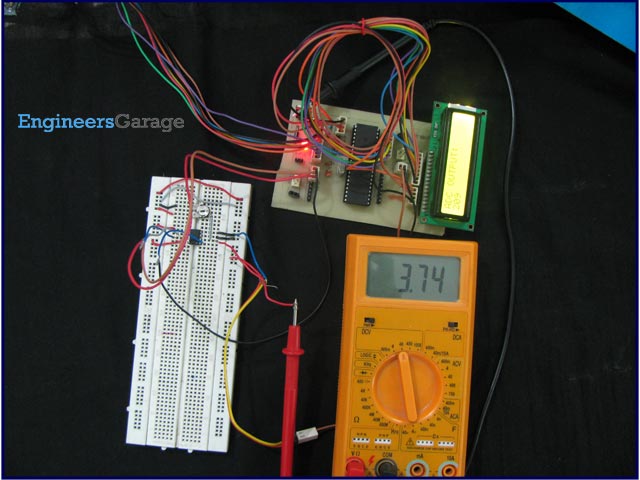
Using parallel ADCs is one option for such applications. However using parallel ADC will increase the size of the hardware as a 10-bit parallel ADC will have 10 output lines. Also you might have to use controller with higher number of pins. The other option is to use serial ADC, which needs smaller number of pins. Since the data is transmitted serially, the data transfer rate of the serial ADC is low as compared to parallel ADC. They can serve as a very good alternative in applications where speed of data transfer in not a critical point. This article explores interfacing of serial ADC0831 with ATmega16.
The ADC0831 is an 8 pin, single channel serial ADC which gives 8-bit data output. The input can be either single ended or differential type. Using the differential input option, A/D conversion can be performed for two different voltage levels. The function of each pin is described in the following table:
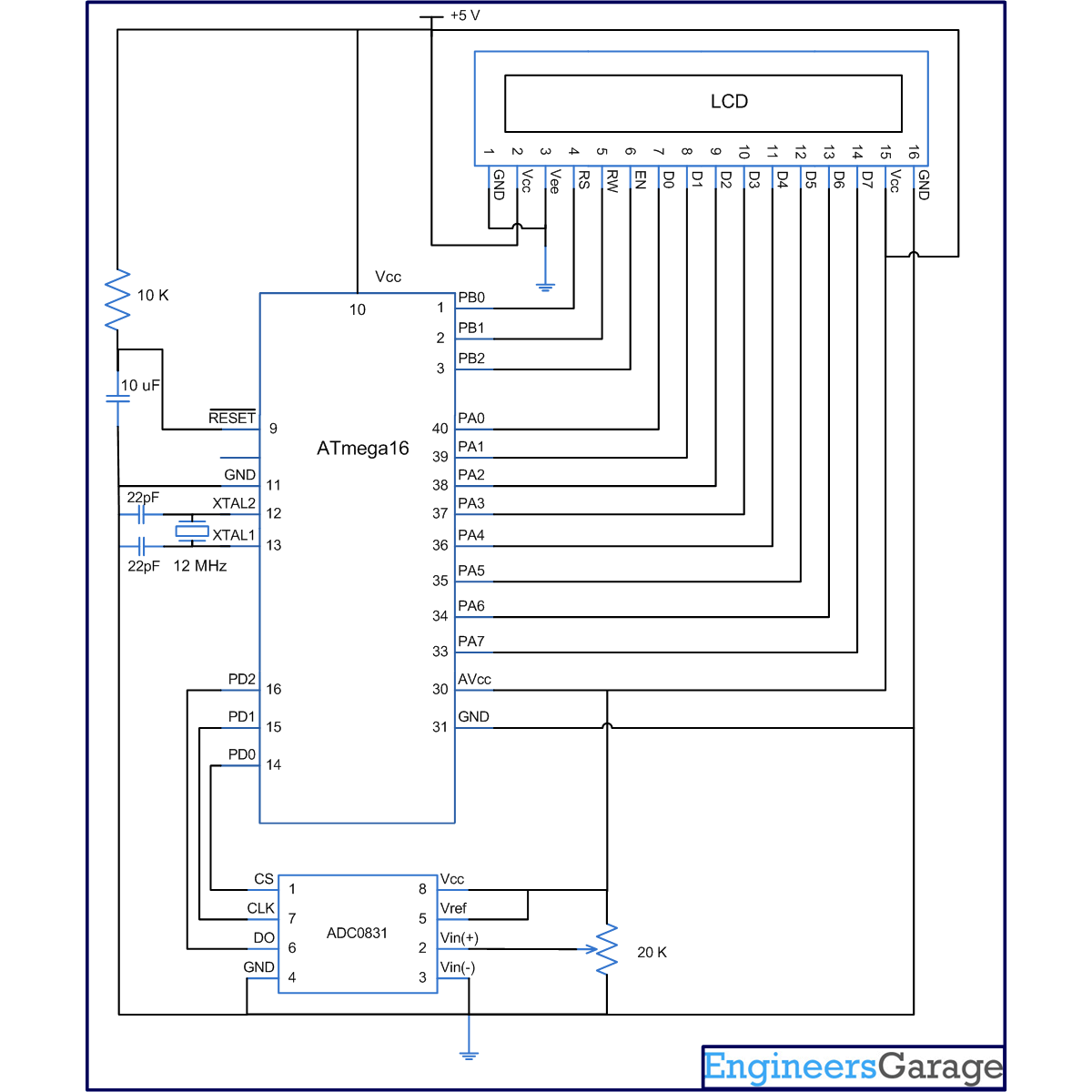
1. (Chip Select) – In order to initiate conversion a high-to-low is provided on.
2. Vin (+) (Positive Analog Input) – Positive voltage is applied at this pin. The input range for this is 0 to 5votls.
3. Vin (-) (Negative Analog input) – Negative voltage is applied at this pin.
4. GND (Ground) – This pin is connected to the ground of circuit.
5. Vref (Reference Voltage) – This pin is used to set the input voltage range of ADC.
6. CLK (Clock) – Clock pulse is provided on CLK pin for synchronization.
7. DO (Data Output) – This pin is an output pin of ADC, serial output data is available on this pin.
8. Vcc (Power Supply) – This is connected to +5 volt power supply.
For more detail: How to interface serial ADC0831 with AVR microcontroller (ATmega16)
- What type of digital output does the ADC0831 provide?
The ADC0831 gives an 8-bit data output. - How do you initiate a conversion on the ADC0831?
A high-to-low signal is provided on the Chip Select pin to initiate conversion. - What is the input voltage range for the Vin (+) pin?
The input range for the positive voltage pin is 0 to 5 volts. - Can the ADC0831 perform differential input conversions?
Yes, using the differential input option allows A/D conversion for two different voltage levels. - Which pin is used to set the input voltage range of the ADC?
The Vref pin is used to set the input voltage range of the ADC. - Why might a designer choose a serial ADC over a parallel ADC?
A serial ADC needs a smaller number of pins compared to a parallel ADC which increases hardware size. - Is the data transfer rate of a serial ADC faster than a parallel ADC?
No, the data transfer rate of the serial ADC is low as compared to a parallel ADC. - What is the function of the CLK pin on the ADC0831?
A clock pulse is provided on the CLK pin for synchronization. - How many pins does the ADC0831 chip have?
The ADC0831 is an 8 pin device. - What power supply voltage is connected to the Vcc pin?
The Vcc pin is connected to a +5 volt power supply.
