
Summary of Rad tolerant megaAVR MCU for space & avionics applications
The Atmel ATmegaS128 is a rad-tolerant microcontroller designed for space and avionics applications, offering 30 krad total ionising dose tolerance, latch-up immunity, and SEU resistance. It features a 64-lead ceramic package, full wafer lot traceability, and compatibility with the industrial ATmega128 ecosystem to reduce prototyping costs. The device supports motor control, sensor management, and data handling within a small footprint and low power profile.
Parts used in the ATmegaS128 Project:
- ATmegaS128 Microcontroller
- 64-lead Ceramic Package (CQFP)
- Atmel Studio Ecosystem
- STK600 Starter Kit and Development System
- Industrial Version of ATmega128 MCU
- Atmel Studio IDE
AtmegaS128 – the first µC Rad Tolerant device for Atmel – delivers full wafer lot traceability, 64-lead ceramic package (CQFP), space screening, space qualification according to QML and ESCC flow and total ionising dose up to 30 krad (300 Gy Si) for space applications. The ATMegaS128 is “latch up” immune thanks to a dedicated silicon process: SEL LET > 62.5Mev at 125°C, 8 MHz/3.3V. SEU to heavy ions is estimated to 10 -3 error/device/day for Low Earth Orbit applications.
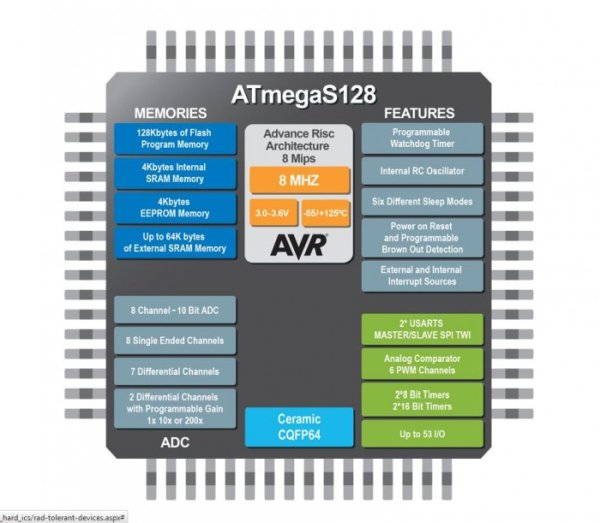
The space-grade AVR family continues to use the Atmel Studio ecosystem and allows aerospace developers to use the industrial-version of the ATmega AVR to prototype their applications for a fraction of the cost. The ATmegaS128 is available in a ceramic hermetic packaging and is pin-to-pin and drop-in compatible with existing ATmega128 MCUs, allowing flexibility between commercial and qualified devices, enabling faster-time-to-market and minimising development costs. With this cost-effective approach and a plastic Hirel-qualified version, the ATmegaS128 can be also considered in more general aerospace applications including class A and B avionic critical cases where radiation tolerance is also a key requirement.
Atmel adds, “By improving radiation performance with our proven Atmel AVR cores and ecosystem, the new ATmegaS128 provides developers targeting space applications a smaller footprint, lower power and full analogue integration such as motor and sensor control along with data handling functions for payload and platform. We look forward to putting more Atmel solutions into space.”
There is a a complete STK600 starter kit and development system for the ATmegaS128 AVR MCU giving designers a quick start to develop code on the AVR with advanced features for prototyping and testing new designs. Users can also start their designs with an industrial version of the ATmega128—with the exact pin-out of the ATmegaS128—to save costs. The new AVRs are supported by the Atmel Studio IDP for developing and debugging Atmel | SMART ARM processor-based MCUs and Atmel AVR MCU applications.
For more detail: Rad tolerant megaAVR MCU for space & avionics applications
- What is the total ionising dose tolerance of the ATmegaS128?
The device delivers a total ionising dose up to 30 krad (300 Gy Si). - How does the ATmegaS128 compare to existing ATmega128 MCUs in terms of compatibility?
The ATmegaS128 is pin-to-pin and drop-in compatible with existing ATmega128 MCUs. - Can developers use the industrial version of the ATmega AVR to prototype applications?
Yes, the space-grade family allows aerospace developers to use the industrial version to prototype for a fraction of the cost. - What packaging type does the ATmegaS128 use?
The device is available in a 64-lead ceramic package (CQFP) which is hermetic. - Does the ATmegaS128 offer protection against single event latching?
Yes, it is latch-up immune thanks to a dedicated silicon process with SEL LET greater than 62.5Mev at 125°C. - What development tools are supported for the ATmegaS128?
The new AVRs are supported by the Atmel Studio IDE for developing and debugging applications. - Is there a starter kit available for quick development on the ATmegaS128?
Yes, a complete STK600 starter kit and development system is available for designers. - What functions does the ATmegaS128 integrate for payload and platform?
It provides full analogue integration such as motor and sensor control along with data handling functions.
