
Summary of Lab: DC Motor Control Using an H-Bridge
This tutorial explains how to control a DC motor's direction using an H-bridge circuit, specifically the Texas Instruments L293NE or SN754410. It covers necessary prerequisites like understanding electronic components and Arduino digital input, setting up a breadboard with power connections, selecting a suitable low-voltage DC motor (5–15V), and safely testing the motor before integration.
Parts used in the DC Motor Direction Control Project:
- Texas Instruments L293NE H-bridge
- Texas Instruments SN754410 H-bridge
- Arduino module
- Breadboard
- DC motor (5–15V)
- Soldering leads
- Bench power supply
Introduction
Contents [show]
In this tutorial, you’ll learn how to control a DC motor’s direction using an H-bridge.
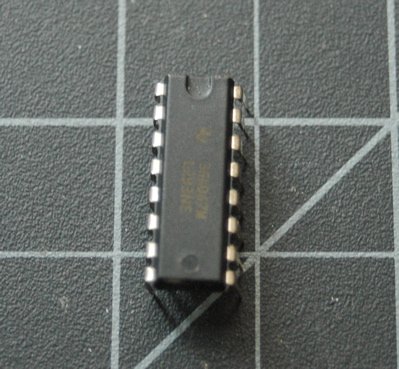
To reverse a DC motor, you need to be able to reverse the direction of the current in the motor. The easiest way to do this is using an H-bridge circuit. There are many different models and brands of H-Bridge. This tutorial uses one of the most basic, a Texas Instruments L293NE or a Texas Instruments SN754410.
If you simply want to turn a motor on and off, and don’t need to reverse it, for example if you’re controlling a fan, try the tutorial on controlling high current loads with transistors.
What You’ll Need to Know
To get the most out of this lab, you should be familiar with the following concepts. You can check how to do so in the links below:
- Electronic components
- Digital input with Arduino
- How to use transistors to control high current loads
- How to use transistors to control high current loads with Arduino
- Video: H-Bridges
Prepare the breadboard
Connect power and ground on the breadboard to power and ground from the microcontroller. On the Arduino module, use the 5V and any of the ground connections: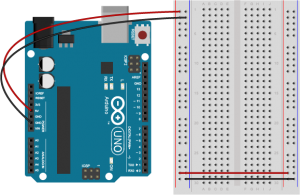
Find a motor
Find yourself a DC motor that runs on low DC voltage within the range of 5 – 15V. RadioShack often sells several small DC motors, the NYU Book Store on occasion has a few, the junk shelf is almost always a goldmine for discarded motors and fans. Asking classmates and second years is another good approach.
Solder leads to the motor’s terminals. With DC motors, there is no polarity regarding the motor terminals so you can connect it any way you’d like.
Optional: Consider testing your motor with a bench power supply from the equipment room. Ask a teacher or resident if you need help setting one up. Begin by adjusting the voltage on the bench power supply and observe its effects. Take note of its speed at different voltages without dipping to low or too high.
Safety Warning: Running a motor at a voltage much lower or much higher than what it’s rated for could potentially damage or permanently destroy your motor. When the motor doesn’t spin, the voltage is too low. When the motor runs hot, or sounds like it’s straining, the voltage is too high.
Set up the H-bridge
For more detail: Lab: DC Motor Control Using an H-Bridge
- How do I reverse a DC motor?
You must reverse the direction of the current in the motor using an H-bridge circuit. - Which H-bridge models are recommended for this project?
The tutorial recommends using the Texas Instruments L293NE or the Texas Instruments SN754410. - What voltage range should the DC motor operate within?
The motor should run on low DC voltage within the range of 5 to 15 volts. - Does polarity matter when connecting DC motor terminals?
No, there is no polarity regarding the motor terminals so you can connect it any way you like. - How can I tell if the voltage applied to the motor is too high?
If the motor runs hot or sounds like it is straining, the voltage is too high. - What happens if the voltage is too low for the motor?
When the voltage is too low, the motor will not spin. - Can I use transistors instead of an H-bridge if I only need to turn the motor on and off?
Yes, if you do not need to reverse the motor, you can try controlling high current loads with transistors. - Where can I find small DC motors for this project?
You can find them at RadioShack, the NYU Book Store, on junk shelves, or by asking classmates.
