
Summary of AVR Atmega dehumidifier controller board, update
This article details an updated AVR Atmega dehumidifier controller designed to resolve microcontroller crashes caused by Electromagnetic Interference (EMI) from the compressor and fan. Key improvements include insulating relays with metal tape, increasing their distance from the microcontroller, and implementing a watchdog reset. The project also introduces minimum on/off time logic to protect the compressor and replaces the DHT11/22 sensor with a more EMI-resistant AMT1001 analog sensor.
Parts used in theAVR Atmega dehumidifier controller:
- AVR Atmega microcontroller
- Relays
- Metal tape
- Watchdog control
- Compressor
- Fan
- AMT1001 sensor
This project is an update to the previous dehumidifier based you can here: http://davidegironi.blogspot.it/2013/04/avr-atmega-dehumidifier-controller.html
This update adds some usefull functions.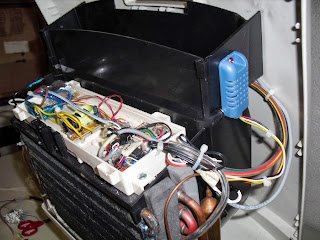
The main issue that i’ve fixed is the microcontroller crash, that happens sometimes. I’ve noticed that sometimes the controller stop running, crash or doesn’t works as expected.
After some experimets, i’ve noticed that probem was due to Electromagnetic Interference (EMI), EMI happens when the compressor and fan starts or stops.
I’ve solved this issues by:
- insulating relays with metal tape
- outdistance relays from the microcontroller
If you look at the image below you can see that relays are not distant from the microcontroller.
To build a more secure controller, i’ve added a watchdog control to reset the microcontroller if anything goes wrong.
Another improvement to the previous design is the additions of a minimum off/on time to prevent the compressor to be switched on and off in a short time. Some compressor may get broken if those timed function does not exists.
Finally i’ve switched the DHT11/22 sensor with an AMT1001 sensor. The AMT1001 sensor is less sensible to EMI, and it has analogic output.
Changelog
- 1.0.9: added offset calibration for humidity/temperature sensor
- 1.0.8: fix minimum on/off compressor time with antifrost temperature.
- 1.0.6: DHT switched to AMT1001, add watchdog, add minimum on/off compressor time.
- 1.0.4: DHT library update to prevent blocking.
- 1.0.3:first release.

For more detail: AVR Atmega dehumidifier controller board, update
- What was the main issue fixed in this update?
The microcontroller crash caused by Electromagnetic Interference when the compressor and fan start or stop. - How did the author solve the EMI problem?
By insulating relays with metal tape and outdistancing them from the microcontroller. - Does the new design include a mechanism to reset the controller if it fails?
Yes, a watchdog control was added to reset the microcontroller if anything goes wrong. - Why is a minimum off/on time function important for the compressor?
To prevent the compressor from being switched on and off in a short time, which could break it. - Which sensor replaced the DHT11/22 in this project?
The AMT1001 sensor was used as a replacement. - What are the advantages of using the AMT1001 sensor over the previous one?
The AMT1001 is less sensitive to EMI and has an analogic output. - Can users calibrate the humidity and temperature sensors?
Yes, offset calibration for the humidity and temperature sensor was added in version 1.0.9. - Did the software fix address blocking issues with the library?
Yes, the DHT library was updated in version 1.0.4 to prevent blocking.
