
Summary of Bionic Organs/Devices/Limbs Wireless Charging
This project proposes a wireless charging system for bionic devices to eliminate frequent battery replacement surgeries. The system utilizes an IDT Qi 5W Transmitter and Receiver Kit, controlled by an Atmel Atmega328p microcontroller and an HC-SR04 ultrasonic sensor. The sensor activates the transmitter only when a receiver coil is detected, preventing unnecessary power dissipation. This approach aims to enhance patient safety and device longevity in biomedical applications.
Parts used in the Bionic Devices Wireless Charging Project:
- IDT Qi 5W Transmitter Prototype Kit
- IDT Qi 5W Receiver Prototype Kit
- Atmel Atmega328p
- HC-SR04 Ultrasonic Sensor
| Hardware components: | ||||||
 |
|
× | 1 | |||
 |
|
× | 1 | |||
|
× | 1 | ||||
|
× | 1 | ||||
| Hand tools and fabrication machines: | ||||||
|
||||||
|
||||||
|
||||||
Story
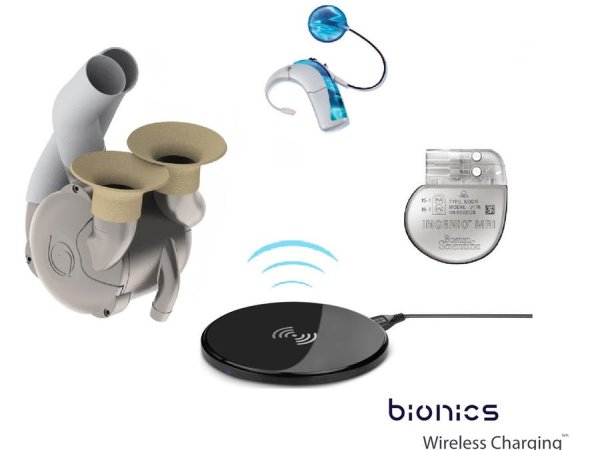 Bionic devices/organs has a limited lifetime where its battery needs to be replaced in order for it to function continually. The limited battery life causes the patient to be subjected to an operation every time the battery life comes to its end. This puts the patient in great danger and discomfort. To solve this problem, wireless charging becomes a very crucial asset. If wireless charging is integrated with bionic organs/devices, the only operation the patient would undergo is to only implant a bionic organ/device. In my opinion, I think that this could be a life saver for humans in the future of electronics to come.
IDT’s wireless Transmitter and the Receiver is a huge step forward for Electronics. It is small, compact and programmable. This provides the capability to custom build your own wireless power unit.
The wireless transmitter and receiver can be used in bio medical industry to take a huge leap forward. Using IDT’s wireless power platform, bionic devices no longer needs to have batteries that needs to be running for years.
The bionic device can be charged wireless, performance can be monitored, and how much remaining charge it has. Not only IDT’s wireless power a great product, but it can also be used as a lifesaver!
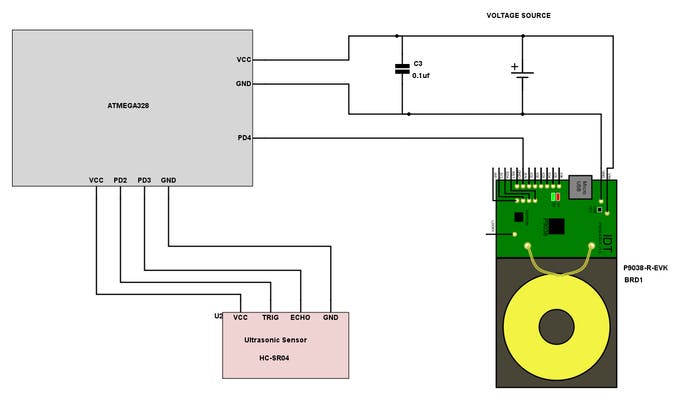
In this Project, it is focused on wireless charging of bionic devices inside human beings. Transmitter is controlled by an ATmega328 Micro-controller with an ultrasonic proximity sensor. Proximity sensor is used to activate transmitter only when the Receiver coil is present over the transmitter. This is done to save unnecessary power dissipation in the transmitter coil.
The Transmitter block diagram from Schemeit is shown below:
http://www.digikey.com/schemeit/#2sxs
For more detail: Bionic Organs/Devices/Limbs Wireless Charging
- How does the system prevent unnecessary power dissipation?
The ultrasonic proximity sensor activates the transmitter only when the receiver coil is present over the transmitter. - What problem does this project solve for patients?
It solves the issue of limited battery life requiring dangerous and uncomfortable operations for battery replacement. - Which microcontroller controls the wireless transmitter?
The ATmega328 microcontroller controls the transmitter block. - Can the performance of the bionic device be monitored?
Yes, the system allows for performance monitoring and checking the remaining charge. - Why are IDT's wireless components considered suitable for this project?
They are small, compact, programmable, and allow for custom building of wireless power units. - What tool was used to create the transmitter block diagram?
Schemeit was used to design the transmitter block diagram. - Does the receiver need to be replaced frequently?
No, the wireless charging capability means the device can be charged without removing or replacing the battery. - What industry benefits significantly from this technology?
The biomedical industry takes a huge leap forward with this wireless power platform.
