
Summary of LIN Protocol — One Wire Protocol for Automotive Applications
LIN is a low-cost, single-wire automotive network protocol for non-critical subsystems, using a single master and multiple slaves. The master sends a header (break, sync 0x55, and identifier) to synchronize slaves and request frames. LIN supports various frame types (unconditional, event-triggered, sporadic, diagnostic, user-defined), software- or hardware-based UART implementations, self-synchronization without crystal resonators, deterministic timing, and speeds up to 20 kbit/s. Specialized transceivers like the Melexis MLX80030 provide level shifting, voltage regulation, and protection for automotive 12 V environments.
Parts used in the LIN Project:
- Microcontroller nodes
- LIN master node
- LIN slave nodes
- UART/SCI interface hardware (or equivalent)
- LIN transceiver (e.g., Melexis MLX80030)
- Level shifter
- Low drop voltage regulator
- Protection components for automotive 12 V spikes
With the host of protocols available in electronics interfaces, choosing a protocol is a hard job. Some protocols are designed for long distance and reliable communication applications such as RS-485. Others are used for low cost and short range communication such as I2C, and so on.
The backbone car’s network is the Controller Area Network (CAN). CAN is reliable and adopted widely in automotive industry but it’s expensive to embed CAN interface in all aspects of the car’s sub-system. As a cheap alternative, today’s protocol LIN, is designed for low cost and multi-nodes automotive networks. LIN can be used to communicate with non-critical sub-systems such as: door-lock driver and window motors. Moreover, LIN is implemented to be a one wire interface.
LIN stands for Local Interconnect Network. According to the official LIN manual, the main properties of the LIN bus are:
- single master with multiple slaves concept.
- low cost silicon implementation based on common UART/SCI interface hardware, an equivalent in software, or as pure state machine.
- self synchronization without a quartz or ceramics resonator in the slave nodes.
- deterministic signal transmission with signal propagation time computable in advance low cost single-wire implementation.
- speed up to 20 kbit/s.
- signal based application interaction.
The LIN topology consists of one master and several slaves. The master provides the header which consists of a break and sync pattern (0x55) followed by an identifier.
The 0x55 Synch byte helps the slaves to be synchronized with the master clock. All messages are initiated by the master with unique ID; A slave will reply according to a given message identifier.
The identifier specifies the frame type which can be one of the following:
- Unconditional frame
- Event triggered frame
- Sporadic frame
- Diagnostic frames
- User-defined frames
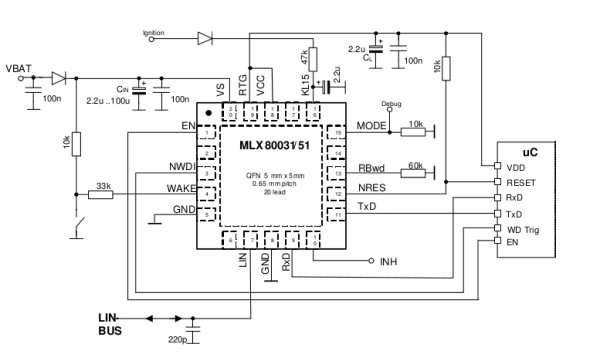
The nodes are typically microcontrollers, but as LIN is designed for automotive applications in the first place, some specialized transceivers can be added to the nodes such as Melexis MLX80030 which is basically a level shifter with some add-ons like low drop voltage regulator with some protection features since the available supply voltage in cars are mostly a spiky 12v.
Read more: LIN Protocol — One Wire Protocol for Automotive Applications
- What does LIN stand for?
LIN stands for Local Interconnect Network. - How many masters and slaves does LIN use?
LIN uses a single master with multiple slaves. - How are slaves synchronized with the master?
Slaves synchronize using the master header that includes a break and a sync byte 0x55. - What is the maximum speed of LIN?
LIN supports speeds up to 20 kbit/s. - What frame types does LIN support?
LIN supports unconditional, event-triggered, sporadic, diagnostic, and user-defined frames. - Can LIN be implemented without a crystal resonator in slaves?
Yes, LIN supports self synchronization without a quartz or ceramic resonator in slave nodes. - What hardware can be used for LIN interface implementation?
LIN can be implemented using common UART/SCI interface hardware, an equivalent in software, or as a pure state machine. - Why are specialized transceivers like Melexis MLX80030 used?
Specialized transceivers provide level shifting, low drop voltage regulation, and protection for the spiky 12 V automotive supply.
