
Summary of Pyboard D Series MicroPython Board Features STM32F7 MCU, WiFi and Bluetooth
The Pyboard D-series is a MicroPython-enabled board featuring an STM32F7 Cortex-M7 MCU with 512KB RAM and 2MB Flash. It includes built-in WiFi, Bluetooth, external Flash chips, and a micro SD slot for storage. The board supports programming via command line, USB mass storage, or WebREPL over WiFi. It offers extensive expansion through GPIO headers and unique WBUS connectors designed to stack add-on boards like DIP28 or DIP68 for additional I/O capabilities.
Parts used in the Pyboard D-series:
- STM32F7xx Arm Cortex M7 microcontroller
- Micro SD card slot
- 2x external flash chips
- WiFi & Bluetooth module
- On-board antenna
- u.FL antenna connector
- Micro USB port
- 2.54mm pitch through holes (16x GPIOs)
- 1.27mm pitch castellated and through holes (32x GPIOs)
- 2x 40-pin WBUS connectors
- User button
- Reset button
- RGB LED
- Clock
Pyboard D-series (aka Pyboard D, or just PyBD) board was introduced during the Micropython presentation at FOSDEM 2019 and it’s build around a faster STM32F7 Cortex-M7 MCU, with 512Kb of RAM, and 2Mb of Flash, as well as built-in WiFi and Bluetooth connectivity. It also features a pair of external Flash chips and a micro SD card slot for additional expansion options.
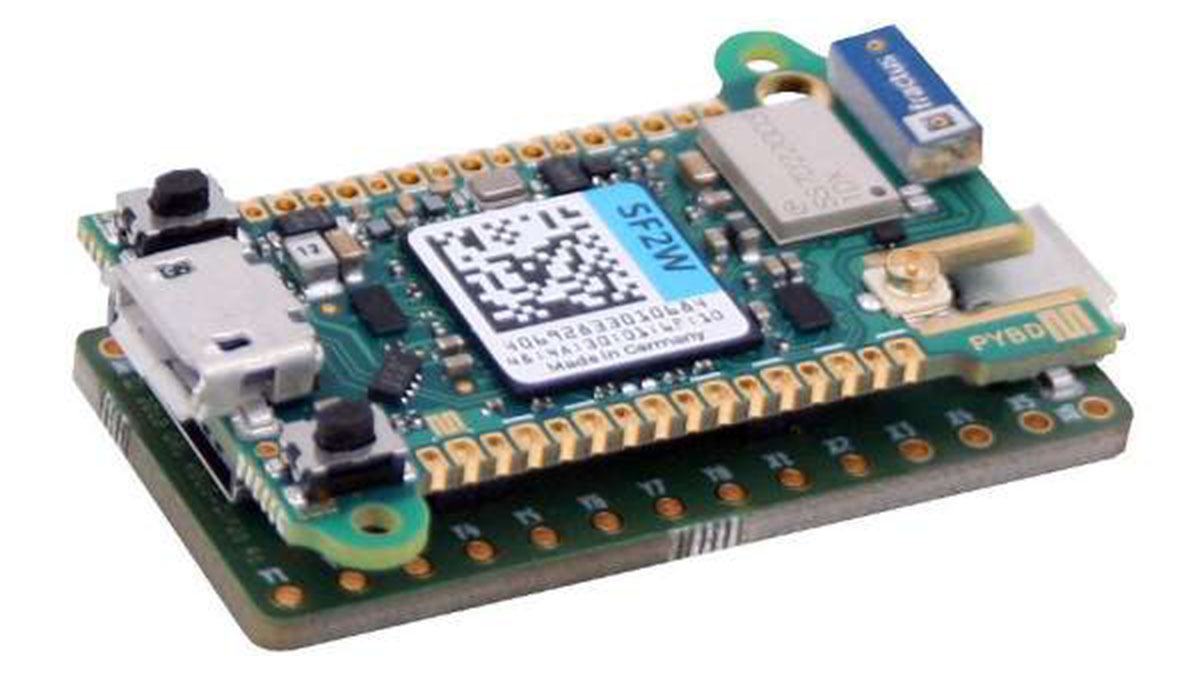
The board can be programmed with MicroPython either from the command line. Copying the Python file to the board (seen as a USB flash drive from your computer), or via WiFi using WebREPL terminal client.
If you are not sure, what MicroPython is, continue reading. MicroPython is a lightweight version of Python 3 optimized to run on microcontrollers, which is described as a ByteCode + virtual machine + file system compiler for the BareMetal OS implemented on the microcontroller.
Pyboard D preliminary specifications:
- MCU – STMicro STM32F7xx Arm Cortex M7 microcontroller at 216 MHz with 512KB RAM, 2MB flash
- Storage – micro SD card slot, and 2x external flash chips
- Connectivity – WiFi & Bluetooth with on-board antenna and u.FL antenna connector
- USB – 1x micro USB port for power, flash disk access, and USB to serial debugging/programming
- Expansion
- 2.54mm pitch through holes for 16x GPIOs
- 1.27mm pitch castellated and through holes for 32x GPIOs
- 2x 40-pin WBUS connectors for a total of 59 GPIOs
- Misc – User and reset buttons, RGB LED, clock
- Dimensions – TBD
The WBUS connectors are also a new feature and will allow you to stack add-ons boards. For example the WBUS DIP28 or DIP68 boards are exposing respectively 28 and 68 I/O pins, and they can take one or more sensor board(s) via other smaller 2x 10-pin sensor board connectors.
Read more: Pyboard D Series MicroPython Board Features STM32F7 MCU, WiFi and Bluetooth
- How can the Pyboard D be programmed?
You can program it using MicroPython from the command line, by copying Python files to the board as a USB flash drive, or via WiFi using the WebREPL terminal client. - What is MicroPython?
MicroPython is a lightweight version of Python 3 optimized for microcontrollers, described as a ByteCode plus virtual machine plus file system compiler for the BareMetal OS. - Does the Pyboard D have wireless connectivity?
Yes, it features built-in WiFi and Bluetooth connectivity with an on-board antenna and a u.FL antenna connector. - What are the storage options available on the board?
The board includes a micro SD card slot and two external flash chips for additional storage expansion. - How many GPIOs are available through the standard headers?
The board provides 16 GPIOs via 2.54mm pitch through holes and 32 GPIOs via 1.27mm pitch castellated and through holes. - What is the purpose of the WBUS connectors?
The WBUS connectors allow you to stack add-on boards and expose a total of 59 GPIOs when combined with sensor boards. - Can I connect multiple sensor boards to the Pyboard D?
Yes, sensor boards can be connected via smaller 2x 10-pin sensor board connectors attached to the WBUS add-ons. - What microcontroller is used in the Pyboard D?
It uses an STMicro STM32F7xx Arm Cortex M7 microcontroller running at 216 MHz. - Is there a way to debug the board via USB?
Yes, the single micro USB port supports USB to serial debugging and programming in addition to power and flash disk access.
