
Summary of Sine wave oscillator using LM741
This article introduces sine wave oscillators, which convert DC to AC signals for applications like transmitters, receivers, and signal generators. It categorizes them by components (RC vs. LC) and frequency (AF, LF, RF). The text specifically details the construction of two RC-based oscillators: the RC phase shift oscillator and the Wien bridge oscillator, both utilizing an op-amp for audio or radio frequencies.
Parts used in the Sine Wave Oscillator Project:
- CRO or DSO
- Dual power supply (+15 V & -15 V)
- Connecting wires
- CRO probes
- Bread board
- LM741 IC
- Resistors – 1 K, 47 KΩ (pot), 1.2 KΩ, 10 KΩ, 22 KΩ
- Capacitors – 0.1 µF
The oscillators are the devices that generate oscillatory (AC) output from given DC input. There are different kinds of oscillators based on the output waveform they generate. Like
- Sinusoidal oscillators – they generate sinusoidal (sine) wave output
- Square wave oscillators – they generate square (or rectangular) wave output
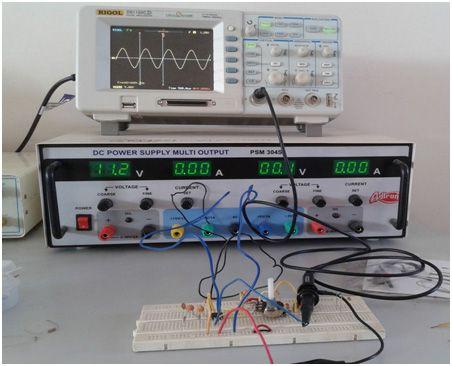
- Triangular wave oscillators – they generate triangle or sawtooth wave output
- The most widely used oscillators are sine wave oscillators. Such oscillators are used in
- Transmitters – to generate carrier signal for transmission
- Receivers – to generate local carrier signal to extract IF (intermediate frequency) from mixer
- Modulators – to generate carrier for information signal and generate modulated wave
- RADAR and SONAR – to generate signal that will be transmitted and received back
- RF (Radio Frequency) or AF (Audio Frequency) signal generators
Thus we may list out number of such applications where sine wave oscillators are used. In addition I would say the signal communication is impossible without oscillators.
There are different kinds of Sine wave oscillators based on the components used or based on the output frequency that they generate.
- Based on components means if they produce oscillation using resistors (R) and capacitors (C) then they are called RC oscillators and if they use inductor (L) and capacitor (C) then they are termed as LC oscillators.
- Based on output frequency means if they generate frequency in audio range (20 Hz – 20 KHz) then they are Audio Frequency (AF) oscillators. If they generate frequency in low range (100 – 200 KHz) then they are called Low Frequency (LF) oscillators and last, if they generate frequency in high range (in MHz or GHz) then they are termed as High frequency (HF) or Radio Frequency (RF) oscillators.
I am presenting here two such sine-wave oscillators that uses RC components to generate oscillations and they can generate frequency in AF range as well as RF range. The two oscillators are
- RC phase shift oscillator
- Wien bridge oscillator
Both are built using op-amp and it is very easy to build them on bread board or on general PCB with few additional components. So let us first gather the required components, instruments and apparatus.
Instruments required:
- CRO or DSO
- Dual power supply (+15 V & -15 V)
Apparatus required:
- Connecting wires
- CRO probes
- Bread board
Components required:
- LM741 IC
- Resistors – 1 K, 47 KΩ (pot), 1.2 KΩ, 10 KΩ, 22 KΩ
- Capacitors – 0.1 µF
Let us first start with RC phase shift oscillator
RC Phase shift oscillator:
RC oscillator is build using an amplifier and a RC network in feedback. For any oscillator the two prime requirements to generate sustained and constant oscillations are.
Fore more detail: Sine wave oscillator using LM741
- What are the two prime requirements to generate sustained and constant oscillations?
The article states that an amplifier and a feedback network are required but does not explicitly list the two specific conditions beyond mentioning they exist. - How can sine wave oscillators be categorized based on components?
They are categorized as RC oscillators if they use resistors and capacitors, or LC oscillators if they use inductors and capacitors. - What frequency ranges define Audio Frequency oscillators?
Audio Frequency oscillators generate frequencies in the range of 20 Hz to 20 KHz. - Can these oscillators be built on a breadboard?
Yes, both the RC phase shift and Wien bridge oscillators are easy to build on a breadboard or general PCB with few additional components. - What instruments are required to test these circuits?
The required instruments are a CRO or DSO and a dual power supply providing +15 V and -15 V. - Which specific IC is recommended for building these sine wave oscillators?
The LM741 IC is the component required to build the described sine wave oscillators. - What are some common applications of sine wave oscillators?
Applications include transmitters, receivers, modulators, RADAR, SONAR, and RF or AF signal generators.
