
Summary of PICOSCOPE 4-CHANNEL 16GHZ SAMPLER-EXTENDED REAL-TIME OSCILLOSCOPES
The PicoScope 9404-16 SXRTO is a 16GHz sampler-extended real-time oscilloscope offering high-speed performance at a lower cost than traditional benchtop solutions. It features four 12-bit channels with up to 5TS/s equivalent-time sampling, enabling precise analysis of repetitive signals, clock performance, and eye diagrams up to 11Gb/s. The device supports both ETS and real-time modes, captures 250,000 samples per channel, and operates via USB with PicoSample 4 software on Windows PCs.
Parts used in the PicoScope 9404-16 SXRTO:
- PicoScope 9404-16 SXRTO instrument
- Four high-resolution 12-bit channels
- USB connection interface
- PicoSample 4 software
- Windows PC display
The PicoScope 9404-16 brings very high-speed performance at less than half the cost of other traditional benchtop solutions with four high-resolution 12-bit channels driven by up to 5TS/s (0.2ps) equivalent-time sampling
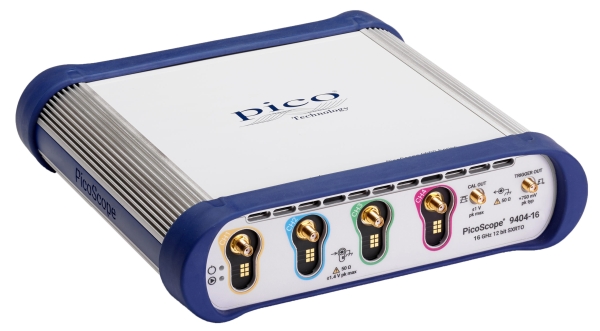
Saelig Company, Inc. has introduced the PicoScope 9404-16 SXRTO, a 16GHz sampler-extended real-time oscilloscope which extends the range of a preceding 5GHz model. Designed to analyze repetitive or clock-derived signals, it features four high-resolution 12-bit channels driven by up to 5TS/s (0.2ps) equivalent-time sampling (ETS). The wide-band inputs can accurately measure transitions as fast as 22ps, pulses down to 45ps wide, and permits clock performance and eye diagram analysis of up to 11Gb/s gigabit signals (to third harmonic). In addition, the real-time broadband sampling modes can support analysis for other common RF signals such as wireless frequencies of 900MHz, 2.4 and 5.5GHz and upwards. Pico’s SXRTO instrument architecture reduces the cost of broadband time-domain sampling for repetitive signal or clock-related applications.
In contrast to “sampling oscilloscopes”, the ETS technique supports trigger and pre-trigger capture and the familiarity, convenience and ease of real-time oscilloscope operation. Pico’s SXRTO technology seamlessly transitions to single-event, real-time waveform capture at sampling rates at and below 500MS/s. Both sampling modes capture to memory of 250,000 samples (single channel). This is particularly valuable for the capture of slower system signals, modulation envelopes, and repeating pulse or data patterns, for example.
This USB-controlled PicoScope 9404-16 is supplied with PicoSample 4 software. A free touch-compatible GUI controls the instrument and presents waveforms, measurements and statistics on an attached PC display. There is full support for available Windows display resolutions, allowing the inspection of waveform detail or presentation of measurements, for example on 4k monitors or projection, or across multiple monitors.
Read more: PICOSCOPE 4-CHANNEL 16GHZ SAMPLER-EXTENDED REAL-TIME OSCILLOSCOPES
- What is the maximum sampling rate of the PicoScope 9404-16?
The instrument is driven by up to 5TS/s (0.2ps) equivalent-time sampling. - Can this oscilloscope analyze gigabit signals?
Yes, it permits clock performance and eye diagram analysis of up to 11Gb/s gigabit signals. - How many samples can be captured per channel?
Both sampling modes capture to memory of 250,000 samples for a single channel. - Does the device support real-time waveform capture?
Yes, the technology seamlessly transitions to single-event, real-time waveform capture at rates at and below 500MS/s. - What software controls the PicoScope 9404-16?
The instrument is supplied with PicoSample 4 software which includes a free touch-compatible GUI. - Is the oscilloscope compatible with 4k monitors?
There is full support for available Windows display resolutions, including inspection on 4k monitors or projection. - What types of RF signals can be analyzed?
It supports analysis for wireless frequencies such as 900MHz, 2.4GHz, 5.5GHz, and upwards. - How fast are the transitions this device can measure?
The wide-band inputs can accurately measure transitions as fast as 22ps.
