
Summary of ACCONEER’S LOW-POWER XM132/XE132 ENTRY RADAR MODULE WITH A SOLDERABLE DESIGN FEATURES
Acconeer's XM132 is a low-power, solderable radar module featuring a land grid array for PCB connection. It integrates the A111 pulsed coherent radar with an STM32G071CBU6 MCU and supports 1.8V to 3.6V operation. Designed for evaluation and commercial integration, it functions standalone via RSS API or with external hosts using UART, I2C, or GPIO interfaces. The XE132 evaluation board facilitates quick setup with USB support and pin-header access.
Parts used in the XM132 Entry Module Project:
- XN132 entry module
- A111 pulsed coherent radar
- STM32G071CBU6 32-bit 64 MHz Arm Cortex M0+ MCU
- XE132 evaluation board
- Radar System Software (RSS)
- Software Development Kit (SDK)
Acconeer’s Low-power radar module with a solderable design features a land grid array for connection to a host PCB
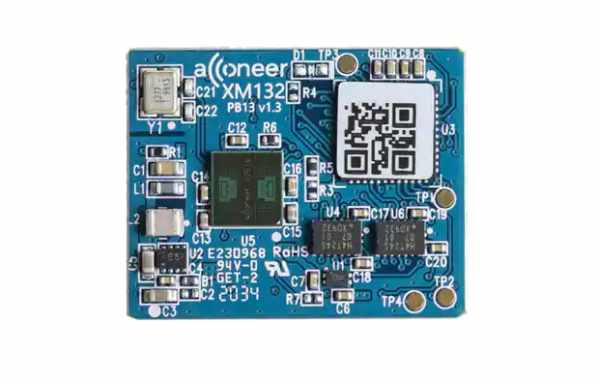
Acconeer’s XM132 entry module is a low-power radar module with a solderable design featuring a land grid array for connection to a host PCB. This entry module integrates the A111 pulsed coherent radar with a 32-bit 64 MHz Arm® Cortex® M0+ MCU, the STM32G071CBU6 from STMicroelectronics with 128 KB of Flash memory and 36 KB of RAM. The module supports a single supply operating voltage range from 1.8 V to 3.6 V.
The XM132 entry module is an integration-ready module intended to be used for evaluation and development purposes as well as for integration into commercial products. With software adapted for specific use cases, cost and time-to-market are streamlined.
The XM132 can be used as a stand-alone module where customers can embed their application on top of the Acconeer RSS (radar system software) using the RSS API (application programming interface). It can also be used with an external host controller where communication to the module is via a register command protocol using one of the following interfaces: UART, I2C, and GPIO. The Acconeer RSS including a software development kit (SDK) for stand-alone usage is available for download to the XM132 via the Acconeer web page. An exploration tool that helps visualize the radar measurement results can also be downloaded.
To quickly get the XM132 up and running, use the evaluation board XE132, which has the XM132 entry module soldered to it. The XE132 has support for UART communication over USB, which enables a straight-forward way to flash and debug the module, as well as easy access to all interfaces from the XM132 module via pin-headers.
Read more: ACCONEER’S LOW-POWER XM132/XE132 ENTRY RADAR MODULE WITH A SOLDERABLE DESIGN FEATURES
- What components are integrated into the XM132 module?
The module integrates the A111 pulsed coherent radar with an STM32G071CBU6 MCU featuring 128 KB Flash and 36 KB RAM. - How can the XM132 communicate with an external host controller?
It communicates via register command protocol using UART, I2C, or GPIO interfaces. - What voltage range does the XM132 support?
The module supports a single supply operating voltage range from 1.8 V to 3.6 V. - Is there an evaluation board available for the XM132?
Yes, the XE132 evaluation board has the XM132 module soldered to it. - Can the XM132 be used as a stand-alone module?
Yes, customers can embed their application on top of the Acconeer RSS using the RSS API. - How do you flash and debug the XM132 module quickly?
You use the XE132 evaluation board which supports UART communication over USB. - Where can the Radar System Software and SDK be downloaded?
The software is available for download via the Acconeer web page. - Does the article mention a tool for visualizing radar measurements?
Yes, an exploration tool that helps visualize radar measurement results can be downloaded.
