
Summary of SEEED STUDIO’S WIO RP2040 MINI DEVELOPMENT BOARD FEATURING ONBOARD WIFI
The Wio RP2040 Mini is a compact development board by Seeed Studio featuring the Raspberry Pi RP2040 SoC and onboard WiFi. It offers a cost-effective alternative to the Arduino Nano RP2040 Connect for Wi-Fi-only projects, costing half as much. The board includes a dual-core Cortex M0+ processor, 2MB QSPI Flash, USB-C connectivity, and supports IEEE802.11 b/g/n in both Access Point and Station modes.
Parts used in the Wio RP2040 Mini Development Board:
- Raspberry Pi RP2040 SoC
- Seeed Studio WiFi Module
- Dual Cortex M0+ Processors
- 264 KB Embedded SRAM
- 2MB QSPI Flash Memory
- USB-C Connector
- 20x Multifunctional GPIO Pins
- Boot Button
- Reset (RUN) Button
- VIN Header Pins
Yet another development board featuring Raspberry Pi’s RP2040 SoC with WiFi capabilities. The Wio RP2040 Mini Development board by Seeed Studio comes in a smaller form factor for compact wireless applications. The powerful RP2040 SoC by Raspberry Pi and Seeed’s Studio’s WiFi module bring out the best of both worlds.
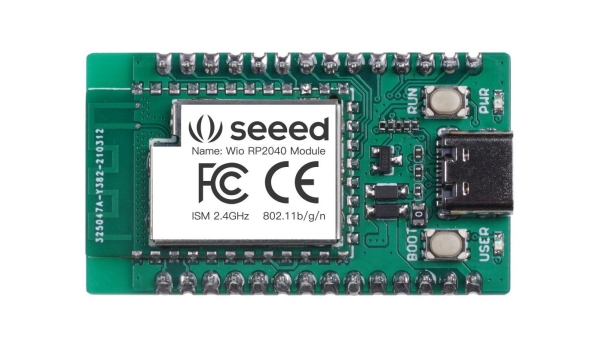
We recently saw the Arduino Nano RP2040 Connect board offering WiFi and Bluetooth functionality along with various onboard sensors. It also comes with a u-blox NINA-W102 radio module compatible with Arduino Cloud. Hence, this justifies the high cost of the board as it can support a wide range of applications. But if you want your applications to limit to only WiFI functionalities then Seeed Studio’s Wio RP2040 Mini Development Board would be a reasonable choice for you. As it costs half the price of Arduino’s RP2040 Connect Board.
Technical Specifications Of Wio RP2040 Mini Development Board
- RP2040 microcontroller featuring dual Cortex M0+ processors working up to 133 MHz along with 264 KB of embedded SRAM in 6 banks.
- QSPI Flash Memory of 2MB.
- On-board USB-C Connector for programming with USB 1.1 Host/Device functionality.
- 20x multifunctional GPIO Pins for basic input-output functions.
- 2.4GHz wireless connectivity supporting IEEE802.11 b/g/n along with the Ap & Station mode.
- Onboard buttons like Boot and Reset(RUN).
- Two power supply methods; 5V via USB-C port and VIN(5V~3.6V) and GND header pins.
Talking more about the WiFi functionality, it supports the frequency range from 2.4~2.4835 GHz. This connectivity supports IEEE802.11 b/g/n standards. The board can act as both Access Point as well as Station. The board creates a WiFi zone when it is in Access Point mode and it acts as a client device and connects to the WiFi network in Station mode.
Seeed Studio explains “ Wio RP2040 mini development board has rich interfaces, including 28 GPIO PINs (19 PINs support PIO and PWM), 2 UART, 4 ADC, 2 SPI, 2 I2C. Some pins can be multiplexed, such as GP12 and GP13 with I2C, SPI, UART functions. That’s why 28 GPIO PINs can achieve more I/O PINs and interfaces.
Read more: SEEED STUDIO’S WIO RP2040 MINI DEVELOPMENT BOARD FEATURING ONBOARD WIFI
- What is the primary advantage of the Wio RP2040 Mini over the Arduino Nano RP2040 Connect?
The Wio RP2040 Mini costs half the price of the Arduino Nano RP2040 Connect and is designed specifically for applications limited to Wi-Fi functionality. - Does the Wio RP2040 Mini support Bluetooth connectivity?
The article states the board supports only Wi-Fi functionalities and does not mention Bluetooth capabilities like the Arduino Nano RP2040 Connect. - How fast do the processors on the RP2040 microcontroller work?
The dual Cortex M0+ processors work up to 133 MHz. - Can the board operate in both Access Point and Station modes?
Yes, the board supports IEEE802.11 b/g/n standards and can act as both an Access Point and a client device in Station mode. - What is the frequency range supported by the onboard WiFi module?
The connectivity supports a frequency range from 2.4 GHz to 2.4835 GHz. - How many GPIO pins are available on the Wio RP2040 Mini?
The board features 20 multifunctional GPIO pins, though Seeed Studio notes rich interfaces including 28 GPIO PINs with multiplexing capabilities. - What power supply methods does the board support?
The board supports 5V via the USB-C port and VIN headers ranging from 3.6V to 5V. - Does the board include memory for program storage?
Yes, it includes 2MB of QSPI Flash Memory.
