
Summary of NEW ENERGY HARVESTING SYSTEM WILL POWER WEARABLES USING HEAT GENERATED BY YOUR SKIN
This article discusses a new flexible thermoelectric generator (TEG) developed by Chinese researchers to power wearables using body heat. Unlike rigid traditional TEGs, this device utilizes p-type Sb2Te3-based and n-type Mg3Bi2-based materials embedded in a porous polyurethane matrix with flexible printed circuit board electrodes. It operates passively without moving parts, offering high performance while maintaining flexibility. The system demonstrated significant power density on human skin and survived 10,000 bending cycles without performance loss, addressing key limitations of size, cost, and battery life in current wearable technology.
Parts used in the Flexible Thermoelectric Generator:
- p-type Sb2Te3-based materials
- n-type Mg3Bi2-based materials
- Porous polyurethane matrix
- Flexible printed circuit board electrodes
- Thermoelectric generators
While several advancements in battery technology, thanks to increased research in the field, have driven up the potential and range of applications for wearables, there are some application areas of wearables that are still being hindered by power, with issues ranging from the size of batteries, to cost, and other issues around battery life and charging. Several efforts are ongoing to power wearables from energy harvested from several human activities from walking (using Piezos and motion-based systems) to talking(converting sound energy), the latest, however, seeks to power wearables using a by-product of the human body system, body heat.
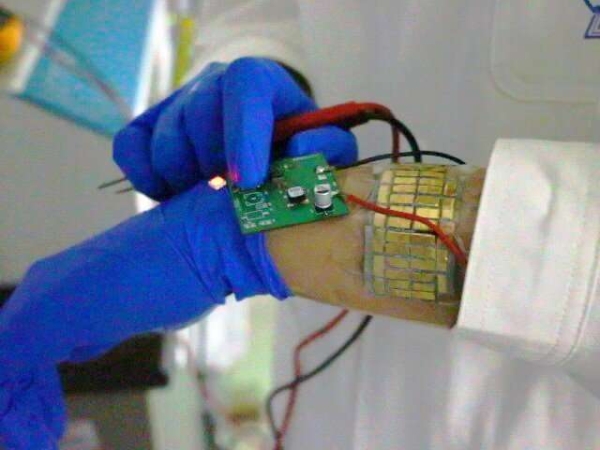
A product of work done by researchers in China, the device, leverages the ability of thermoelectric generators (TEGs) to produce electricity using heat gradients. Unlike most modes of electricity generation, TEGs do not require ingredients like working fluids, and moving parts, neither does it require the movement, positioning, etc., required by other forms of energy harvesting solutions. It is passive in its operations and this makes it great for applications that require a quiet, reliable, and portable power source.
For the researchers, while the potentials of TEGs was clear, a major challenge they had was making TEGs in a way that makes them useful for wearables, as traditional TEGs are rigid and rigidity doesn’t exactly fit most of the wearable applications that the device could potentially support. While flexible TEGs exist, they tradeoff different features like coverage area, and energy generation capacity for flexibility.
To solve this, the team designed and fabricate a reliable and high-performance flexible TEG that was made from p-type Sb2Te3-based, and n-type Mg3Bi2-based materials with porous polyurethane (PU) matrix and flexible printed circuit board (FPCB) electrodes. The obtained flexible TEGs after development demonstrated a peak power density of 20.6 μW/cm2 on a human arm at an ambient temperature of 289 K (air velocity, 1.1 m/s) and a peak power density of 13.8 mW/cm2 at a temperature difference of 50 K. Showing a good balance between performance and flexibility, the system withstood 10,000 bending cycles at a bend radius of 13.4 mm with no major drop in output performance.
Read more: NEW ENERGY HARVESTING SYSTEM WILL POWER WEARABLES USING HEAT GENERATED BY YOUR SKIN
- How does the new device generate electricity?
The device leverages thermoelectric generators to produce electricity using heat gradients from body heat. - Can this technology be used for quiet applications?
Yes, because it is passive in its operations, it is suitable for applications requiring a quiet power source. - What problem did researchers face with traditional TEGs?
Traditional TEGs are rigid, which does not fit most wearable applications that require flexibility. - Does the flexible TEG have moving parts?
No, unlike other modes of electricity generation, these TEGs do not require moving parts or working fluids. - What was the peak power density on a human arm?
The flexible TEGs demonstrated a peak power density of 20.6 μW/cm² on a human arm at an ambient temperature of 289 K. - How many bending cycles can the system withstand?
The system withstood 10,000 bending cycles at a bend radius of 13.4 mm with no major drop in output performance. - What materials were used to create the flexible TEG?
The team used p-type Sb2Te3-based and n-type Mg3Bi2-based materials with a porous polyurethane matrix.
