
Summary of The ATmega1280: An Advanced 8-Bit Microcontroller
The ATmega1280 is an 8-bit AVR RISC microcontroller (up to 16 MHz) with 128KB Flash, 4KB SRAM, and 512B EEPROM. It offers 54 digital I/O (14 PWM), 8-channel 10-bit ADC, multiple communication interfaces (USART, SPI, TWI), versatile timers/counters (four 8-bit, two 16-bit), low-power modes, and 1.8–5.5V operation. Packaged in 100-pin TQFP/QFN, it suits automotive, industrial, home appliance, robotics, audio/video, and medical applications requiring high I/O, precise timing, and energy efficiency.
Parts used in the ATmega1280 Project:
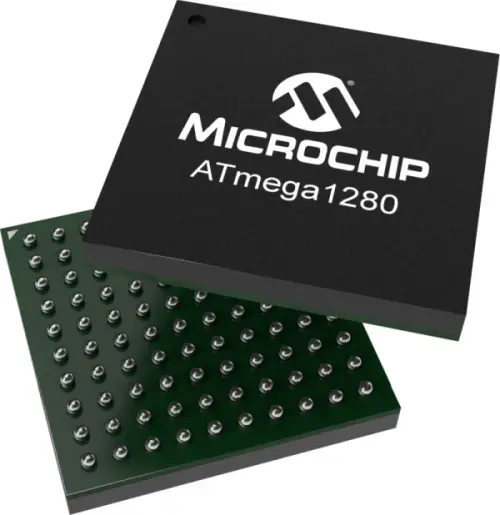
- ATmega1280 microcontroller (100-pin TQFP or 100-ball QFN)
- Power supply (1.8V to 5.5V input)
- Crystal or oscillator (internal/external oscillator options)
- Decoupling capacitors for VCC and AVCC
- Reset circuitry (reset pin, pull-up resistor)
- Programming header or ISP connector
- USART-compatible serial interface components (RS-232/RS-422/RS-485 transceivers as needed)
- SPI peripheral devices (LCDs, sensors, external flash)
- Analog sensors for ADC inputs
- PWM-driven actuators or motor drivers
- External watchdog or supervisory circuit (optional)
- PCB with routing for 54 digital I/O and power/ground planes
Introduction
The ATmega1280 is an 8-bit microcontroller developed by Microchip Technology very efficiently. Being one of the most complex models in the ATmega series, it provides a good basis for making various embedded systems. So, in this discussion, I will feature its main characteristics and technical specifications and also present some case studies of its application.
Processing Power and Memory
Priding the ATmega1280 is the 8-bit AVR RISC-based microprocessor at its heart. The AVR processor makes up to 16 MHz and there is more than enough raw computing prowess when it comes to many of the embedded applications. It has 32 general-purpose working registers, allowing for maximum parallelism in processing instructions. This results in very efficient code without the need for many complex instructions. AC coupled with the processor is 128KB In-System Programmable Flash for program code and data storage; 4KB SRAM for high-speed temporary storage of variables and 512 bytes EEPROM for non-volatile parameters and configuration. The combination of processing power and memory makes the ATmega1280 capable of running fairly complex embedded programs.
Analog and Digital I/O
An important characteristic of any microcontroller is its inputs/outputs to communicate with the world outside it. The ATmega1280 does not disappoint in this area offering fifty-four digital I/O pins that users can program as input or output devices. This high pin count allows for maximum design flexibility. Of these pins, 14 can be configured as PWM outputs for generating modulated signals. In addition, the ATmega1280 includes 16 channels of 10-bit ADC for analog signal sampling across 8 input pins. This enables it to directly interface with a wide variety of analog sensors. There are also comparator and temperature sensor modules on-chip. All of these I/O options make the ATmega1280 well-equipped to take input from and control most types of peripherals and devices.
Communications Interfaces
Modern embedded applications increasingly require microcontrollers to be networked together and connected to PCs or mobile devices. The ATmega1280 offers several popular communication interfaces that fulfill these needs. Firstly, it integrates a full-duplex software USART which enables the implementation of standard asynchronous serial communication like RS-232, RS-422, and RS-485. Two such USARTs are available. There is also a hardware SPI port for high-speed synchronous serial communication commonly used with devices like LCDs or other peripherals. Lastly, the microcontroller integrates a 10-bit resolution quadrature encoder input that is useful for reading rotation or motion. With these diverse communications peripherals, the ATmega1280 can interface with a huge range of external devices and networks.
Power Management Features
For battery-powered or energy-harvesting embedded systems, low-power operation is crucial. The ATmega1280 was designed with several features that minimize energy usage. Firstly, when the microcontroller is idle it can be put into one of three sleep modes using software where power consumption is drastically reduced. An on-chip voltage regulator also allows operation from as low as 1.8V up to 5.5V input voltage, reducing energy wasted as heat. Dynamic Adaptive Scaling further optimizes power versus clock speed. Beyond this, power-reducing measures like separate power and clock domains for peripherals help maximize battery life on portable ATmega1280 designs. These management techniques make it suitable for portable, energy-efficient embedded applications.
Versatile Timers and Counters
Any microcontroller needs the ability to precisely generate and measure timing intervals. The ATmega1280 delivers best-in-class timer/counter options to fulfill these needs. It includes four 8-bit Timer/Counters that can be independently configured as general timers, input capture units, or output compare modules. There is a dedicated 16-bit Timer/Counter with input capture that extends the resolution range. A watchdog timer safeguards the software in case of failures. Two dedicated 16-bit PWM channels are provided for encoder or waveform generation tasks. This comprehensive set of flexible timer blocks gives designers extensive control over timing in their applications.
Block Diagram and Pinout
To better understand the ATmega1280’s architecture and features at a high level, let us examine its block diagram:
In summary, the diagram shows the AVR CPU at the center connected to both program flash memory and internal SRAM. The digital I/O ports and various peripherals interface with the CPU through a shared bus architecture. Analog signals are routed through the ADC or comparators.
Looking at the microcontroller’s physical pinout gives insight into how its logical blocks are mapped to physical pins:
[A diagram of the ATmega1280 pinout is included showing the allocation of the 54 general-purpose I/O pins, VCC, GND, and pin functions for communications interfaces, analog inputs, and power management pins.]
We can see the distribution of I/O, analog, and special function pins across the 100-pin TQFP and 100-pin QFN packages. This packaging and pinout enable easy interfacing of the ATmega1280 to outside circuitry and systems.
Real-World Applications of the ATmega1280
Given its robust set of features, the ATmega1280 has been used across a wide range of embedded applications. Here are a few notable examples:
Automotive –
Because of the competitive environment in which electrical and electronic appliances have to operate in a car, the high reliability and temperate stability of the ATmega1280 ensure that it can be used in under-bonnet applications such as the engine control unit, instrument cluster, anti-locking break system and so on. Its real-time control abilities handle time-critical control functions.
Industrial Automation –
PLCs, factory automation controllers, motor drivers, and industrial networking equipment – These industrial applications benefit from the ATmega1280’s precision timing capabilities and rugged design. Its distributed I/O is well-suited for modular, scalable machine control architectures too.
Home Appliances –
Washing machines, refrigerators, and air conditioners – The microcontroller’s analog and PWM features effortlessly interface with motor controls, sensors, and HMI panels in various home appliances. Its low-power modes are optimized for portable equipment as well.
Robotics –
For tasks like sensor processing, motor control, and navigation in autonomous robots, the ATmega1280 handles real-time control demands very well with a high I/O count. Its on-chip peripherals integrate functionality while keeping the design compact.
Audio/Video –
Set-top boxes, media streamers, security cameras – Applications requiring audio/video encoding and streaming put the ATmega1280’s CPU and communications interfaces to good use. Integrated ADCs support microphone and camera inputs directly on the chip.
Medical Equipment –
This small chip is at the heart of most patient monitoring devices, active surgical instruments, accurate sensing, timing, and safety-critical functions requiring fail-safes in healthcare.
As we can see, the versatility of the ATmega1280 makes it applicable to a diverse range of embedded domains spanning industrial, consumer, automotive, and medical equipment. Its unique mix of processing power, peripherals, and low-power design has endured its popularity for decades.
Specifications Summary
To conclude this commentary on the impressive ATmega1280 microcontroller, here is a quick summary of its key specs:
- CPU: 8-bit AVR RISC at 0-16MHz clock speed
- Flash Program Memory: 128KB
- SRAM: 4KB
- EEPROM: 512B
- Digital I/O Pins: 54 pins configurable as inputs/outputs
- Analog Inputs: 8-channel 10-bit ADC
- USA RT/Hardware SPI: Two each
- Timer/Counters: Four 8-bit + two 16-bit including INPUT/OUTPUT capture
- Oscillators: Internal/external oscillator options
- Communication Interfaces: SPI, TWI, UART
- PWM Channels: Two 16-bit
- Power Supply: 1.8-5.5V operating range
- Low Power Modes: Various sleep modes down to the pA range
- Operating Temperature: -40°C to +85°C
- Packaging: 100-pin TQFP/QFN
In summing up, the features that include the complete combination of features, easy reliability, and relatively low cost, have made the ATmega1280 arguably the most highly employed microcontroller ever sold in the market. It is still popular in numerous embedded applications this century.
FAQ
Q: How much Flash memory does it provide?
A: 128KB
Q: What type of analog inputs are available?
A: 8 channels of 10-bit single-ended inputs served by an ADC
Q: How many timers/counters are integrated?
A: Four 8-bit timers plus two 16-bit timers/counters
Q: What packaging options does it offer?
A: 100-pin TQFP or 100-ball QFN surface mount packages
- How much Flash memory does the ATmega1280 provide?
The ATmega1280 provides 128KB of in-system programmable Flash program memory. - What are the analog input capabilities of the ATmega1280?
It has 8 analog input pins served by a 10-bit ADC with 16 channels for sampling. - How many digital I/O pins are available and how many support PWM?
There are 54 digital I/O pins total, of which 14 can be configured as PWM outputs. - What communication interfaces does the ATmega1280 include?
It includes two USARTs for serial communication, a hardware SPI port, and TWI (I2C) support. - What timer and counter resources does the ATmega1280 offer?
It offers four 8-bit Timer/Counters and two 16-bit Timer/Counters, plus input capture, output compare, and a watchdog timer. - What is the operating voltage range for the ATmega1280?
The device operates from 1.8V up to 5.5V input voltage. - Does the ATmega1280 support low-power sleep modes?
Yes. It supports multiple sleep modes to reduce power consumption when idle. - What package options are available for the ATmega1280?
The ATmega1280 is available in 100-pin TQFP and 100-pin QFN packages. - What are common application areas for the ATmega1280?
Common applications include automotive, industrial automation, home appliances, robotics, audio/video devices, and medical equipment. - What memory types are included on the ATmega1280?
It includes 128KB Flash, 4KB SRAM, and 512 bytes of EEPROM.
