
Summary of wifi microcontroller
Wi-Fi interfacing enables microcontrollers to exchange data wirelessly over IEEE 802.11 networks. High-speed microcontrollers with ample RAM and ROM (e.g., Microchip PIC18F452 family, Atmel ATmega/Xmega) are preferred for Wi‑Fi modules. The RN-XV (Roving Networks) is a turnkey Wi‑Fi module based on RN-171, offering 802.11b/g radio, a 32-bit processor, 16-bit microcontroller, TCP/IP stack, RTC, crypto accelerator, power management, and analog sensor interface. It supports infrastructure and ad-hoc modes, industrial temperature ranges, and suits sensor networks, controllers, utility meters, and M2M applications.
Parts used in the Wifi Interfacing with microcontroller:
- Microcontroller (high speed with sufficient RAM and ROM)
- Microchip PIC18F452 or PIC18F family microcontrollers
- Atmel ATmega and Xmega AVR microcontrollers
- RN-XV Wi‑Fi module (Roving Networks)
- RN-171 based 802.11 b/g radio
- 32-bit processor (on RN-XV)
- 16-bit microcontroller (on RN-XV)
- TCP/IP stack (integrated in RN-XV)
- Real-time clock (RTC) (on RN-XV)
- Crypto accelerator (on RN-XV)
- Power management unit (on RN-XV)
- Analog sensor interface (on RN-XV)
wifi Interfacing with microcontroller:
Wifi is a popular technology that allows an electronic device to exchange data wirelessly (using radio waves) over a computer network, including high-speed Internet connections. The Wi-Fi Alliance defines Wi-Fi as any “wireless local area network (WLAN) products that are based on (IEEE) 802.11 standards”. However, since most modern WLANs are based on these standards, the term “Wi-Fi” is used in general English as a synonym for “WLAN” Wifi Microcontroller term refers to the use of wifi interface for communcation with other devices.

Microcontroller going to interface with Wifi Module needs to be high speed with high data storage capacity. Both Ram and Rom. There are variety of 3rd Generation microcontrollers in different brand to meet this requirement for example in Microchip microcontrollers Pic18f452 and 18f family and in Atmel there is a variety of ATmega and Xmega avr microcontrollers which can be used with wifi module.
RN-XV Wifi Module for Microcontrollers
The RN-XV module is roving networks a certified Wi-Fi solution especially designed for customer who want to migrate their existing 80.15.4 architecture to a standard TCP/IP based platform without having to redesign their existing hardware.
The RN-XV module is based upon Roving Networks’ robust RN-171 Wi-Fi module and incorporates 802.11 b/g radio, 32 bit processor,16 bit microcontrollers, TCP/IP stack, real-time clock, crypto accelerator, power management unit and analog sensor interface.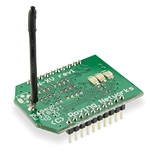
The RN-XV module supports infrastructure networking for worldwide internet access directly by every node and adhoc connectivity for fully connected point to point networks, unlike many 802.15.4 implementations that need extensive, custom application profiles and additional bridging products. The RN-XV supports industrial temperature ranges, making it ideal for applications such as sensor networks, industrial or commercial controllers, utility meters, and M2M applications.Click Download Datasheet for RN-XV Wifi Module for Microcontroller
- What is Wi-Fi interfacing with a microcontroller?
It refers to using a Wi-Fi interface to enable a microcontroller to communicate wirelessly with other devices over IEEE 802.11 networks. - What microcontroller features are important for Wi-Fi interfacing?
High speed and ample data storage capacity in both RAM and ROM are important. - Which microcontrollers are mentioned as suitable for Wi-Fi modules?
Microchip PIC18F452 and other PIC18F family members, and Atmel ATmega and Xmega AVR microcontrollers are mentioned. - What is the RN-XV Wi-Fi module?
The RN-XV is a Roving Networks certified Wi-Fi solution based on the RN-171 module, designed to migrate 802.15.4 architectures to TCP/IP without redesigning hardware. - What wireless standards does the RN-XV support?
It incorporates 802.11 b/g radio. - What integrated features does the RN-XV include?
It includes a 32-bit processor, a 16-bit microcontroller, TCP/IP stack, real-time clock, crypto accelerator, power management unit, and analog sensor interface. - Does the RN-XV support different networking modes?
Yes, it supports infrastructure networking for internet access and ad-hoc connectivity for point-to-point networks. - Is the RN-XV suitable for industrial applications?
Yes, it supports industrial temperature ranges, making it suitable for sensor networks, industrial controllers, utility meters, and M2M applications.
