
Summary of ATTiny Board For AVR ATTiny microcontrollers
With this small ISP board you can program many AVR ATTiny microcontrollers or use it as a standalone 5V development platform powered by a 9V battery or wall adapter. It includes a 5V regulator (up to 1000 mA), DIP8 and DIP20 sockets (ZIF-friendly), an AVR 10-pin ISP connector, and two 10-pin headers exposing PORTB, PORTD, and 5V. Programming via STK500 or a parallel-port ISP cable (with IC-Prog 1.05C or BASCOM-AVR) is supported. Several example projects are provided, including LED blink and LCD-based applications.
Parts used in the ATTiny Board For AVR ATTiny microcontrollers:
- Board PCB with mounting for components
- 5V voltage regulator (1000 mA rated)
- Power jack for wall adapter
- Battery connector for 9V battery
- AVR 10-pin standard ISP connector
- Textool ZIF socket footprint (space for ZIF socket)
- DIP8 socket (or footprint) for ATTiny DIP8 devices
- DIP20 socket (or footprint) for ATTiny DIP20 devices
- Two 10-pin headers exposing PORTB, PORTD, and 5V
- Supporting traces, connectors, and passive components for power and signals
Description
With this small board you can program most of the AVR ATTiny microcontrollers or you can build your projects to use it in a stand alone application. It can be powered with a 9V battery because it has 5V voltage regulator on it. The voltage regulator can give 1000mA current. The power to the board can also be supplied with a wall wart. Low power external devices like a LCD module can be powered via the board itself.
The board supports programming of:
| DIP8 Tiny | DIP20 Tiny | DIP20 obsolete |
|---|---|---|
|
|
|
Hardware
The board contains the AVR 10 pin standard ISP connector with which you can program the device on the board. On the board itself there is space enough to place a textool ZIF-socket so you can insert the device into the socket, program it and easily take it out again. The board contain two different sockets for the DIP8 and DIP20 ATTiny microcontrollers.
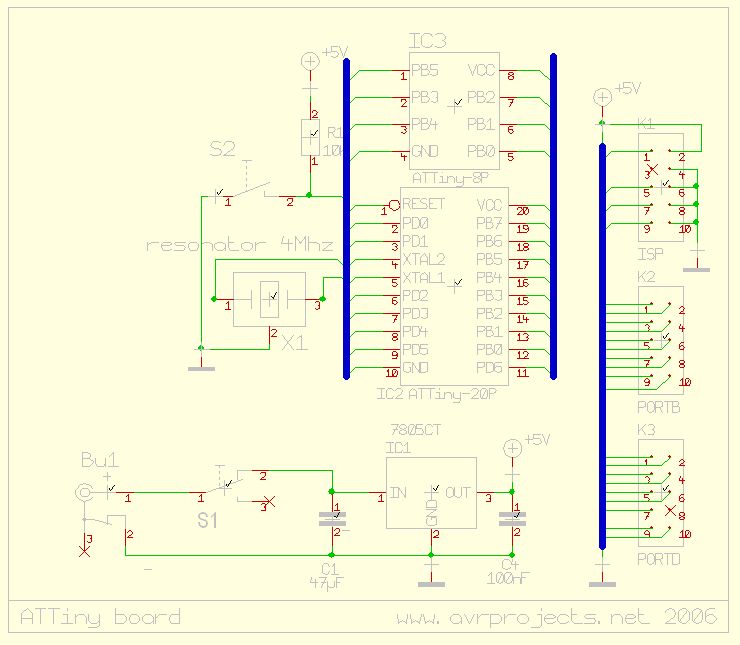
Programming of the device in one of the sockets can be done when the board is connected to the STK500 or with an ISP programming cable connected to the parallel port of your PC, in that case you need the software IC-Prog 1.05C or BASCOM-AVR to program your device.
Here you can learn how to use the software and and how to program your ATTiny device.
The ports B and D of the ATTiny2313 are connected to the outside world via two 10pin headers. The 5V power supply is also available on the 10pin headers.
Software
There are several projects on this site that you can try and use with the ISP-board:
For more details, click: ATTiny Board For AVR ATTiny microcontrollers
- What ATTiny devices does the board support?
The board supports ATTiny12, ATTiny13, ATTiny15, ATTiny25, ATTiny28, ATTiny45, ATTiny85, ATTiny2313, AT90S1200, and AT90S2313. - Can the board be powered by a 9V battery?
Yes, the board can be powered with a 9V battery using its onboard 5V regulator. - What is the current rating of the voltage regulator?
The onboard 5V voltage regulator can provide up to 1000 mA. - How do you program a device on the board?
Devices can be programmed via the AVR 10-pin ISP connector using an STK500 or an ISP cable to the PC parallel port with IC-Prog 1.05C or BASCOM-AVR. - Does the board provide headers for external connections?
Yes, ports B and D of the ATTiny2313 and the 5V power supply are available on two 10-pin headers. - Is there space for a ZIF socket on the board?
Yes, the board has enough space to place a textool ZIF socket for easy insertion and removal of devices. - Can low power external devices be powered from the board?
Yes, low power external devices like an LCD module can be powered via the board. - Which software is mentioned for programming via parallel port?
The article mentions IC-Prog 1.05C and BASCOM-AVR for programming via a parallel-port ISP cable.
