
Summary of How Tape Recorders Work
This article explains the composition and history of magnetic audio recording systems. It details how tape consists of a plastic base coated with ferric oxide, which allows for instant recording, erasing, and playback due to its ferromagnetic properties. The text traces the evolution from early steel wire recorders to reel-to-reel formats, culminating in the dominant compact cassette format introduced in 1964.
Parts used in the Compact Cassette:
- Two spools
- Long piece of tape
- Two rollers
- Two halves of a plastic outer shell
- Holes and cutouts
- Small felt pad
The Tape
There are two parts to any audio magnetic recording system: the recorder itself (which also acts as the playback device) and the tape it uses as the storage medium.
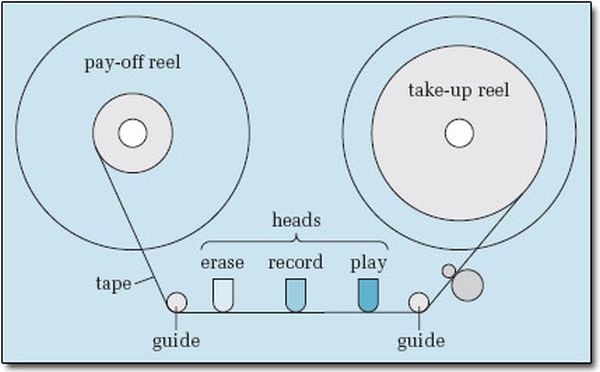
The tape itself is actually very simple. It consists of a thin plastic base material, and bonded to this base is a coating of ferric oxide powder. The oxide is normally mixed with a binder to attach it to the plastic, and it also includes some sort of dry lubricant to avoid wearing out the recorder.
Iron oxide (FeO) is the red rust we commonly see. Ferric oxide (Fe2O3) is another oxide of iron. Maghemite or gamma ferric oxide are common names for the substance.
This oxide is a ferromagnetic material, meaning that if you expose it to a magnetic field it is permanently magnetized by the field. That ability gives magnetic tape two of its most appealing features:
- You can record anything you want instantly and the tape will remember what you recorded for playback at any time.
- You can erase the tape and record something else on it any time you like.
These two features are what make tapes and disks so popular — they are instant and they are easily changed.
Audio tapes have gone through several format changes over the years.
- The original format was not tape at all, but actually was a thin steel wire. The wire recorder was invented in 1900 by Valdemar Poulsen.
- German engineers perfected the first tape recorders using oxide tapes in the 1930s. Tapes originally appeared in a reel-to-reel format. See this page for a picture of an early reel-to-reel recorder.
- Reel-to-reel tapes were common until the compact cassette or “cassette tape” took hold of the market. The cassette was patented in 1964 and eventually beat out 8-track tapes and reel-to-reel to become the dominant tape format in the audio industry.
If you look inside a compact cassette, you will find that it is a fairly simple device. There are two spools and the long piece of tape, two rollers and two halves of a plastic outer shell with various holes and cutouts to hook the cassette into the drive. There is also a small felt pad that acts as a backstop for the record/playback head in the tape player. In a 90-minute cassette, the tape is 443 feet (135 meters) long.
For more detail: How Tape Recorders Work
- What are the two main parts of an audio magnetic recording system?
The recorder itself and the tape used as the storage medium. - What material is bonded to the plastic base of the tape?
A coating of ferric oxide powder mixed with a binder and dry lubricant. - Why is ferric oxide considered appealing for magnetic tapes?
It is a ferromagnetic material that can be permanently magnetized by a magnetic field. - Who invented the original wire recorder in 1900?
Valdemar Poulsen. - When were German engineers able to perfect the first tape recorders using oxide tapes?
In the 1930s. - Which format eventually beat out 8-track tapes and reel-to-reel to become dominant?
The compact cassette or cassette tape. - How long is the tape inside a 90-minute cassette?
443 feet or 135 meters. - What acts as a backstop for the record/playback head in a tape player?
A small felt pad located inside the compact cassette.
