
Summary of How Facial Recognition Systems Work
Identix's FaceIt facial recognition software detects faces by identifying about 80 facial landmarks (nodal points) — such as eye distance, nose width, eye socket depth, cheekbone shape, and jawline length — and converts them into a numerical faceprint for database comparison. Early systems used 2D images that required nearly frontal, consistently lit faces, causing high failure rates in real-world, uncontrolled conditions; the article indicates later sections discuss fixes for these limitations.
Parts used in theFacial Recognition Technology:
- FaceIt software (by Identix)
- 2D facial images
- Database of stored facial images
- Facial nodal point measurements
- Faceprint numerical code
Facial Recognition Technology
Identix®, a company based in Minnesota, is one of many developers of facial recognition technology. Its software, FaceIt®, can pick someone’s face out of a crowd, extract the face from the rest of the scene and compare it to a database of stored images. In order for this software to work, it has to know how to differentiate between a basic face and the rest of the background. Facial recognition software is based on the ability to recognize a face and then measure the various features of the face.
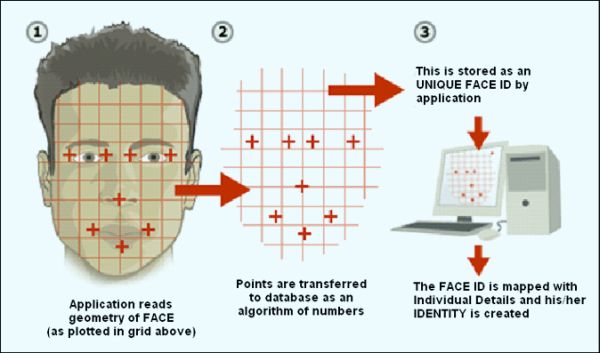
Every face has numerous, distinguishable landmarks, the different peaks and valleys that make up facial features. FaceIt defines these landmarks as nodal points. Each human face has approximately 80 nodal points. Some of these measured by the software are:
- Distance between the eyes
- Width of the nose
- Depth of the eye sockets
- The shape of the cheekbones
- The length of the jaw line
These nodal points are measured creating a numerical code, called a faceprint, representing the face in the database.
In the past, facial recognition software has relied on a 2D image to compare or identify another 2D image from the database. To be effective and accurate, the image captured needed to be of a face that was looking almost directly at the camera, with little variance of light or facial expression from the image in the database. This created quite a problem.
In most instances the images were not taken in a controlled environment. Even the smallest changes in light or orientation could reduce the effectiveness of the system, so they couldn’t be matched to any face in the database, leading to a high rate of failure. In the next section, we will look at ways to correct the problem.
For more detail: How Facial Recognition Systems Work
- What company developed FaceIt?
Identix, a company based in Minnesota, developed FaceIt. - What does FaceIt do?
FaceIt picks a face out of a crowd, extracts it from the scene, and compares it to a database of stored images. - How does facial recognition software differentiate a face from background?
It recognizes facial landmarks called nodal points and measures them to distinguish a face from the background. - How many nodal points does each human face have according to FaceIt?
Each human face has approximately 80 nodal points. - What are examples of nodal points measured?
Examples include distance between the eyes, width of the nose, depth of the eye sockets, cheekbone shape, and jawline length. - What is a faceprint?
A faceprint is a numerical code created from measured nodal points representing the face in the database. - What limitation did past facial recognition systems have?
Past systems relied on 2D images requiring nearly frontal faces with consistent lighting and expression, causing high failure rates in uncontrolled conditions. - Why did small changes in light or orientation cause problems?
Small changes could reduce system effectiveness so images could not be matched to the database, leading to many failures.
