
Summary of Low-duty-cycle LED flasher keeps power draw at 4 mW
This article describes a low-duty-cycle LED flasher circuit designed for battery-operated equipment to minimize power consumption while providing a power-on indication. The circuit uses a Schmitt-trigger inverter and passive components to generate a square wave with a 1% duty cycle, ensuring the LED is on for only about 5 milliseconds every 0.5 seconds. This approach significantly reduces average power draw compared to a continuous indicator.
Parts used in the Low-duty-cycle LED Flasher:
- SN74AHC1G14 single-gate Schmitt-trigger logic inverter
- Resistor RT (200k)
- Timing capacitor C (6.8 μF tantalum solid-electrolytic)
- Charging resistor RCH
- Schottky diode D1S
- LED
Battery-operated equipment often will benefit from a power-on indicator.
The indicator, however, can waste significant power. In situations where a low-duty-cycle blinking indicator provides an adequate indication of the power being turned on, the simple circuit described here should prove useful.
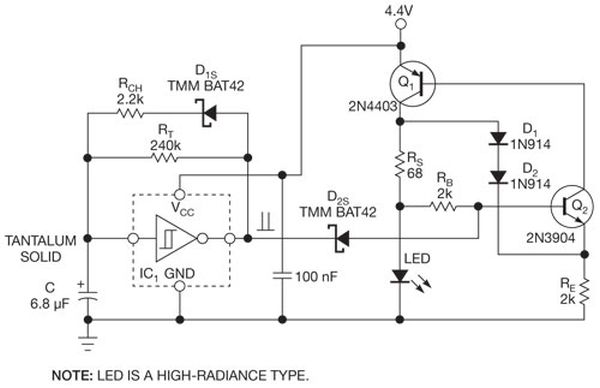
Figure 1 Q1 and Q2 function as a current source and push a constant current through the LED regardless of its forward voltage drop (within the compliant voltage limitations). The Schmitt inverter forms a classic square-wave generator, modified with RCH and D1S to produce an asymmetrical output.
A tiny, single-gate Schmitt-trigger logic inverter, the SN74AHC1G14, together with two resistors, a Schottky diode, and a capacitor form the timing generator of the blinker, shown in Figure 1. The output waveform has a period of about 0.5 sec and a very low duty-cycle value, of around 1%. The interval of low-output duration, TL, of the generator is expressed as

where VHYST is the hysteresis voltage at the input of IC1 and VCC is the supply voltage of IC1.
For VCC=4.5V, the typical value for VHYST is 0.75V. For the required value of TL=0.5 sec, a value for RT of 200k was selected. The value of the timing capacitor, C, can be calculated from the equation, with a small amount of algebraic rearranging, as 7.45 μF. The nearest standard value is 6.8 μF; a tantalum solid-electrolytic capacitor is used for this value. To achieve the low duty cycle of the generator, the high-output duration, TH, is shortened by speeding up the time to charge capacitor C. This is done through the additional resistor, RCH, and the series-connected Schottky diode, D1S. The forward voltage drop at D1S is no more than 200 mV and can be neglected. The LED is on for approximately (1/100)×TL≈5 msec.
For more detail: Low-duty-cycle LED flasher keeps power draw at 4 mW
- What is the main benefit of this circuit?
The circuit provides a power-on indicator for battery-operated equipment while wasting very little power. - How does the circuit achieve a low duty cycle?
It shortens the high-output duration by speeding up the capacitor charge time using an additional resistor and a Schottky diode. - What is the output period of the generator?
The output waveform has a period of about 0.5 seconds. - What value was selected for resistor RT?
A value of 200k was selected for RT to achieve a low-output duration of 0.5 seconds. - Which type of capacitor is used for the timing circuit?
A tantalum solid-electrolytic capacitor with a value of 6.8 μF is used. - How long is the LED on during each cycle?
The LED is on for approximately 5 milliseconds per cycle. - Can the forward voltage drop of the Schottky diode be neglected?
Yes, the forward voltage drop at the Schottky diode is no more than 200 mV and can be neglected. - What is the typical hysteresis voltage for the IC at 4.5V supply?
The typical hysteresis voltage is 0.75V when the supply voltage is 4.5V.
