
Summary of How MMORPGs Work
MMORPGs like "World of Warcraft" and "Guild Wars" have surged in popularity, offering immersive virtual worlds where players create characters, interact with non-player characters, and progress through levels. These games evolved from tabletop RPGs, live-action role-playing, and early computer games, blending fantasy elements with real-world economic and social research opportunities.
Parts used in the MMORPG project:
- Virtual characters (PCs)
- Non-player characters (NPCs)
- Character classes (warriors, rogues, mages, healers)
- Experience points
- Levels
- Skills
- Weapons
- Gear
- Monsters
- Quests
Two examples of MMORPGs: “World of Warcraft” and “Guild Wars”
Regardless of whether people play because of a sense of purpose or a desire to gather huge amounts of virtual wealth, in the past few years, MMORPGs have really taken off. Although they still don’t make up the bulk of video game titles, the top-selling PC game in 2006 was Blizzard’s MMORPG, “World of Warcraft” [source: NPD]. As of July 2007, “World of Warcraft” had about 9 million active subscribers worldwide [source: Blizzard].
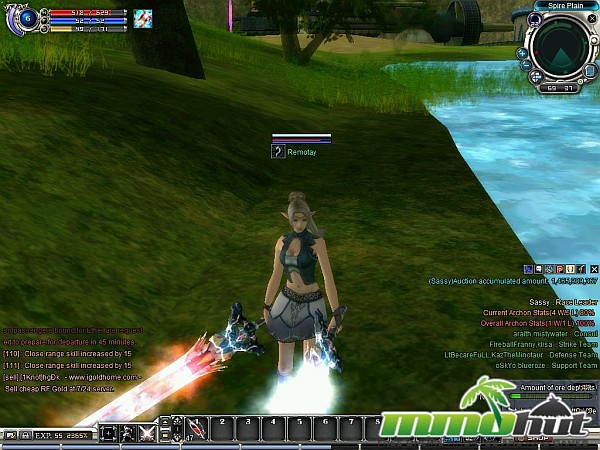
But the impact of video games like these goes beyond just the number of people who play. Newspapers and magazines have reported that participation in MMORPGs, especially in a leadership role, can look good on a person’s résumé. Economists have studied in-game cash flows, looking for insight into the real-world economy. Health officials have even researched a plague that happened only in a virtual world in the hope of learning about how a disease becomes an epidemic.
All of this academic work is possible because of one common trait of MMORPG worlds — they’re immersive. To be successful, games have to allow players to think of an imaginary world as a real place with real rules. These rules cover everything from physics, like what happens when a character jumps off a waterfall, to etiquette, like what happens when one player in a group cheats others out of their loot.
In this article, we’ll look at what it takes to create an immersive virtual world that allows people to move around and play within it. We’ll also explore who plays these games and why. We’ll begin with a look at where MMORPGs came from.
MMORPG Predecessors: Role-playing Games
Although there are exceptions, most MMORPGs are set in worlds that have science-fiction or fantasy elements. Some worlds that appear in MMORPGs, such as the “Star Wars” universe and J.R.R. Tolkien’s Middle-earth, existed long before their corresponding games did. Others are derived from other computer games or invented from scratch.
The worlds themselves can be vastly different from each other, but game play is usually similar from world to world. Basically, human players create virtual characters. These player characters (PCs) can interact with each other and with characters that the computer controls — these are non-player characters (NPCs). There are different types, or classes of PCs, such as warriors, rogues, mages and healers. The different classes come with different sets of skills.
As PCs move through the world, they kill monsters and complete quests. In the process, they gain experience, which allows them to progress through levels, or level up. As characters level up, they get physically stronger and gain access to better skills, weapons and gear.
This basic style of game play was present in MMORPGs’ early predecessors — the tabletop role-playing games (RPGs), such as “Dungeons & Dragons,” that debuted in the 1970s. In these games, a rulebook outlines everything from character creation to combat progression. A game master (GM) or dungeon master (DM) uses the rules to structure the game. He or she gives the players tasks, hints and bits of information designed to move a story forward. In theory, the story — and the game — can go on forever, but often the GM creates a campaign, or an arc of events that gives the overall story a little direction.
Today’s RPGs are similar to those from 30 years ago. Players sit together in a room and describe what’s happening in an imaginary world, using dice or other tools to determine whether characters are successful at what they’re trying to accomplish. The progression of the story and the development of the characters in it are the heart of the game.
Some players take tabletop RPGs into the real world. In live-action role playing games (LARPs), players physically act out the actions of their characters, including participating in simulated combat with props and padded weapons.
After the development of home computers, it didn’t take long for people to turn these low-tech, in-person games into computer games. Next, we’ll take a look at the digital predecessors to MMORPGs.
For more Detail: How MMORPGs Work
- What are MMORPGs?
MMORPGs are massively multiplayer online role-playing games set in immersive virtual worlds with science-fiction or fantasy elements. - How do players progress in MMORPGs?
Players gain experience by killing monsters and completing quests, which allows them to level up and access better skills, weapons, and gear. - Can playing MMORPGs help a résumé?
Yes, participation in MMORPGs, especially in leadership roles, can look good on a person's résumé according to newspaper and magazine reports. - What are the predecessors of MMORPGs?
The predecessors include tabletop role-playing games like Dungeons & Dragons, live-action role-playing games (LARPs), and early computer games. - Do all MMORPGs have similar gameplay?
Yes, while worlds differ, gameplay is usually similar, involving player characters interacting with each other and non-player characters. - What rules govern MMORPG worlds?
Rules cover physics, such as character interactions with the environment, and etiquette, like consequences for cheating out loot. - Why are MMORPGs considered immersive?
They allow players to think of an imaginary world as a real place with real rules, enabling academic research on topics like disease epidemics. - What is the role of a game master in tabletop RPGs?
A game master uses rules to structure the game, giving players tasks and hints to move a story forward.
