
Summary of A TINY SENSOR IN GE DEVELOPMENT COULD ENABLE SMARTPHONES TO DETECT COVID-19 CORONAVIRUS
GE researchers are developing a fingertip-sized sensor to detect airborne viruses like SARS-CoV-2 using NIH funding. This microchip embeds into smartphones or smartwatches, utilizing nanowells with specific bioreceptors that act as locks for viral keys, ignoring other particles like pollen or flu.
Parts used in the GE Viral Detection Sensor:
- Fingertip-sized sensor
- Microchip smaller than a dime
- Nanowells (tiny pores)
- Bioreceptors
- Smartphone
- Smartwatch
One of the most daunting aspects of the COVID-19 pandemic involves tracking the spread of the microscopic, airborne coronavirus causing the disease. But what if you could spot its presence via your smartphone?
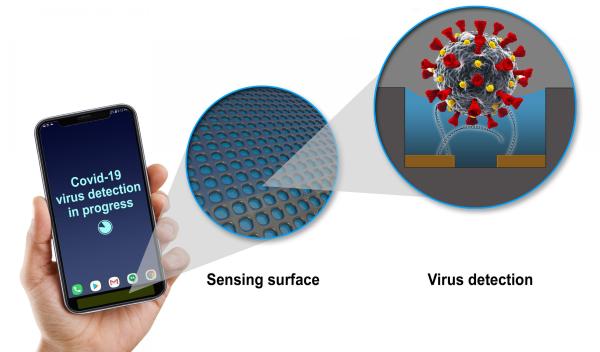
It’s not as far-fetched as it sounds. GE researchers are working on a sensor smaller than a fingertip that could find viruses and pathogens in the air. Led by Radislav Potyrailo, a principal scientist at GE Research in Niskayuna, New York, the team received a two-year research grant from the National Institutes of Health to build the tiny device.
The group’s success could mean that, in the future, smartphones and smartwatches equipped with such sensors could help users detect not only the SARS-CoV-2 virus causing COVID-19, but potentially other pathogens and irritants. “One of the first lines of defense against any virus is avoiding exposure, which is easier said than done when you can’t see it,” Potyrailo says. “Through our project with the NIH, we are developing a sensor small enough to embed in a mobile device that could detect the presence of the COVID-19 virus.”
The project will draw on GE’s years of experience with developing industrial sensors that can detect minute amounts of gases and chemicals in the environment in the presence of dust and other common chemical and biological contaminants. Like a digital bloodhound, the technology is programmed to isolate and identify a specific pathogen while excluding the interference of other particles. “The holy grail is to detect a single virus particle,” Potyrailo says.
The finished project will produce a microchip smaller than a dime with nanowells, or tiny pores, that can be activated only by a particular molecule — in this case, a molecule from the coronavirus causing COVID-19. “In each of those nanowells there are bioreceptors that are designed to recognize only the virus particle they were designed for,” Potyrailo says. “If some flu particle or pollen or bacterium appears, it won’t be recognized. It’s like a lock and key.”
Read more: A TINY SENSOR IN GE DEVELOPMENT COULD ENABLE SMARTPHONES TO DETECT COVID-19 CORONAVIRUS
- What is the primary goal of the GE research project?
To develop a tiny sensor that can find viruses and pathogens in the air. - How will this technology be integrated into consumer devices?
The sensor is designed to be embedded in smartphones and smartwatches. - Can the sensor distinguish between different types of particles?
Yes, it isolates specific pathogens while excluding interference from dust or other contaminants. - What mechanism allows the sensor to identify only the coronavirus?
Nanowells contain bioreceptors designed to recognize only the specific virus particle they were made for. - What is the size of the finished microchip project?
The finished project produces a microchip smaller than a dime. - Who provided the funding for this two-year research grant?
The National Institutes of Health provided the two-year research grant. - Does the sensor react to flu particles or pollen?
No, those particles will not be recognized by the bioreceptors. - What is the ultimate detection capability described by the lead scientist?
The holy grail is to detect a single virus particle.
