
Summary of AAEON LAUNCHES M.2 AND MINI-PCIE BASED AI ACCELERATORS USING LOW-POWER KNERON NPU
Aaeon launched three energy-efficient AI Edge Computing Modules based on Kneron's KL520 SoC, featuring a dual Cortex-M4 architecture and 0.3 TOPS NPU performance at just 0.5W to 0.9W. Designed for IoT, smart home, and security applications, these M.2 and mini-PCIe cards support major deep learning frameworks like TensorFlow and ONNX. They enable local processing for facial recognition and gesture detection without cloud dependency, enhancing privacy and reducing latency while operating within a 0°C to 70°C temperature range.
Parts used in the Aaeon AI Edge Computing Modules:
- Kneron KL520 AI SoC
- Dual Cortex-M4 MCUs
- Neural Processing Unit (NPU)
- M2AI-2280-520 Module
- M2AI-2242-520 Module
- Mini-AI-520 Module
- UART debug interface
- JTAG debug interface
Aaeon’s M.2 and mini-PCIe “AI Edge Computing Modules” are based on Kneron’s energy-efficient, dual Cortex-M4-enabled KL520 AI SoC, which offers 0.3 TOP NPU performance on only half a Watt. by Eric Brown @ linuxgizmos.com
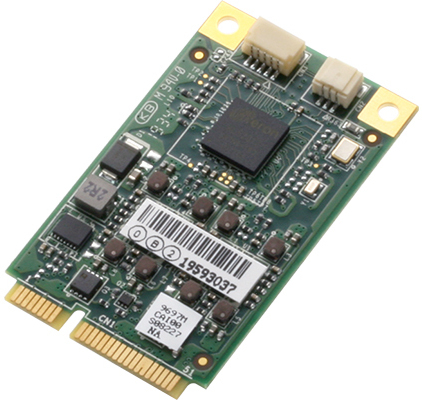
Aaeon took an early interest in edge AI acceleration with Arm-based Nvidia Jetson TX2 based computers such as the Boxer-8170AI. More recently, it has been delivering M.2 and mini-PCIe form-factor AI Core accessories for its Boxer computers and UP boards equipped with Intel Movidius Myriad 2 and Myriad X Vision Processing Units (VPUs). Now, it has added another approach to AI acceleration by launching a line of M.2 and mini-PCIe AI acceleration cards built around Kneron’s new KL520 AI SoC.
Aaeon is taking orders for three KL520-based AI Edge Computing Modules cards aimed at IoT, smart home, security, and mobile devices:
- M2AI-2280-520 — M.2 B-Key 2280
- M2AI-2242-520 — M.2 2242
- Mini-AI-520 — mini-PCIe
Aaeon’s 0 to 70°C tolerant AI Edge Computing Modules operate at 0.5W to 0.9W. There do not appear to be any functional differences between the three modules, which all supply UART and JTAG debug interfaces and communicate with the host processor via USB signals. The modules support acceleration for ONNX, TensorFlow, Keras, Caffe frameworks with models including Vgg16, Resnet, GoogleNet, YOLO, Tiny YOLO, Lenet, MobileNet, and DenseNet.
The KL520 AI SoC combines dual Cortex-M4 MCUs with Kneron’s Neural Processing Unit (NPU) chip, which can be licensed separately. The power-efficient KL520 supports co-processor use, as deployed in Aaeon’s AI Edge Computing Modules, in scenarios that would typically connect to an embedded Linux computer. The SoC can also be used as a standalone, AI-enabled IoT node in applications such as smart door locks.
The KL520 AI SoC is designed to accelerate general AI models such as facial and object recognition, gesture detection, and driver behavior for AIoT applications including access control, automation, security, and surveillance. It can also be used to monitor consumer behavior in retail settings – a trend that could push even more customers to shop online. Aaeon notes, however, that the solution enhances privacy — and reduces latency — because edge AI devices do not require a cloud connection.
Read more: AAEON LAUNCHES M.2 AND MINI-PCIE BASED AI ACCELERATORS USING LOW-POWER KNERON NPU
- What is the power consumption of the modules?
The modules operate between 0.5W and 0.9W. - Does the KL520 SoC include an NPU?
Yes, it combines dual Cortex-M4 MCUs with Kneron's Neural Processing Unit. - Which AI frameworks are supported by the modules?
They support ONNX, TensorFlow, Keras, and Caffe frameworks. - Can the KL520 be used as a standalone node?
Yes, it can function as a standalone AI-enabled IoT node in applications like smart door locks. - How does this solution enhance privacy?
Edge AI devices do not require a cloud connection, which enhances privacy. - What is the operating temperature range?
The modules are tolerant from 0°C to 70°C. - Do the three module variants have functional differences?
No, there appear to be no functional differences between the three modules. - What types of models can the modules accelerate?
They support models including Vgg16, Resnet, GoogleNet, YOLO, Tiny YOLO, Lenet, MobileNet, and DenseNet.
