
Summary of APPSENS’S BLE WEARABLE ECG SENSOR POWERED BY NORDIC NRF52832 DETECTS ARRHYTHMIA
AppSens developed the ECG247 Smart Heart Sensor, a wearable device powered by Nordic's nRF52832 SoC to detect atrial fibrillation and arrhythmias. It features a disposable electrode patch and a reusable electronic unit that continuously monitors heart activity via Bluetooth LE. The system utilizes an ARM Cortex M4 processor with an FPU for complex algorithms, runs on a CR2032 battery for 14 days, and transmits data to smartphones for cloud-based AI analysis accessible to cardiologists.
Parts used in the ECG247 Smart Heart Sensor:
- Disposable electrode-patch
- Reusable electronic component
- nRF52832 SoC
- ARM Cortex M4 processor
- Floating-point unit (FPU)
- CR2032 coin-cell battery
- Android or iOS smartphone
- Cloud-based storage
AppSens, a Norway-based medical technology manufacturer, designed ‘ECG247 Smart Heart Sensor‘ – a Bluetooth LE enabled wearable ECG sensor, powered by Nordic’s nRF52832 SoC, to detect irregular heartbeats. This device is a wearable electrocardiographic (ECG) heart monitor designed to detect atrial fibrillation and other major cardiac arrhythmias. Atrial fibrillation is the most commonly occurred cardiac rhythm disorder and is a common cause of stroke.
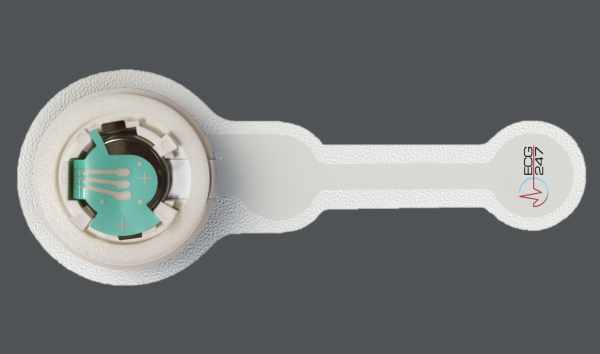
ECG247 Smart Heart Sensor has two parts – a disposable electrode-patch to fasten the sensor to the patient’s chest and a reusable electronic component for measuring the ECG signal. The patient can use this solution to self-diagnose their heart condition. This can also be used during exercise/physical activity.
The brain of this ECG247 Smart Heart Sensor is an nRF52832 SoC, based on a 64MHz, 32-bit ARM Cortex M4 processor with a floating-point unit (FPU). This processor is capable of handling the proprietory algorithm for continuously measuring and analyzing the electrical activity in the patient’s heart and detect any irregularity in the rhythm. Such complex algorithms need fast and accurate floating-point operations – here comes the powerful FPU of nRF52832. The nRF52832 is an ultra-low-power SoC that draws only a 5.5mA peak current while transmitting or receiving over the 2.4GHz band. This lets the patch run continuously for 14 days with a single CR2032 coin-cell battery.
The sensor sends the measurement data using BLE to an android or iOS smartphone so that the patient can monitor everything using the application. The heart rhythm recordings are automatically transferred to secured cloud-based storage where a sophisticated AI-based algorithm analyzes the data. Then, either it confirms the episodes of arrhythmia or rejects as electrical interference in rhythm monitoring. Cardiologists can see the recorded ECG data and make decisions accordingly.
Read more: APPSENS’S BLE WEARABLE ECG SENSOR POWERED BY NORDIC NRF52832 DETECTS ARRHYTHMIA
- What is the primary function of the ECG247 Smart Heart Sensor?
The device detects irregular heartbeats, specifically atrial fibrillation and other major cardiac arrhythmias. - Can the sensor be used during physical activity?
Yes, patients can use this solution during exercise or physical activity. - How long does the CR2032 battery last?
A single CR2032 coin-cell battery allows the patch to run continuously for 14 days. - Does the nRF52832 SoC support floating-point operations?
Yes, it includes a floating-point unit (FPU) to handle complex algorithms for rhythm analysis. - How is the measurement data transmitted to the user?
The sensor sends data using Bluetooth Low Energy to an Android or iOS smartphone. - Who analyzes the recorded ECG data after upload?
Sophisticated AI-based algorithms analyze the data in secured cloud storage, and cardiologists review the results. - What type of processor powers the nRF52832 SoC?
It is based on a 64MHz, 32-bit ARM Cortex M4 processor. - What are the two main parts of the ECG247 sensor?
The device consists of a disposable electrode-patch and a reusable electronic component.
